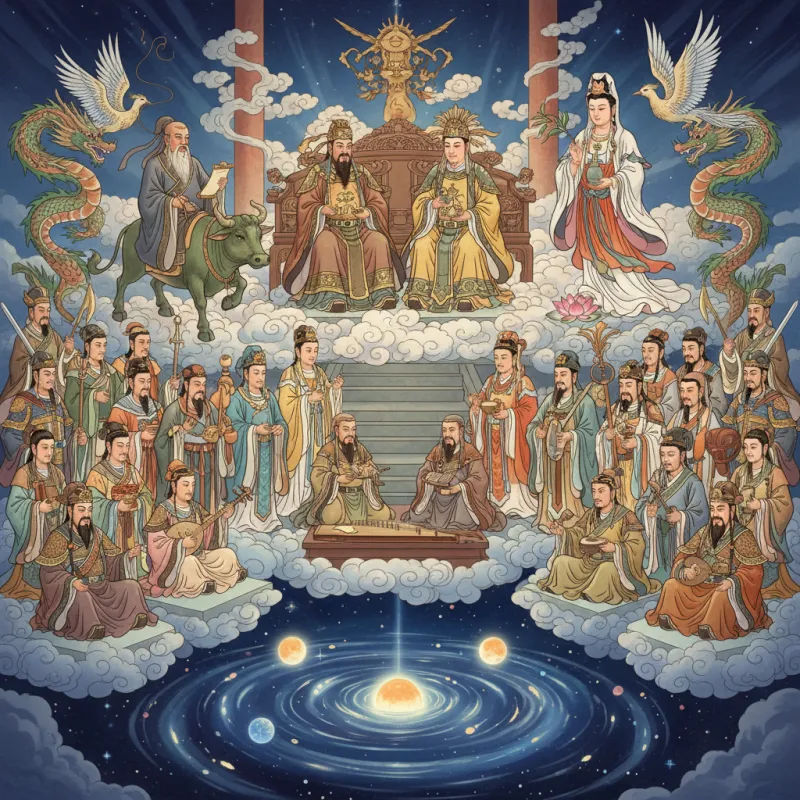
When Pangu (盤古, Pángǔ) cracked open the cosmic egg after 18,000 years of gestation, he didn't just create heaven and earth—he set in motion a theological arms race that would span millennia. As his body transformed into mountains, rivers, and stars, the stage was set for an extraordinary proliferation of deities, immortals, and cosmic bureaucrats that would make the Greek pantheon look positively understaffed. The question isn't whether Chinese creation myths are complex; it's how two major religious traditions—Daoism and Buddhism—managed to weave their competing and complementary visions of cosmic origins into a single, sprawling narrative that still captivates millions today.
The Daoist Vision: From Chaos to Cosmic Order
Daoist creation mythology operates on a principle of spontaneous emergence rather than deliberate creation. Before Pangu, before anything, there was Wuji (無極, Wújí)—the state of limitless potential, absolute emptiness that paradoxically contained everything. From this void emerged Taiji (太極, Tàijí), the Supreme Ultimate, which then divided into yin and yang, the fundamental dualities that structure all existence.
But here's where it gets interesting: the Daoist pantheon didn't stop with abstract principles. The Three Pure Ones (三清, Sānqīng) emerged as the highest deities, personifications of the Dao itself at different stages of cosmic unfolding. Yuanshi Tianzun (元始天尊, Yuánshǐ Tiānzūn), the Celestial Venerable of the Primordial Beginning, represents the Dao before differentiation. Lingbao Tianzun (靈寶天尊, Língbǎo Tiānzūn) governs the sacred texts and cosmic law. Daode Tianzun (道德天尊, Dàodé Tiānzūn)—better known as Laozi—brings the Dao into the human realm.
This hierarchy wasn't established overnight. During the Tang Dynasty (618-907 CE), Daoist theologians systematically organized their pantheon to compete with Buddhism's sophisticated cosmology. They needed their own cosmic bureaucracy, their own celestial administrators, and most importantly, their own creation narrative that could stand alongside Buddhist accounts. The result was a mythology that balanced philosophical abstraction with vivid personification, giving practitioners both metaphysical depth and relatable divine figures.
Buddhist Cosmology: Infinite Worlds, Endless Cycles
Buddhism arrived in China during the Han Dynasty (206 BCE - 220 CE) carrying a radically different creation story—or rather, a radical rejection of creation stories altogether. In Buddhist cosmology, there is no first cause, no prime mover, no moment of creation. Instead, the universe operates in endless cycles of formation, existence, destruction, and void, each lasting incomprehensible eons called kalpas (劫, jié).
Yet Chinese Buddhism couldn't remain purely abstract. As it adapted to local culture, it developed its own pantheon of cosmic figures. Vairocana Buddha (毗盧遮那佛, Pílúzhēnà Fó), the Cosmic Buddha, represents the dharmakaya—the truth body that pervades all existence. Unlike a creator god, Vairocana doesn't make the universe; he is the universe becoming aware of itself. This subtle but crucial distinction shaped how Chinese Buddhists understood their relationship to the cosmos.
The bodhisattvas added another layer to this cosmology. Guanyin (觀音, Guānyīn), Manjushri (文殊, Wénshū), and Samantabhadra (普賢, Pǔxián) function as cosmic intermediaries, beings who have achieved enlightenment but remain engaged with the world out of compassion. They don't create or govern in the Daoist sense; they guide and liberate. This fundamental difference in divine function would create both tension and creative synthesis as the two traditions interacted.
The Jade Emperor: Where Daoism and Buddhism Collide
No figure better illustrates the fusion of Daoist and Buddhist elements than the Jade Emperor (玉皇大帝, Yùhuáng Dàdì). Officially a Daoist deity, he rules the celestial bureaucracy with the administrative precision of a Song Dynasty official. Yet his biography, codified in texts like the Jade Emperor's Classic during the Song Dynasty (960-1279 CE), borrows heavily from Buddhist concepts of merit accumulation and spiritual cultivation.
According to his origin story, the Jade Emperor wasn't born divine. He was a prince who renounced his throne, practiced cultivation for millions of kalpas, and gradually ascended through the celestial ranks. This narrative arc—mortal to immortal to supreme deity—reflects Buddhist ideas about enlightenment while maintaining Daoist concepts of immortality and cosmic hierarchy. He governs not through absolute power but through virtue and merit, a Confucian overlay on top of Daoist-Buddhist foundations.
The Jade Emperor's court mirrors earthly imperial administration, complete with departments for weather, longevity, wealth, and justice. This bureaucratization of the divine served a practical purpose: it made the cosmos comprehensible and navigable for ordinary people. You didn't need to grasp the philosophical subtleties of Wuji or dharmakaya; you just needed to know which deity handled your specific problem, much like knowing which government office to petition.
The Eight Immortals: Daoist Exemplars of Transformation
While high gods and cosmic buddhas operated on celestial planes, the Eight Immortals (八仙, Bāxiān) brought divine power down to earth—literally. These figures, popularized during the Ming Dynasty (1368-1644 CE), represent the Daoist ideal that anyone, regardless of social status, can achieve immortality through cultivation and virtue.
Each immortal embodies a different path to transcendence. Lü Dongbin (呂洞賓, Lǚ Dòngbīn), a Tang Dynasty scholar, achieved immortality through alchemical practice and sword cultivation. He Xiangu (何仙姑, Hé Xiāngū), the only female among the eight, attained immortality by consuming powdered mother-of-pearl and moonbeams—a poetic description of internal alchemy practices. Lan Caihe (藍采和, Lán Cǎihé), whose gender remains ambiguous in traditional accounts, wandered as a street performer, suggesting that enlightenment doesn't require conventional respectability.
These immortals didn't participate in creation myths directly, but they demonstrated something equally important: that the cosmic processes initiated by Pangu and organized by the Three Pure Ones remained accessible to humans. They bridged the gap between primordial creation and contemporary practice, showing that the same forces that shaped the universe could transform an individual body into an immortal vessel.
Nuwa and Fuxi: The Indigenous Layer
Before Daoism formalized its pantheon and Buddhism arrived from India, indigenous Chinese mythology already had its creation deities. Nuwa (女媧, Nǚwā) and Fuxi (伏羲, Fúxī), often depicted as serpent-bodied siblings or spouses, represent an older stratum of creation mythology that both Daoism and Buddhism had to accommodate.
Nuwa's most famous act—repairing the sky with colored stones after the cosmic pillar broke—appears in texts dating to the Warring States period (475-221 BCE). She also created humanity from yellow clay, individually crafting nobles and mass-producing commoners by dragging a rope through mud. This class-conscious creation story reveals much about early Chinese social structures, but later Daoist and Buddhist interpreters had to reconcile it with their own cosmologies.
The solution was incorporation rather than replacement. Nuwa and Fuxi became immortals within the Daoist pantheon, their ancient creation myths reframed as events within the current cosmic cycle. Buddhism, with its doctrine of endless kalpas, could accommodate them as beings from previous world-systems. This flexibility—the ability to absorb rather than reject indigenous traditions—proved crucial to both religions' success in China.
The Cosmic Bureaucracy: Organizing the Divine
By the Song Dynasty, Chinese religious culture had developed what might be called "bureaucratic syncretism"—a system where Daoist, Buddhist, and folk deities coexisted within an elaborate administrative hierarchy. This wasn't theological confusion; it was sophisticated religious engineering that reflected Chinese political philosophy.
The celestial bureaucracy mirrored earthly government, with departments, ranks, and jurisdictions. The City God (城隍, Chénghuáng) governed local affairs, reporting to regional deities, who answered to the Jade Emperor. Buddhist bodhisattvas operated alongside Daoist immortals, each with defined responsibilities. Even the underworld had its bureaucracy, with the Ten Kings of Hell (十殿閻王, Shí Diàn Yánwáng) judging souls according to both Buddhist karma and Daoist moral codes.
This organizational impulse extended to creation mythology itself. Rather than competing narratives, Chinese religious culture developed a chronological framework: Pangu's physical creation came first, then the Three Pure Ones established cosmic law, then various deities and immortals took up their administrative posts. Buddhist cosmology operated on a different timescale—infinite cycles rather than linear progression—but even this could be accommodated by treating the current kalpa as the relevant timeframe for Daoist and folk narratives.
Living Myths: How Creation Stories Shape Practice
These creation myths aren't just ancient stories; they structure contemporary religious practice. When a Daoist priest performs a ritual, they're not merely asking for divine favor—they're aligning themselves with the same cosmic forces that emerged from Wuji and organized the universe. The ritual recreates creation in microcosm, with the priest embodying the role of the Three Pure Ones bringing order to chaos.
Similarly, Buddhist meditation practices often begin with visualizations of cosmic buddhas and bodhisattvas, positioning the practitioner within the infinite web of existence that has no beginning or end. The point isn't to understand creation intellectually but to experientially realize one's participation in the ongoing cosmic process.
Folk religion takes a more pragmatic approach. Worshippers might not know the philosophical distinctions between Daoist and Buddhist cosmology, but they understand that Nuwa created humanity, the Jade Emperor governs heaven, and Guanyin offers compassion. These deities and their creation stories provide a framework for understanding one's place in the cosmos and navigating life's challenges with divine assistance.
The genius of Chinese creation mythology lies not in its consistency but in its capacity for integration. It absorbed indigenous myths, accommodated foreign religions, and continuously evolved while maintaining core themes: the emergence of order from chaos, the accessibility of cosmic power through cultivation, and the ongoing relationship between human and divine realms. Whether you approach these myths as literal truth, philosophical metaphor, or cultural heritage, they offer profound insights into how Chinese civilization has understood existence itself—not as a single moment of creation but as an endless unfolding of potential, guided by deities and immortals who remain as relevant today as when their stories first emerged from the mists of antiquity.
Related Reading
- Pangu and the Cosmic Egg: How the Chinese Universe Began
- Creation Myths in Chinese Religion: How Gods Made the World
- Nüwa Repairs the Sky: The Goddess Who Saved the World
- Pangu Opens Heaven and Earth: The Chinese Creation Story
- Fuxi: The God-Emperor Who Gave Humanity Civilization
- Chinese Rituals and Ceremonies: The Sacred Practices That Connect Heaven and Earth
- Dizang: The Bodhisattva Who Empties Hell
- How to Pray at a Chinese Temple: A Respectful Visitor's Guide