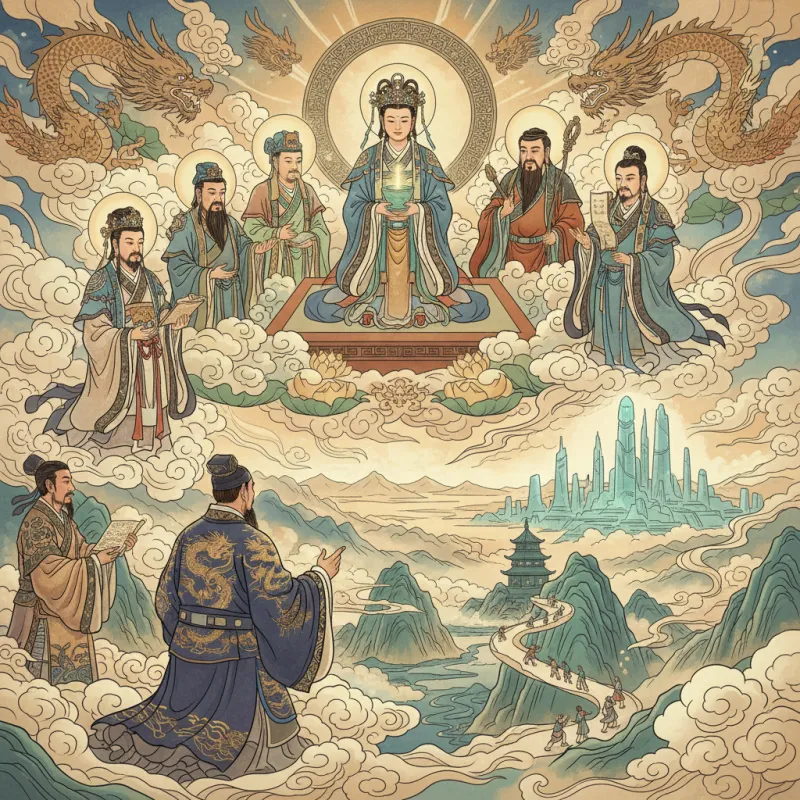
The mercury gleamed like liquid moonlight in the jade bowl. Emperor Qin Shi Huang raised it to his lips, believing he held immortality itself. Within months, he would be dead — poisoned by the very elixir meant to save him. This scene, repeated across two millennia of Chinese history, reveals a paradox at the heart of Daoist alchemy: the quest for eternal life became a reliable path to premature death.
The Alchemical Obsession of Imperial China
The elixir of life (仙丹 xiāndān, literally "immortal pill") wasn't just a mythological curiosity — it was a state-sponsored research program that consumed imperial treasuries and countless lives. Beginning with Qin Shi Huang in the 3rd century BCE and continuing through the Tang Dynasty, Chinese emperors funded vast alchemical operations. They built laboratories, employed hundreds of practitioners, and ingested experimental compounds with the fervor of modern biohackers.
The theoretical foundation seemed sound enough. Daoist alchemists reasoned that certain substances — particularly cinnabar (mercury sulfide), gold, and jade — possessed inherent qualities of permanence. Gold doesn't rust. Jade endures for millennia. Mercury flows eternally, neither solid nor truly liquid. If these materials could be properly refined and consumed, surely their imperishable nature would transfer to the human body.
This wasn't superstition masquerading as science; it was the science of its era. The same empirical observation and systematic experimentation that led to genuine discoveries — gunpowder, porcelain glazes, metallurgical advances — also produced the lethal compounds that killed at least six Tang Dynasty emperors. The alchemists weren't charlatans; they were researchers working with incomplete knowledge and catastrophic assumptions.
Xu Fu's Voyage and the Geography of Immortality
When Qin Shi Huang commissioned the alchemist Xu Fu (徐福 Xú Fú) to find the islands of the immortals, he wasn't sending him on a vague spiritual quest. The expedition in 219 BCE involved three thousand young people, substantial provisions, and specific geographic targets. Historical texts suggest Xu Fu sailed east toward what might have been Japan, seeking the legendary Penglai (蓬莱 Pénglái), one of three mythical islands where immortals supposedly dwelled.
Xu Fu never returned. Some Japanese legends claim he landed in their islands and became a cultural hero. More likely, he recognized that returning empty-handed to an emperor obsessed with immortality would be fatal, and chose permanent exile over certain execution. His disappearance only intensified the mystique — perhaps he had found the elixir and chosen to remain among the immortals rather than share it with a tyrant.
The concept of immortal realms as physical locations rather than spiritual states reflects early Daoist cosmology's concrete materialism. Immortality wasn't achieved through moral cultivation alone but through consuming the right substances in the right places. This geographical dimension explains why so many seekers ventured into remote mountains — they weren't retreating from the world but searching for specific locations where the boundary between mortal and immortal grew thin.
The Chemistry of Death
Let's be specific about what these elixirs actually contained. The most common base was cinnabar (丹砂 dānshā), a brilliant red mercury sulfide mineral. Alchemists would heat cinnabar to extract pure mercury, then combine it with sulfur, lead, arsenic, and various plant materials. The resulting compounds were often heated repeatedly — sometimes for years — in sealed vessels, a process called "firing" (炼 liàn).
The symptoms of mercury poisoning mimic certain descriptions of immortal transformation in Daoist texts: tremors, heightened sensitivity, altered consciousness, and a peculiar lightness of being. An emperor experiencing these effects might genuinely believe the elixir was working, that his body was becoming more ethereal, more spirit-like. The weight loss, the trembling, the dissociation from physical reality — these weren't side effects but signs of approaching divinity.
Until the convulsions began. Until the organs failed. Until death arrived, often within months of beginning the regimen.
Tang Dynasty records are particularly damning. Emperor Xianzong died in 820 CE after consuming alchemical preparations. Emperor Wuzong died in 846 CE, also from elixir poisoning. Emperor Xuanzong followed in 859 CE. The pattern was obvious to everyone except the emperors themselves, each convinced that previous failures resulted from impure ingredients or incorrect procedures, never from the fundamental toxicity of the enterprise.
From Laboratory to Literature
The elixir of life underwent a fascinating transformation in Chinese fiction, shifting from physical substance to narrative device. In Journey to the West (西游记 Xīyóu Jì), the Monkey King Sun Wukong steals immortality peaches and elixir pills from heaven — but the text treats these as symbols of spiritual attainment rather than chemical compounds. The novel, written in the 16th century after centuries of documented poisoning deaths, couldn't endorse literal elixir consumption. Instead, it encoded the quest for immortality as allegory.
The Investiture of the Gods (封神演义 Fēngshén Yǎnyì) takes a different approach, presenting immortality as something granted by celestial bureaucracy rather than achieved through alchemy. Characters become immortal through merit, appointment, or divine favor — never through ingesting pills. This represents a significant ideological shift: immortality as political reward rather than chemical transformation.
Modern Chinese fantasy fiction has revived the elixir concept but with crucial modifications. Cultivation novels (修真小说 xiūzhēn xiǎoshuō) feature protagonists who consume spiritual pills to advance their power levels, but these pills are explicitly magical rather than chemical. They contain "spiritual energy" (灵气 língqì) rather than mercury. The genre acknowledges the traditional imagery while carefully avoiding endorsement of actual alchemical practice.
The Daoist Reversal: Internal Alchemy
By the Song Dynasty, a revolutionary reinterpretation emerged: internal alchemy (内丹 nèidān). Rather than consuming external substances, practitioners would cultivate an internal elixir through meditation, breathing exercises, and energy circulation. The same terminology persisted — furnaces, firing, refinement — but now referred to processes within the body itself.
This wasn't merely a safety improvement; it represented a fundamental philosophical shift. External alchemy (外丹 wàidān) assumed immortality could be purchased, consumed, or acquired through material means. Internal alchemy insisted that transformation must come from within, through disciplined practice and spiritual cultivation. The Eight Immortals of Daoist tradition achieved their status through various means, but notably, none through simply swallowing pills.
The internal alchemy tradition preserved the quest for immortality while abandoning its most lethal methodology. It acknowledged what emperors could not: that the shortcut to eternal life was actually the fastest route to premature death.
The Modern Elixir: Metaphor and Warning
Today, the elixir of life persists as cultural metaphor. When Chinese science fiction explores life extension technology, it often frames the discussion through alchemical imagery — a deliberate invocation of historical warning. The message is clear: the pursuit of immortality through technological shortcuts may prove as dangerous as mercury pills.
The quest also appears in discussions of traditional Chinese medicine, where practitioners must carefully distinguish between historical practices and evidence-based treatment. The same culture that produced acupuncture and herbal medicine also produced lethal elixirs. Acknowledging this complexity requires neither wholesale rejection nor uncritical acceptance of traditional knowledge.
Perhaps the most enduring lesson isn't about alchemy at all, but about the human relationship with mortality. Every emperor who died from elixir poisoning had access to the finest physicians, the most learned advisors, and clear evidence of previous failures. They consumed the pills anyway. The desire to escape death proved stronger than reason, stronger than evidence, stronger than the survival instinct itself.
The Paradox Endures
The elixir of life killed its seekers with perfect consistency, yet the quest never ended. Even after the Tang Dynasty's spectacular series of imperial poisonings, even after the rise of internal alchemy, even after the transition to metaphor — the dream persists. Modern longevity research, cryonics, and life extension technology represent the same fundamental impulse: the refusal to accept mortality as final.
The difference is methodology, not motivation. We've replaced cinnabar with senolytics, mercury with metformin, but the underlying drive remains identical. We're still seeking the elixir, still convinced that the right combination of substances or procedures will grant us what Qin Shi Huang died pursuing.
The ancient alchemists weren't fools. They were humans confronting the same existential terror we face, using the best tools their era provided. Their failure wasn't in asking the question but in refusing to accept the answer. The elixir of life exists, but not as a substance to be consumed. It exists in the legacy we leave, the knowledge we preserve, the stories we tell about emperors who drank liquid moonlight and died believing they would live forever.
Related Reading
- The Eight Immortals: Complete Guide to China's Most Beloved Gods
- The Quest for Immortality: Why Chinese Mythology Is Obsessed With Living Forever
- The Peaches of Immortality: Xi Wangmu Garden
- Types of Immortals (仙): A Classification Guide
- Creation Myths in Chinese Religion: How Gods Made the World
- Unraveling the Mystique of Chinese War Gods in the Daoist and Buddhist Pantheon
- Unveiling the Rich Tapestry of Chinese Deities and Immortals