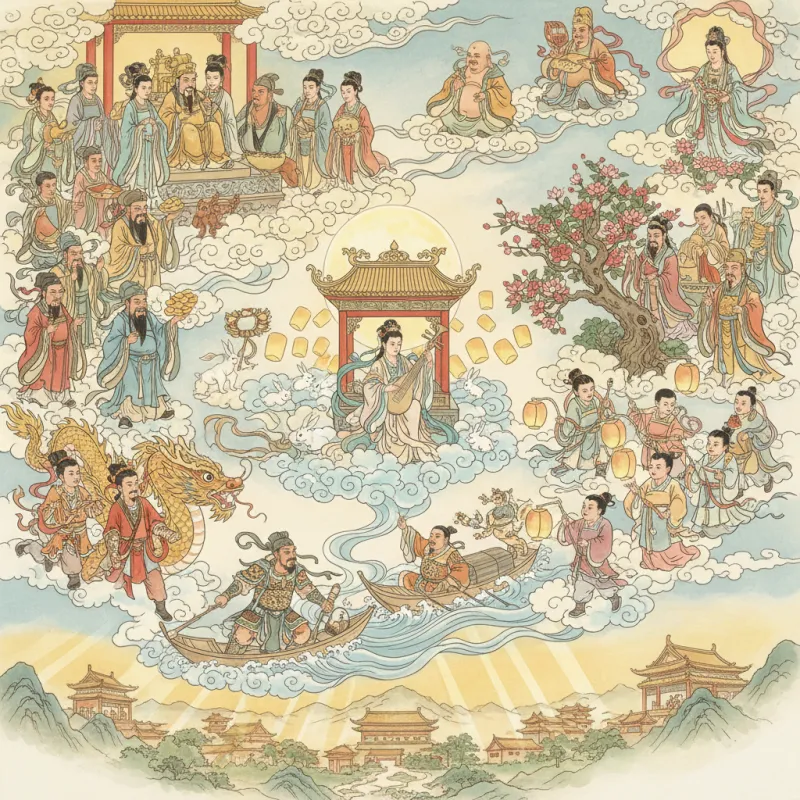
The smoke from a thousand incense sticks rises at midnight on the fifteenth day of the first lunar month, and somewhere in the celestial bureaucracy, the Jade Emperor is checking his calendar. Down on earth, families are lighting lanterns, not for ambiance, but because the deities are watching — and they expect a show. Chinese festivals aren't just cultural traditions or family gatherings. They're scheduled appointments with the divine, each date marking a specific god's birthday, inspection day, or moment of maximum influence over human affairs.
The Kitchen God's Annual Performance Review
Seven days before Chinese New Year arrives, households across China engage in what might be the world's most elaborate attempt at bribing a witness. The Kitchen God (灶神, Zàoshén) has been stationed in your home all year, taking notes. He's seen you snap at your mother-in-law, watched you waste food, observed every petty argument and moral shortcut. Now, on the 23rd day of the 12th lunar month, he's scheduled to ascend to heaven and deliver his annual report to the Jade Emperor.
The solution? Smear his paper image with honey, sticky rice candy, or maltose syrup. The logic is delightfully pragmatic: if his mouth is glued shut with sweetness, his report will be unintelligible. Some families go further, offering him wine to get him drunk before his celestial commute. It's not reverence — it's damage control. When he returns on New Year's Eve, families welcome him back with fresh images and renewed promises to behave better next year. They rarely do, but the Kitchen God will be watching anyway.
The Jade Emperor's Birthday and Cosmic Hierarchy
The ninth day of the first lunar month belongs to the Jade Emperor (玉皇大帝, Yùhuáng Dàdì) himself — the supreme deity who governs heaven, earth, and the underworld. This isn't a casual celebration. Temples prepare elaborate offerings at midnight, the exact moment of his birth, because timing matters when you're honoring the CEO of the cosmos.
What's fascinating is how this festival reveals the Chinese understanding of divine bureaucracy. The Jade Emperor doesn't micromanage — he has department heads for that. But his birthday is when the entire celestial administration is theoretically paying attention, making it an ideal time to submit petitions, requests, and complaints about lower-ranking deities who haven't been doing their jobs. Daoist temples become something like cosmic complaint departments, with priests acting as intermediaries who know the proper forms and protocols.
The offerings tell you everything about his status: whole roasted pigs, elaborate vegetarian dishes arranged in specific patterns, and paper money in denominations that would make a modern banker blush. You don't bring the Jade Emperor a fruit basket.
Qingming and the Bureaucracy of the Dead
Qingming Festival (清明节, Qīngmíng Jié), falling around April 5th, is often translated as "Tomb Sweeping Day," which makes it sound like spring cleaning for graveyards. It's actually a complex negotiation with the dead and the deities who govern them. Families visit ancestral graves not just to pay respects but to maintain relationships that have legal standing in the afterlife.
The offerings aren't symbolic — they're functional. Paper money gets burned so ancestors have currency in the underworld. Paper houses, cars, and even paper smartphones get incinerated so the dead can maintain their lifestyle. This isn't superstition; it's estate planning across the boundary of death. The City God (城隍, Chénghuáng) and his underworld bureaucrats are believed to track these transfers, and families who neglect their ancestors risk both ghostly harassment and divine disapproval.
What separates Qingming from other ancestor worship days is its connection to spring and renewal. The dead aren't just being fed — they're being invited to witness the family's continued prosperity. It's a status report that flows in both directions: the living show they're thriving, and the ancestors are expected to provide continued protection and luck.
The Dragon Boat Festival and Qu Yuan's Immortality
The fifth day of the fifth lunar month brings the Dragon Boat Festival (端午节, Duānwǔ Jié), and with it, one of Chinese culture's most interesting cases of a human becoming a deity through sheer cultural persistence. Qu Yuan (屈原, Qū Yuán), the poet-official who drowned himself in 278 BCE after his state fell to invaders, wasn't originally a god. He was a tragic figure, a loyal minister who chose death over dishonor.
But centuries of commemoration transformed him. The rice dumplings (粽子, zòngzi) thrown into the river to feed the fish so they wouldn't eat his body became ritual offerings. The dragon boat races, originally search parties looking for his corpse, became competitions to honor his spirit. By the Tang Dynasty, Qu Yuan had effectively achieved immortality — not through Daoist cultivation or Buddhist enlightenment, but through collective memory and annual ritual.
The festival also honors various protective deities and involves hanging mugwort and calamus to ward off evil spirits. The fifth month is considered toxic and dangerous in traditional Chinese cosmology, a time when yang energy peaks and threatens to overwhelm balance. The Dragon Boat Festival is essentially a massive spiritual pest control operation, with Qu Yuan's commemoration providing the cultural framework.
The Hungry Ghost Festival and Feeding the Damned
The fifteenth day of the seventh lunar month is when the gates of hell open and the hungry ghosts (饿鬼, èguǐ) are released for their annual parole. The Hungry Ghost Festival (中元节, Zhōngyuán Jié) is Buddhism and Daoism's joint operation to manage what is essentially a month-long supernatural crisis.
Unlike ancestors, who have families to care for them, hungry ghosts are the forgotten dead — those without descendants, who died violently, or who were never properly buried. They're desperate, dangerous, and numerous. The festival's purpose is to feed them so they don't cause trouble. Temples set up elaborate outdoor altars piled with food, and families leave offerings on the street. It's not generosity — it's appeasement.
The theological complexity here is remarkable. Buddhist monks perform rituals to transfer merit to suffering souls, while Daoist priests conduct ceremonies to close the gates of hell at month's end. The City God coordinates with the underworld bureaucracy to ensure the ghosts return on schedule. It's a multi-denominational effort to manage a shared cosmological problem, and it reveals how Chinese religious practice prioritizes practical results over doctrinal purity.
The Mid-Autumn Festival and Chang'e's Lonely Immortality
The fifteenth day of the eighth lunar month brings the Mid-Autumn Festival (中秋节, Zhōngqiū Jié), and with it, the story of Chang'e (嫦娥, Cháng'é), the woman who stole the elixir of immortality and fled to the moon. She's been there ever since, accompanied only by a jade rabbit who pounds medicine in a mortar. It's one of Chinese mythology's most melancholic tales — immortality achieved, but at the cost of everything that makes life worth living.
Families gather to eat mooncakes and gaze at the full moon, which is at its brightest and roundest on this night. The festival celebrates reunion, which makes Chang'e's eternal isolation even more poignant. She's not worshipped so much as acknowledged — a reminder that immortality without connection is just another form of death.
The festival also honors the Moon Goddess (月神, Yuèshén) in her various forms, and some traditions include offerings to the Eight Immortals, who represent more successful paths to transcendence. The contrast is deliberate: Chang'e took a shortcut and ended up alone, while the Eight Immortals cultivated their way to immortality and maintained their relationships with humanity.
The Winter Solstice and Cosmic Renewal
The winter solstice (冬至, Dōngzhì), falling around December 21st, marks the year's longest night and the moment when yang energy begins its return. In traditional Chinese cosmology, this isn't just an astronomical event — it's a cosmic turning point that requires human participation to ensure the cycle continues properly.
Families gather to eat tangyuan (汤圆, tāngyuán), sweet rice balls that symbolize reunion and completeness. The round shape represents the sun and the return of light. Some traditions involve offerings to ancestors and household deities, acknowledging their role in the family's survival through another year. It's less about specific gods and more about maintaining harmony with the fundamental forces that govern existence.
The festival reveals something essential about Chinese religious practice: the calendar itself is sacred. These aren't arbitrary dates chosen for convenience — they're moments when the boundary between human and divine becomes permeable, when specific deities are accessible, when cosmic forces require acknowledgment. Missing a festival isn't just skipping a party. It's failing to show up for an appointment that's been on the books for thousands of years.
Related Reading
- Exploring Chinese Deities and Immortals: Traditions of the Daoist and Buddhist Pantheon
- Dragon Boat Festival: The Poet, the River, and the Race
- Gods of Chinese New Year: The Deities Behind the Festival
- The Mythology of the Mid-Autumn Festival: Chang'e, Hou Yi, and the Moon Rabbit
- The Lantern Festival: When Gods Walk Among Mortals
- Queen Mother of the West: Goddess of Immortality
- Discovering Nature Spirits in Chinese Mythology: Guardians of the Earth and Sky
- Chinese Funeral Traditions: A Guide to Death Customs