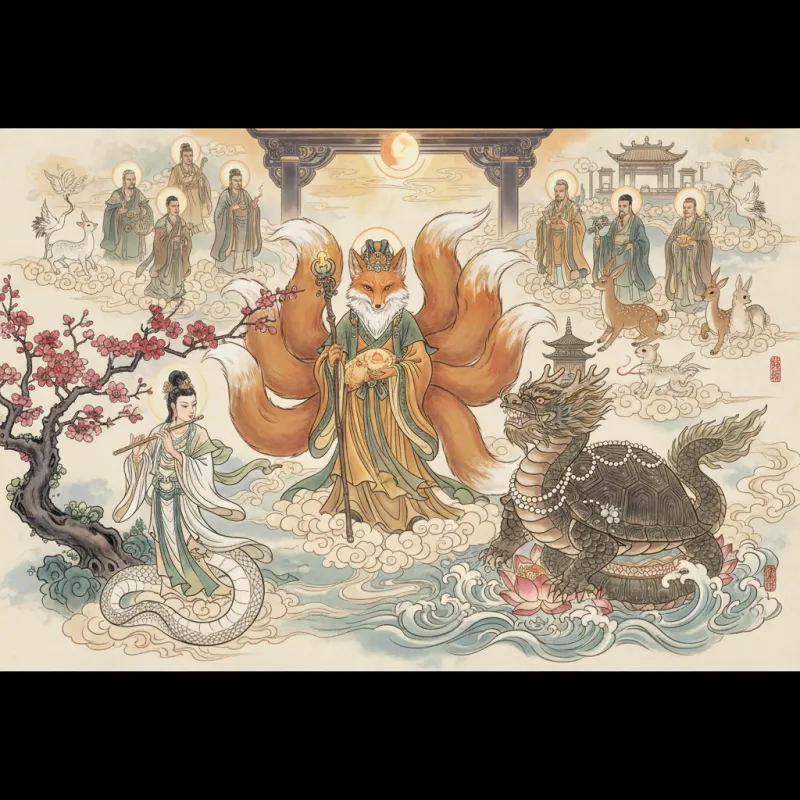
A white fox sits at the edge of a village temple in Jiangsu province, and the elderly woman kneeling before it isn't praying about the fox — she's praying to it. She burns incense, offers rice wine, and whispers her daughter's name, asking the fox spirit to cure an illness that three hospitals couldn't diagnose. This isn't metaphor. This isn't folklore. This is Tuesday afternoon in contemporary China, where the line between animal and deity dissolved centuries ago and never quite reformed.
The Ontological Shift: When Animals Stop Symbolizing and Start Ruling
Western religious frameworks struggle with Chinese animal deities because they keep looking for the metaphor. The fox must represent something. The snake must symbolize wisdom or temptation. But Chinese folk religion operates on different metaphysical principles entirely. When a Daoist priest performs rituals before a turtle deity, he's not honoring what the turtle represents — he's negotiating with an actual divine being who happens to manifest in turtle form.
This distinction matters enormously. The Jade Emperor (玉皇大帝 Yùhuáng Dàdì) governs the celestial bureaucracy, yes, but so does the Fox Immortal (狐仙 Húxiān) govern her domain. Both possess shen (神), divine power. Both can grant blessings, inflict punishments, and alter fate. The fox's authority isn't derivative or symbolic — it's inherent to her nature as a being who has cultivated spiritual power over centuries.
The theological mechanism here is cultivation (修炼 xiūliàn). Animals, like humans, can refine their qi, study Daoist or Buddhist teachings, and transform themselves into immortals. The difference is that animals start with certain advantages: longer lifespans, closer connections to natural forces, and bodies already aligned with cosmic energies. A turtle lives for centuries. A snake sheds its skin and renews itself. A fox possesses nine tails at the peak of its power. These aren't just biological facts — they're spiritual credentials.
The Fox Immortal: Seduction, Scholarship, and Suburban Temples
The Fox Immortal (狐仙 Húxiān) is probably the most widely worshipped animal deity in northern China, with particular strongholds in Shandong, Hebei, and the northeastern provinces. Walk through certain neighborhoods in Tianjin or Harbin, and you'll find small shrines — sometimes just a red cloth draped over a fox statue, sometimes elaborate temples with full-time attendants — dedicated to Húxiān.
The fox's reputation is complicated. Classical literature, especially the Liaozhai Zhiyi (聊斋志异) by Pu Songling (1640-1715), portrays fox spirits as seductresses who drain men's yang energy through sexual encounters. These stories aren't entirely wrong, but they're incomplete. Fox spirits in folk practice are primarily approached for three things: business success, romantic problems, and protection against malicious spirits. The sexual element exists, but it's one aspect of a much broader portfolio.
What's fascinating is the gender dynamics. Fox deities are predominantly female, and their primary worshippers are often women — particularly women in precarious economic or social positions. Prostitutes, entertainers, and businesswomen in the Qing dynasty (1644-1912) frequently maintained fox shrines, asking for protection and prosperity in occupations that Confucian society officially despised. The fox deity didn't judge. She understood survival.
Modern worship has shifted but not disappeared. I've interviewed temple-keepers in Shenyang who report that their fox shrines now attract entrepreneurs, stock traders, and real estate developers — people operating in high-risk, high-reward environments where conventional deities seem too distant or bureaucratic. The fox responds quickly, they say. She understands ambition. She doesn't require moral purity, just respect and proper offerings.
The Snake Mother: From Flood Control to Fertility Goddess
The White Snake (白蛇 Báishé) is both a specific character from the Legend of the White Snake and a broader category of snake deities worshipped across southern China. But the most powerful snake deity isn't white — she's the Snake Mother (蛇母 Shémǔ) of Fujian and Guangdong, a goddess whose origins predate organized Daoism by centuries.
Snake Mother temples dot the coastline from Fuzhou to Shantou, often located near water sources — rivers, springs, irrigation channels. The connection isn't accidental. Snakes in Chinese cosmology are water creatures, associated with rain, floods, and the dragon (龙 lóng), which is essentially a divine snake that has achieved ultimate transformation. Worshipping snake deities is, in part, a negotiation with water itself.
The rituals are specific and non-negotiable. Offerings must include eggs (representing fertility and renewal), wine (which snakes supposedly enjoy), and never, ever chicken (snakes and chickens are natural enemies in Chinese zodiac theory). Violate these rules, and the Snake Mother might withhold rain or, worse, send floods. Respect them, and she ensures agricultural prosperity, safe childbirth, and protection from venomous creatures.
What distinguishes snake worship from other animal cults is its emphasis on transformation. Snakes shed their skin and emerge renewed — a perfect metaphor for spiritual cultivation and physical healing. Women struggling with infertility pray to Snake Mother not just for conception but for the transformative power to become mothers. Cancer patients ask for the ability to shed disease like a snake sheds old skin. The theology is remarkably sophisticated, rooted in observable natural phenomena but extended into metaphysical territory.
The Turtle Immortal: Longevity, Wisdom, and Cosmic Architecture
The turtle (龟 guī) occupies a unique position in Chinese cosmology because it's simultaneously an animal deity and a cosmic principle. The Black Tortoise (玄武 Xuánwǔ) is one of the Four Symbols (四象 Sìxiàng) representing the cardinal directions — specifically, the north. But beyond this astronomical role, actual turtles are worshipped as longevity deities, wisdom teachers, and even architectural consultants.
Turtle temples are less common than fox or snake shrines, but they're architecturally distinctive. Many are built near water, with ponds containing live turtles that worshippers feed as acts of merit. The largest turtle temple I've visited, in Wuhan, houses a stone turtle statue estimated to be over 800 years old, its shell worn smooth by centuries of pilgrims rubbing it for good luck.
The turtle's association with longevity is obvious — some species live over 150 years — but the wisdom connection is more subtle. In Chinese mythology, the turtle carries the world on its back, making it literally foundational to existence. This cosmic role translates into earthly authority: turtle deities are consulted for major life decisions, business ventures, and even architectural planning. Feng shui practitioners sometimes invoke turtle spirits when determining building orientations, treating the turtle's sense of cosmic order as superior to human calculation.
There's also a darker aspect rarely discussed in English-language sources. Turtles are associated with cuckoldry in Chinese slang (wearing a "green hat" or "turtle hat" means being cheated on), which creates a strange tension in worship practices. Some temples explicitly address this, with priests explaining that the turtle deity transcends such vulgar associations, but the cultural baggage persists. It's a reminder that animal deities exist within complex, sometimes contradictory symbolic systems.
The Weasel Gods: Protection Rackets and Rural Power
The Five Great Immortals (五大仙 Wǔ Dà Xiān) of northeastern China include the fox, but also the weasel (黄鼠狼 huángshǔláng), hedgehog, snake, and mouse. The weasel, specifically, operates more like a protection deity — or, less charitably, like a spiritual protection racket.
Weasel worship is pragmatic and transactional. Farmers maintain small shrines to prevent weasels from raiding chicken coops. Households offer food to weasel spirits to avoid mysterious illnesses or bad luck. The theology is simple: weasels possess spiritual power, they live near humans, and it's better to have them as allies than enemies. This isn't devotion born from love or awe — it's a calculated relationship with a potentially dangerous neighbor.
What's remarkable is how openly mercenary these relationships are. Worshippers don't pretend to revere weasel deities the way they might revere Guanyin (观音 Guānyīn) or other Buddhist bodhisattvas. They're negotiating with powerful but morally ambiguous spirits who can help or harm depending on how they're treated. The offerings reflect this: cheap liquor, leftover food, sometimes just a verbal acknowledgment. It's the spiritual equivalent of paying protection money, and everyone involved understands the terms.
This pragmatism extends to other animal deities as well, but weasel worship makes it most explicit. Chinese folk religion isn't always about transcendence or moral improvement — sometimes it's about managing relationships with the non-human powers that share your environment. The weasel god doesn't care if you're virtuous. He cares if you're respectful and whether you've left him something to eat.
Theological Implications: Polytheism, Animism, or Something Else?
Western religious studies categories struggle with Chinese animal deities. Are they polytheistic gods? Animistic spirits? Totems? The answer is: none of the above, or all of them simultaneously, depending on context.
The key concept is ling (灵), often translated as "spiritual efficacy" or "numinous power." Any being — human, animal, object, or place — can accumulate ling through age, cultivation, or association with significant events. A fox that lives 500 years naturally accumulates ling. A turtle that witnesses a dynasty's rise and fall absorbs historical ling. A snake that lives near a sacred mountain gains ling through proximity.
Once a being possesses sufficient ling, it can grant prayers, appear in dreams, and intervene in human affairs. At this point, the distinction between "spirit" and "god" becomes meaningless. The fox with enough ling functions identically to any deity in the Daoist pantheon. She has a domain, accepts offerings, and responds to rituals. Whether we call her a spirit, immortal, or god is a taxonomic question that Chinese folk practice doesn't particularly care about.
This flexibility drives Western scholars crazy but makes perfect sense within Chinese cosmology. The universe isn't divided into rigid categories (natural/supernatural, animal/divine, mortal/immortal). Instead, it's a continuum of beings at different stages of spiritual development. Humans can become immortals through cultivation. Animals can become gods through the same process. Even objects — swords, mirrors, trees — can accumulate enough ling to become conscious, powerful entities.
Contemporary Practice: Animal Deities in Modern China
The Communist Party's official atheism hasn't eliminated animal deity worship — it's just driven it underground or into ambiguous spaces. Fox shrines in northeastern cities are often labeled as "cultural heritage sites" rather than active temples, allowing worship to continue under bureaucratic cover. Snake Mother temples in Fujian operate as "folk custom preservation centers." The terminology changes; the incense keeps burning.
What has changed is the demographic. Younger worshippers approach animal deities differently than their grandparents did. They're more likely to frame requests in psychological terms (asking the fox for "confidence" rather than "seduction power") or economic terms (asking the turtle for "career stability" rather than "longevity"). The underlying theology remains, but the language adapts to contemporary concerns.
Internet culture has also created new forms of animal deity worship. Online forums discuss fox spirit encounters, share turtle deity dreams, and debate proper offering protocols. Some temples now accept digital donations via WeChat, allowing urban professionals to maintain relationships with animal deities without physically visiting shrines. It's a fascinating hybridization of ancient practice and modern technology.
The persistence of animal deity worship, despite decades of official discouragement and rapid modernization, suggests something profound about Chinese religious consciousness. These aren't quaint superstitions or cultural fossils — they're living relationships with non-human powers that continue to make sense to millions of people. The fox still grants prayers. The snake still controls water. The turtle still offers wisdom. And every Tuesday afternoon, somewhere in Jiangsu, an elderly woman kneels before a white fox and asks for help that no hospital can provide.
For more on the broader context of Chinese folk deities, see Folk Deities and Local Gods. The relationship between animal cultivation and human immortality practices is explored in Daoist Immortals and Their Paths.
Related Reading
- Dragon Worship in China: The Most Powerful Animal Deity
- Sun Wukong as a Real Deity: Temples and Worship of the Monkey God
- Xuanwu: The Turtle-Snake God of the North
- The Dragon Kings: Rulers of Rain and Sea
- Gods of Chinese New Year: The Deities Behind the Festival
- Fuxi: The God-Emperor Who Gave Humanity Civilization
- Chinese Rituals and Ceremonies: The Sacred Practices That Connect Heaven and Earth