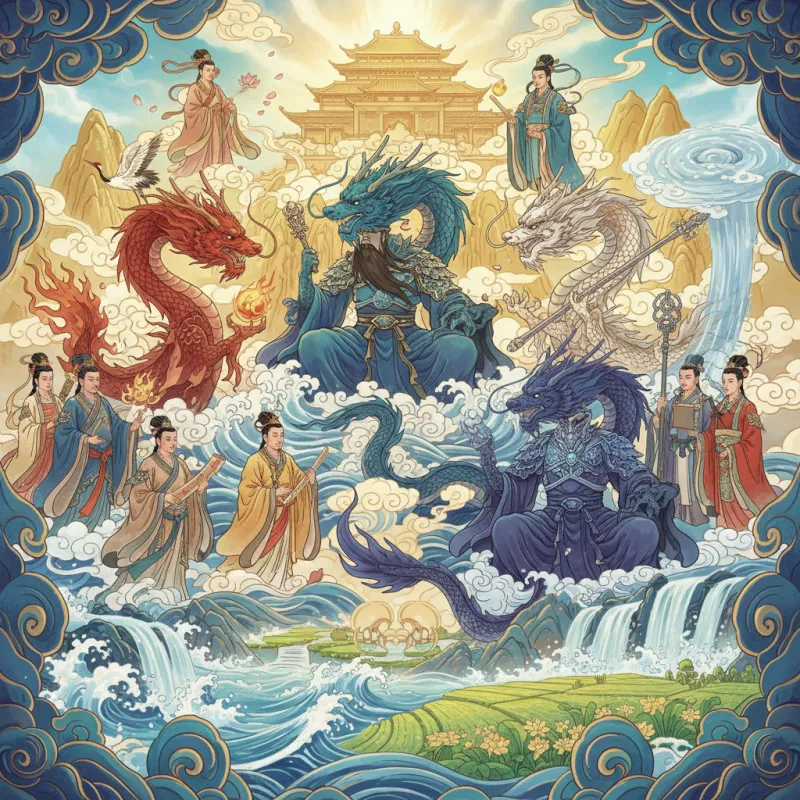
When the Monkey King crashes the Dragon Palace of the Eastern Sea demanding a weapon worthy of his strength, he's not just being his usual arrogant self — he's demonstrating something every Chinese peasant knew in their bones: even the mightiest water gods can be bullied if you're powerful enough. The Dragon Kings (龙王, Lóng Wáng) sit at a fascinating intersection in Chinese mythology: they're cosmic rulers of the seas, controllers of rain and flood, members of the celestial bureaucracy... and yet they're constantly getting pushed around by more powerful beings. This paradox tells us something essential about how Chinese religion actually worked on the ground.
The Four Seas and Their Kings
Traditional Chinese cosmology imagined the world as a square landmass surrounded by four seas, each ruled by a Dragon King. The Eastern Sea (东海, Dōng Hǎi) was governed by Ao Guang (敖广, Áo Guǎng), the eldest and most prominent of the four brothers. His palace appears in Journey to the West as a treasure-house of magical weapons, including the famous Ruyi Jingu Bang (如意金箍棒) — the size-changing staff that becomes Sun Wukong's signature weapon. The Southern Sea (南海, Nán Hǎi) belonged to Ao Qin (敖钦, Áo Qīn), the Western Sea (西海, Xī Hǎi) to Ao Run (敖闰, Áo Rùn), and the Northern Sea (北海, Běi Hǎi) to Ao Shun (敖顺, Áo Shùn).
These aren't just mythological figures — they had real administrative territories. The Eastern Sea roughly corresponded to the Yellow Sea and East China Sea, the Southern Sea to the South China Sea, the Western Sea to the Indian Ocean or sometimes Qinghai Lake, and the Northern Sea to Lake Baikal or the northern ocean beyond the known world. When drought struck a region, you prayed to the Dragon King whose territory included your watershed. This was practical theology.
The Dragon Kings weren't always brothers, and they weren't always four. Earlier traditions sometimes featured a single Dragon King or multiple dragon spirits without clear hierarchy. The standardization into four brother-kings ruling the cardinal seas appears to have solidified during the Tang Dynasty (618-907 CE), when the imperial court began officially recognizing and granting titles to dragon deities. By the Song Dynasty (960-1279 CE), the Dragon Kings had become fully integrated into the state religious apparatus, with official temples and regular sacrifices.
Rain Gods and Bureaucrats
Here's what made the Dragon Kings different from most other Chinese deities: they were middle management. Above them sat the Jade Emperor (玉皇大帝, Yù Huáng Dàdì), who could overrule their decisions. Below them worked countless lesser dragons, fish spirits, and aquatic officials. When a region needed rain, the local magistrate would petition the Dragon King, who would then have to get approval from heaven before releasing the rain. Sometimes he'd get the paperwork wrong and release too much rain, causing floods — a bureaucratic error with catastrophic consequences.
This bureaucratic nature appears vividly in Investiture of the Gods (封神演义, Fēngshén Yǎnyì), where Ao Guang's son Ao Bing is killed by Nezha in a conflict that escalates precisely because both sides are trying to follow proper protocol. Ao Bing wasn't just swimming around for fun — he was on official patrol duty. When Nezha kills him and strips his tendons for a belt, it's not just murder; it's assaulting a government official. The Dragon Kings' subsequent complaint to the Jade Emperor follows proper bureaucratic channels, complete with formal accusations and demands for justice.
The rain-making function was deadly serious. In Journey to the West, we meet the Dragon King of the Jing River who makes a bet with a fortune teller about when and how much rain will fall. When the Jade Emperor's decree arrives specifying the exact time and amount, the Dragon King deliberately disobeys to win his bet — changing the time by one hour and the amount by a few inches. For this minor act of rebellion, he's sentenced to execution. The episode shows how little autonomy these "kings" actually possessed. They were powerful, yes, but they were also trapped in a system where even small deviations from orders meant death.
Crystal Palaces and Cosmic Geography
The Dragon Palaces (龙宫, Lóng Gōng) exist in a liminal space between the physical and spiritual worlds. In Journey to the West, Sun Wukong simply walks into the sea and arrives at Ao Guang's palace — no special magic required, just the ability to breathe underwater. The palace is described with crystalline pillars, coral trees, pearl-studded gates, and treasure rooms filled with magical weapons and armor. These aren't metaphorical descriptions; in the logic of the novel, these palaces physically exist at the bottom of the actual seas.
But they also exist outside normal geography. When the Dragon Kings attend celestial banquets or court sessions, they simply appear in heaven without any described journey. Their palaces connect to the underworld bureaucracy — in some tales, the Dragon Kings have jurisdiction over the souls of those who drowned, creating a three-way connection between heaven, earth, and the underworld. This makes them uniquely positioned in the cosmic hierarchy, with access to all three realms.
The architecture of these palaces reflects Tang and Song Dynasty imperial aesthetics filtered through folk imagination. The crystal and coral aren't random choices — they're materials that suggest both immense wealth and otherworldly beauty, things a peasant might have heard about but never seen. The treasure rooms full of magical weapons serve a narrative function: they establish the Dragon Kings as wealthy and powerful, but also as hoarders who aren't using these treasures themselves. This makes them perfect targets for heroes who need magical equipment.
The Dragon Kings in Literature
The literary Dragon Kings are often surprisingly unheroic. In Journey to the West, Ao Guang is basically bullied into giving Sun Wukong whatever he wants. When the Monkey King first arrives demanding a weapon, Ao Guang tries to fob him off with various spears and halberds, but Sun Wukong breaks them all. Finally, Ao Guang's wife suggests giving him the Ruyi Jingu Bang — the pillar that Yu the Great used to measure the depths of the cosmic ocean — just to get rid of this troublesome visitor. Then Sun Wukong demands armor to match, and Ao Guang has to call his three brothers to contribute pieces of a full set. The scene is almost comic: four cosmic rulers scrambling to appease one monkey.
This pattern repeats throughout Chinese literature. In Water Margin (水浒传, Shuǐhǔ Zhuàn), the Dragon Kings appear in dreams to deliver messages but never directly intervene. In Strange Tales from a Chinese Studio (聊斋志异, Liáozhāi Zhìyì), they're often sympathetic figures whose daughters fall in love with human scholars, leading to complicated marriage negotiations between the aquatic and terrestrial worlds. The Dragon Kings themselves are usually portrayed as concerned fathers trying to manage their daughters' romantic choices while maintaining proper protocol.
The most interesting literary Dragon King might be the one in the Jing River execution story from Journey to the West. He knows he's going to be executed for his disobedience, so he appears in a dream to the Tang Emperor Taizong, begging for help. The emperor promises to intervene, but his minister Wei Zheng — who happens to be the celestial executioner assigned to behead the Dragon King — falls asleep during a chess game and performs the execution in his dream. The Dragon King's head falls into the imperial court, and his ghost begins haunting the emperor, eventually leading to the entire "Journey to the West" plot. This Dragon King is simultaneously a cosmic being and a desperate criminal, powerful enough to appear in the emperor's dreams but powerless to escape his sentence.
Folk Religion and Dragon King Temples
While literati were writing novels about Dragon Kings getting pushed around by heroes, ordinary people were building temples and praying for rain. Dragon King temples (龙王庙, Lóng Wáng Miào) dotted the Chinese landscape, especially near rivers, lakes, and coastlines. These weren't grand imperial structures — most were modest local shrines maintained by village communities. During droughts, villagers would gather at these temples to petition the Dragon King, sometimes performing elaborate rituals that included opera performances, offerings of incense and food, and even threats if the rain didn't come.
Yes, threats. If prayers and offerings failed to bring rain, communities sometimes resorted to "punishing" the Dragon King statue — dragging it out into the sun, removing its ritual garments, or even throwing it into a dry riverbed. The logic was straightforward: if the Dragon King wasn't doing his job, he deserved to suffer like everyone else. This practice reveals something crucial about Chinese folk religion: deities were expected to be effective. Worship was transactional. The Dragon Kings received offerings and respect in exchange for rain; if they failed to deliver, the contract was broken.
This practical approach extended to the imperial level. Emperors regularly issued edicts praising Dragon Kings who brought timely rain and demoting those whose territories suffered drought. The Qing Dynasty (1644-1912) maintained an elaborate system of dragon worship, with specific protocols for different types of rain prayers. The emperor himself would sometimes personally conduct rain-making ceremonies at the Temple of Heaven, petitioning the Dragon Kings as intermediaries between heaven and earth.
The Dragon Kings also protected sailors and fishermen. Coastal communities maintained Dragon King temples where fishermen would pray before voyages and make offerings after safe returns. These temples often contained vivid murals depicting the Dragon King's palace and court, giving worshippers a visual connection to the underwater realm. Some temples claimed to house actual relics — dragon scales, dragon bones, or items gifted by the Dragon King to particularly devout worshippers. Whether these relics were genuine (whatever that means for dragon parts) mattered less than their function in creating a tangible link between the human and dragon worlds.
Dragons, Nagas, and Buddhist Influence
The Dragon Kings didn't emerge fully formed from pure Chinese tradition — they show clear influence from Indian Buddhist nagas. When Buddhism entered China during the Han Dynasty (206 BCE - 220 CE), it brought stories of naga kings who ruled underwater realms and could control weather. These naga kings were sometimes protectors of Buddhism, sometimes obstacles to enlightenment, and always associated with water and rain. Chinese translators used the character 龙 (lóng, dragon) to translate the Sanskrit word "naga," creating a fusion between indigenous Chinese dragon beliefs and imported Indian serpent deities.
This fusion is visible in Buddhist sutras translated into Chinese, where naga kings appear as Dragon Kings attending the Buddha's teachings. The Lotus Sutra mentions eight great Dragon Kings, including Sagara (娑竭罗, Suōjiéluó), whose daughter achieves instant enlightenment — a story that became popular in Chinese Buddhism. These Buddhist Dragon Kings gradually merged with indigenous Chinese water spirits, creating the hybrid figures we see in later literature and folk religion.
The relationship between Dragon Kings and Buddhism remained complex. In some stories, Dragon Kings are devout Buddhists who protect monasteries and support monks. In others, they're obstacles that Buddhist heroes must overcome or convert. The famous Guanyin, the Bodhisattva of Compassion, is often depicted with a dragon as a companion or mount, suggesting a hierarchy where Buddhist deities outrank even the mightiest Dragon Kings. This reflects the broader pattern in Chinese religion where Buddhist and Daoist deities coexisted in a complex, sometimes competitive relationship.
The Dragon Kings Today
The Dragon Kings haven't disappeared from Chinese culture — they've adapted. Modern Chinese television dramas and films regularly feature Dragon King characters, usually portrayed with elaborate CGI palaces and shape-shifting abilities. The 1986 Journey to the West television series gave Ao Guang a memorable portrayal as a somewhat pompous but ultimately sympathetic figure, and this interpretation has influenced subsequent depictions. Video games set in Chinese mythological worlds almost always include Dragon King characters, often as quest-givers or bosses to defeat.
In contemporary Chinese folk religion, Dragon King worship has declined but not vanished. Some temples have been restored as cultural heritage sites, attracting tourists rather than worshippers. Others continue to function as active religious sites, especially in coastal regions where fishing communities maintain traditional practices. The transactional nature of Dragon King worship — pray for rain, receive rain, make offerings — fits awkwardly with modern meteorology, but the cultural resonance remains strong.
The Dragon Kings also appear in diaspora Chinese communities, where Dragon King temples serve as cultural centers connecting immigrants to their heritage. The dragon boat races held during the Duanwu Festival (端午节, Duānwǔ Jié) maintain a connection to dragon worship, even when participants don't consciously think of themselves as honoring the Dragon Kings. The dragons in Lunar New Year celebrations, with their undulating bodies and association with water and prosperity, carry forward ancient beliefs about dragon deities controlling natural forces.
What makes the Dragon Kings enduringly fascinating is their very ambiguity. They're powerful cosmic rulers who get bullied by heroes. They're gods who work as bureaucrats. They're fearsome dragons who are also concerned fathers and sometimes comic figures. They controlled the most essential resource in agricultural China — water — yet they couldn't act without permission from higher authorities. They embodied both the power of nature and the constraints of civilization, both the mystery of the deep ocean and the mundane reality of government administration. In a culture that valued hierarchy, order, and proper relationships, the Dragon Kings represented the complex truth that even the mightiest beings exist within systems that limit their power. And perhaps that's why, even today, they remain such compelling figures in Chinese mythology — because they remind us that power and vulnerability, authority and constraint, can coexist in the same being.
Related Reading
- Animal Deities in Chinese Religion: When Foxes, Snakes, and Turtles Become Gods
- Dragon Worship in China: The Most Powerful Animal Deity
- Xuanwu: The Turtle-Snake God of the North
- Sun Wukong as a Real Deity: Temples and Worship of the Monkey God
- Meet the Eight Immortals: Profiles of China's Favorite Supernatural Squad
- The Jade Emperor: Supreme Ruler of the Chinese Heavens
- Exploring Chinese Deities and Immortals: Traditions of the Daoist and Buddhist Pantheon