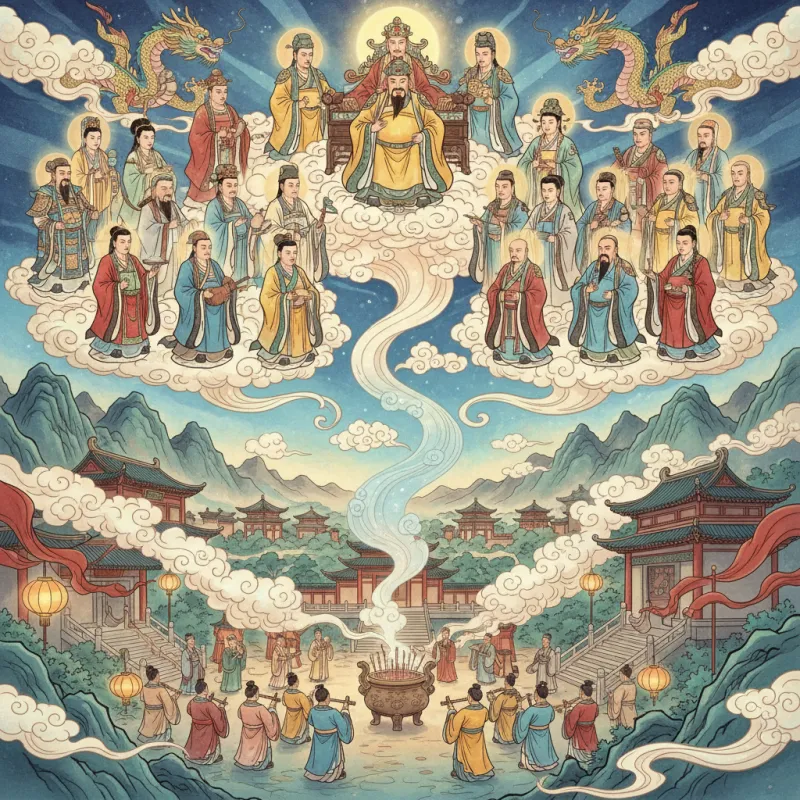
The incense smoke rises in three perfect spirals before the altar, carrying prayers written on yellow paper toward ancestors who died centuries ago. An old woman arranges oranges in groups of three, mutters formulas her grandmother taught her, and lights another stick. To an outsider, this looks like theater. To her, it's engineering—a precise technology for maintaining the cosmic order that keeps her family healthy, her business profitable, and the hungry ghosts at bay.
Chinese rituals aren't performances of faith. They're procedures with measurable outcomes, techniques refined over millennia for manipulating the invisible forces that govern fortune, health, and fate. Get the sequence wrong, use the wrong color paper, face the wrong direction—and the ritual fails as surely as a chemical reaction with incorrect proportions. This is religion as applied science, where efficacy matters more than sincerity.
The Mechanics of Spiritual Technology
When you burn joss paper (纸钱 zhǐqián), you're not symbolically honoring the dead. You're literally transferring currency to the spirit realm through a process of material transformation. The paper becomes smoke, smoke crosses the boundary between worlds, and your ancestor receives actual purchasing power in the afterlife. Modern joss paper shops sell everything from paper iPhones to paper luxury cars—because if the technology works for money, it works for any material good.
This transactional precision extends to every ritual element. Offerings of food don't represent nourishment—they provide it. The spirits consume the essence (精 jīng) of the food, leaving the physical matter behind. That's why ritual food often tastes bland after the ceremony; the vital energy has been extracted. Daoist priests performing a jiao (醮 jiào) ceremony don't symbolically purify a space—they actually redirect the flow of cosmic energy (气 qì), adjusting the spiritual equivalent of plumbing to ensure beneficial forces flow freely while harmful influences drain away.
The functional nature of these rituals creates a fascinating accountability structure. If your business fails after expensive offerings to the God of Wealth, you don't question your faith—you question whether the ritual was performed correctly. Did you use the right incense? Face the proper direction? Recite the formulas without error? Chinese ritual practice operates on troubleshooting logic: identify the malfunction, adjust the procedure, try again.
The Architecture of Ceremony
Every major Chinese ritual follows architectural principles as precise as any building code. The altar arrangement isn't decorative—it's a functional map of cosmic hierarchy. Deities occupy the highest position, ancestors the middle tier, local spirits the lower levels. Place an offering in the wrong position and you've committed a category error, like trying to plug a USB drive into an ethernet port.
Consider the Hungry Ghost Festival (中元节 Zhōngyuánjié) rituals performed during the seventh lunar month. Communities don't just feed wandering spirits out of compassion—they're managing a specific supernatural problem. During this month, the gates between worlds open, releasing spirits who died without descendants to make offerings. These hungry ghosts (饿鬼 èguǐ) become dangerous when desperate, causing accidents, illness, and misfortune. The communal feeding rituals aren't charity; they're preventive maintenance, keeping the spirit population pacified until the gates close again.
The precision extends to timing. Rituals performed at the wrong hour lose efficacy because cosmic energy flows differently throughout the day. The zi hour (子时 zǐshí, 11 PM to 1 AM) when yin energy peaks suits rituals for communicating with the dead. The wu hour (午时 wǔshí, 11 AM to 1 PM) when yang energy dominates works better for petitions to celestial deities. Daoist priests consult almanacs (通书 tōngshū) that map these energy fluctuations with astronomical precision, scheduling ceremonies the way engineers schedule launches during optimal weather windows.
The Priesthood as Technical Specialists
This understanding of ritual as technology creates a specific role for religious specialists. Daoist priests and Buddhist monks aren't primarily spiritual counselors or moral teachers—they're technicians who've mastered complex procedures most people can't perform correctly. A Daoist priest conducting a funeral ritual isn't comforting the bereaved; he's navigating the deceased through the bureaucratic maze of the underworld, filing the correct paperwork with the correct officials to ensure the soul reaches its proper destination.
The training reflects this technical focus. Priests memorize vast catalogs of formulas, mudras (hand gestures), and ritual sequences. They learn which deities have jurisdiction over which problems, which offerings each prefers, which days they're available for petitions. It's closer to legal training than theological education—mastering a complex system of rules, precedents, and procedures.
This creates an interesting dynamic where religious authority derives from technical competence rather than spiritual charisma. A priest who consistently produces results—patients who recover, businesses that prosper, hauntings that cease—gains reputation regardless of personal virtue. Conversely, a morally exemplary priest whose rituals fail loses clients. The system rewards effectiveness over piety.
Domestic Rituals and Everyday Engineering
While elaborate ceremonies require specialists, Chinese households maintain their own ritual infrastructure for daily spiritual maintenance. The kitchen god (灶神 Zàoshén) receives offerings because he reports annually to the Jade Emperor about the family's conduct. Smearing honey on his lips before his ascension isn't symbolic—it's literally sweetening his report, ensuring favorable testimony that affects the family's fortune for the coming year.
Ancestral tablets (神主牌 shénzhǔpái) aren't memorial objects—they're residence permits allowing deceased family members to remain connected to the household rather than wandering as hungry ghosts. Regular offerings maintain this connection, providing the ancestors with resources they need while securing their protection and blessing in return. Miss too many offerings and the relationship deteriorates, leaving the family vulnerable to misfortune.
Even simple acts like arranging fruit on an altar follow functional logic. Oranges represent gold, their round shape symbolizing completeness and their bright color attracting beneficial energy. Placing them in groups of three or nine (yang numbers) amplifies their effectiveness. This isn't superstition—it's applied correspondence theory, using material objects to manipulate immaterial forces through systematic relationships between the visible and invisible worlds.
The Bureaucratic Cosmos
Chinese ritual practice assumes the spirit world operates like an imperial bureaucracy—a vast hierarchy of officials, each with specific jurisdiction and authority. Petitioning the wrong deity is like filing paperwork with the wrong department; nothing happens because you've approached an official who lacks authority over your problem. This bureaucratic model shapes ritual strategy in fascinating ways.
When facing a serious problem, you might petition multiple deities simultaneously, hedging your bets across different departments. Or you might work up the hierarchy, starting with local earth gods (土地公 Tǔdìgōng) who handle neighborhood-level issues, escalating to city gods (城隍 Chénghuáng) for larger problems, and finally petitioning celestial deities like Guanyin for matters beyond mortal jurisdiction. Each level requires different offerings, different formulas, different protocols—like navigating a complex organizational chart.
The bureaucratic framework also explains why Chinese religion accommodates multiple traditions simultaneously. Buddhism, Daoism, and folk religion aren't competing systems—they're different departments handling different problems. You might consult a Buddhist monk for karmic issues affecting your next life, a Daoist priest for immediate health problems, and a spirit medium for communication with specific ancestors. Each specialist has different tools, different connections, different areas of expertise.
When Rituals Fail
The functional understanding of ritual creates a problem: what happens when correctly performed rituals don't produce expected results? Chinese religious practice has developed sophisticated explanations that preserve the system's logic while accounting for failure.
One explanation involves karmic debt (业障 yèzhàng) too severe for ritual intervention to overcome. Your offerings might be correct, but if you're working against massive karmic imbalance from past lives, the ritual's power proves insufficient. This doesn't invalidate the ritual—it just means you need more powerful interventions, more expensive ceremonies, or acceptance that some karmic debts must be paid through suffering.
Another explanation focuses on timing and cosmic conditions. Even correct rituals fail during inauspicious periods when harmful energies dominate. The solution isn't abandoning the ritual but waiting for favorable conditions, like rescheduling surgery until the patient's condition stabilizes. Almanacs help identify these windows, mapping the complex interplay of celestial stems, earthly branches, and elemental forces that determine each day's suitability for different activities.
Sometimes failure indicates interference from more powerful spiritual forces. A haunting that resists exorcism might involve a particularly strong ghost, requiring escalation to more powerful deities or more elaborate ceremonies. This troubleshooting approach—diagnosing why the standard procedure failed and adjusting accordingly—mirrors engineering problem-solving more than religious doubt.
The Modern Persistence of Ritual Technology
Walk through any Chinese city and you'll find this ritual technology operating at full capacity. Skyscrapers incorporate feng shui principles in their design, positioning doors and windows to optimize energy flow. Tech entrepreneurs burn incense to Caishen before product launches. Families consult almanacs to schedule weddings, business openings, and surgical procedures during auspicious hours.
This persistence isn't cultural conservatism or nostalgic tradition. It reflects the pragmatic logic underlying Chinese ritual practice: if something works, you keep using it. Modern Chinese people approach traditional rituals the way they approach traditional medicine—skeptical of the theoretical framework but convinced by empirical results. They might not believe in the bureaucratic cosmos, but they've seen businesses prosper after proper offerings, watched illnesses resolve after temple visits, experienced the correlation between ritual observance and good fortune often enough to maintain the practice.
The rituals adapt to modern contexts while preserving their functional core. Joss paper now includes paper credit cards and paper stock certificates. Offerings include packaged snacks alongside traditional fruits. Some temples accept online donations and digital prayer requests. The technology updates its interface while maintaining the underlying operating system—the fundamental belief that correct procedures produce real effects in the spiritual realm.
This isn't blind faith or superstitious practice. It's a sophisticated system for managing uncertainty, maintaining social bonds across the boundary of death, and asserting human agency in a cosmos that often seems indifferent to human welfare. The rituals work not because they manipulate supernatural forces—though practitioners believe they do—but because they provide structure, meaning, and actionable responses to life's fundamental anxieties. That's a technology worth preserving, regardless of what you believe about hungry ghosts and celestial bureaucrats.
Related Reading
- Burning Ghost Money: The Complete Guide to Afterlife Offerings
- How to Offer Incense: A Practical Guide to Chinese Temple Worship
- Chinese Rituals for the Dead: A Practical Guide to Ancestor Worship
- Exploring Chinese Deities and Immortals: Rituals in Daoist and Buddhist Traditions
- Chinese Funeral Traditions: A Guide to Death Customs
- Exploring the Rich Tapestry of Chinese Deities and Immortals
- Unveiling the Mystique of Chinese Animal Spirits in Daoist and Buddhist Beliefs
- Ancient Chinese Underworld Deities: Guardians of Death and Afterlife Realms