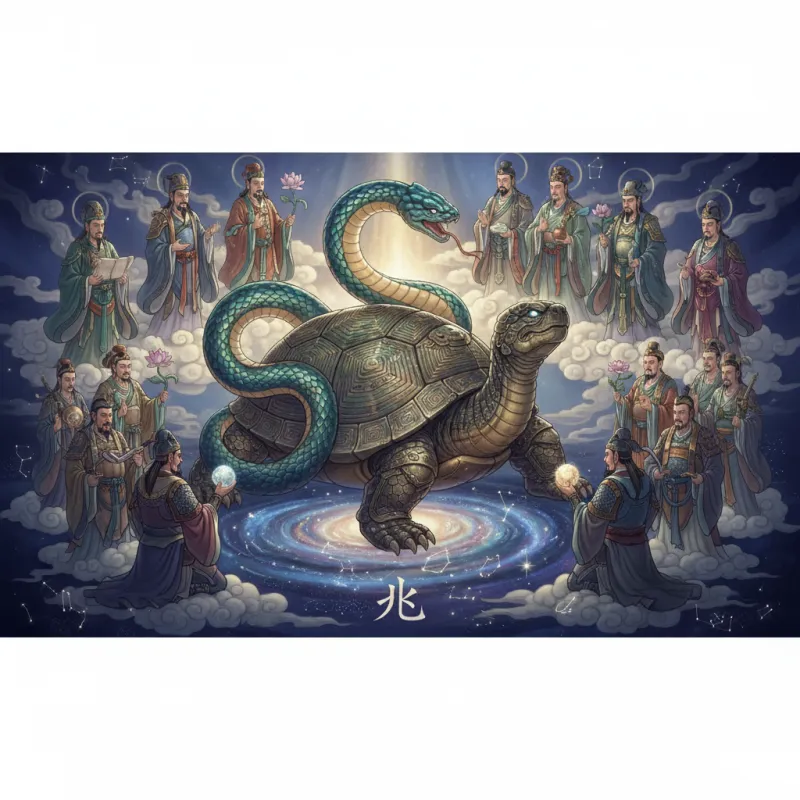
Picture this: a massive tortoise, ancient beyond reckoning, its shell scarred by millennia of cosmic battles, with a serpent coiled around its body — not strangling it, but fused with it, the two creatures breathing as one. This is Xuanwu (玄武 Xuánwǔ), the Dark Warrior of the North, and he's been guarding China's northern frontier since before anyone thought to write down his name.
Unlike the flashy dragon kings or the bureaucratic Jade Emperor, Xuanwu doesn't fit neatly into categories. He's older than most of the pantheon, weirder than almost all of them, and his origin story involves self-mutilation, demon-slaying, and a transformation so complete that his own internal organs became independent deities. If Chinese mythology had a punk rock phase, Xuanwu would be its poster child.
The Turtle-Snake: China's Oldest Power Couple
Before Xuanwu became a god with a human face, he was simply two animals — a black tortoise (玄龜 xuánguī) and a snake, intertwined in eternal embrace. This wasn't some cute symbolic pairing dreamed up by philosophers. Archaeological evidence from the Shang Dynasty (1600-1046 BCE) shows turtle-snake imagery in burial contexts, suggesting this combination held cosmic significance for over three thousand years.
The pairing makes perfect sense once you understand the logic. The tortoise embodies yin (陰 yīn) — it's slow, grounded, defensive, associated with water and earth. Its shell is literally a shield, and tortoises were believed to live for thousands of years, making them symbols of endurance and cosmic memory. The snake, meanwhile, is pure yang (陽 yáng) — quick, aggressive, transformative, shedding its skin in cycles of death and rebirth. One creature carries the weight of the world; the other strikes with lethal precision.
Together, they're not just complementary — they're complete. This is the yin-yang principle made flesh (or scale and shell), and it predates the famous black-and-white circle symbol by centuries. When you see Xuanwu in his original form, you're looking at one of the foundational images of Chinese cosmology, right up there with the dragon as a creature that shaped how an entire civilization understood reality.
From Constellation to Guardian God
Xuanwu's story begins in the stars. The ancient Chinese divided the night sky into four quadrants, each ruled by a celestial animal. The Azure Dragon (青龍 Qīnglóng) governed the east, the Vermilion Bird (朱雀 Zhūquè) the south, the White Tiger (白虎 Báihǔ) the west, and Xuanwu the north. These weren't just pretty patterns — they were cosmic forces that regulated the seasons, influenced human affairs, and maintained the structure of reality itself.
The northern quadrant, Xuanwu's domain, consisted of seven lunar mansions (宿 xiù) that ancient astronomers tracked obsessively. The north was associated with winter, water, the color black, and the number one. It was the direction of cold, darkness, and death — but also of stillness, depth, and the potential for renewal. Xuanwu wasn't just a constellation; he was the embodiment of these principles, the guardian who kept the frozen chaos of the north from overwhelming the ordered world of the south.
By the Han Dynasty (206 BCE - 220 CE), Xuanwu had evolved from a stellar pattern into a full-fledged deity with temples and rituals. Military commanders prayed to him before northern campaigns. Emperors invoked his protection against barbarian invasions. He became the god you called on when facing the unknown, the dangerous, the potentially catastrophic.
The Human Transformation: Prince Xuanwu's Brutal Path
Here's where things get wild. Sometime during the Tang Dynasty (618-907 CE), Daoist priests decided that a turtle-snake combo wasn't relatable enough for the masses. They needed a human origin story, and they came up with one that's equal parts inspiring and horrifying.
According to the legend that emerged, Xuanwu was originally a prince named Xuanwu (same name, different character emphasis) who abandoned his royal life to pursue immortality in the Wudang Mountains (武當山 Wǔdāng Shān). He meditated for decades, but couldn't achieve enlightenment. His stomach and intestines, still craving worldly food and pleasure, were holding him back.
So he did what any reasonable immortality-seeker would do: he cut them out.
The texts describe him slicing open his own belly, pulling out his offending organs, and washing them in a river. The stomach and intestines, now independent entities, transformed into a demon turtle and a demon snake that terrorized the countryside. Xuanwu, now purified and enlightened, had to hunt down and subdue his own former body parts. When he finally defeated them, they became his loyal servants — the turtle and snake that accompany him in iconography.
This story is bonkers, but it reveals something crucial about how Chinese religion works. The ancient turtle-snake deity didn't disappear when the human version emerged; instead, the two forms merged. Xuanwu the god contains both the cosmic animal pairing and the self-mutilating prince. He's simultaneously the primordial force and the perfected human, the symbol and the story.
The Zhenwu Emperor: Xuanwu's Ming Dynasty Rebirth
The Song Dynasty (960-1279 CE) brought a name change. The emperor's personal name included the character "武" (wǔ), and since you couldn't use the same character as the emperor (that was taboo), Xuanwu became Zhenwu (真武 Zhēnwǔ), the "True Warrior" or "Perfected Warrior." But the real explosion of his cult came during the Ming Dynasty (1368-1644 CE).
The Yongle Emperor (永樂帝 Yǒnglè Dì), who ruled from 1402 to 1424, was obsessed with Zhenwu. He claimed the god had personally assisted him in his rebellion against his nephew, appearing in visions and sending supernatural aid. Once he seized the throne, Yongle poured imperial resources into Zhenwu worship. He rebuilt the temple complex at Wudang Mountains into a sprawling religious city with palaces, halls, and shrines that rivaled the Forbidden City itself.
The Wudang complex still stands today, a UNESCO World Heritage site and a testament to how a turtle-snake deity from the Bronze Age became the personal patron of one of China's most powerful emperors. Yongle's promotion of Zhenwu wasn't just religious devotion — it was political strategy. By elevating a northern deity, he reinforced his legitimacy as a ruler who had come from the north (he'd been Prince of Yan, based in Beijing) and who could protect China from northern threats.
Xuanwu in Popular Culture and Practice
Walk into any traditional Chinese temple today, and you'll likely find Xuanwu somewhere in the pantheon. He's particularly popular in southern China and among overseas Chinese communities, where he's often called Beidi (北帝 Běidì), the "Northern Emperor," or Pak Tai in Cantonese.
His iconography is instantly recognizable: a fierce warrior with long hair, often barefoot, wearing black robes and armor, with a sword in hand. Sometimes he stands on the turtle and snake; sometimes they flank him as separate attendants. His face is usually dark or black, referencing both his association with the north and the "dark" (玄 xuán) in his name.
Martial artists, especially practitioners of Wudang-style internal martial arts like Taijiquan, consider him their patron deity. The connection makes sense — Xuanwu embodies the principle of overcoming hard with soft, of using stillness and patience (the turtle) combined with sudden, decisive action (the snake). This is the core philosophy of internal martial arts, and Wudang Mountain remains a pilgrimage site for martial artists worldwide.
In Hong Kong and Macau, Xuanwu temples host massive festivals where devotees carry his statue through the streets, perform lion dances, and make offerings of fruit, incense, and paper money. He's invoked for protection against disasters, for success in business (especially risky ventures), and for general good fortune. Unlike some deities who specialize in narrow domains, Xuanwu is a generalist — a cosmic bodyguard who'll help with whatever threatens you.
The Enduring Mystery of the Dark Warrior
What makes Xuanwu fascinating isn't just his longevity or his weird origin story — it's how he represents the Chinese genius for synthesis. He's simultaneously an ancient cosmological principle, a constellation, a pair of animals, a self-mutilating prince, an imperial patron deity, and a neighborhood protector god. These aren't contradictory identities; they're layers, each adding depth without erasing what came before.
Compare him to the phoenix, which maintained a relatively stable identity across millennia, or to newer deities like Guandi, who started as a historical general and was gradually deified. Xuanwu is different. He began as pure symbol — turtle plus snake equals cosmic balance — and then accumulated stories, human forms, and religious functions like a snowball rolling downhill, gathering mass and momentum.
The turtle-snake image persists because it works on a level deeper than narrative. You don't need to know the story of Prince Xuanwu to understand what the intertwined animals represent. The symbol speaks directly to something fundamental about how Chinese culture understands the world: that opposites don't conflict, they complete each other. That defense and offense, stillness and movement, earth and water, yin and yang are not enemies but partners in an eternal dance.
Why Xuanwu Still Matters
In an age of smartphones and skyscrapers, why does a turtle-snake god from the Bronze Age still command devotion? Partly it's tradition — Chinese religious practice is conservative, preserving forms and rituals across centuries. But there's more to it than that.
Xuanwu represents something that modernity hasn't replaced: the idea that the universe operates on principles of balance, that extremes are dangerous, that true strength comes from integrating opposites rather than choosing sides. In a world that increasingly demands you pick a team, declare an identity, and defend it against all comers, Xuanwu offers a different model. Be both turtle and snake. Be both still and striking. Be both ancient and ever-renewing.
The Dark Warrior of the North has been guarding his frontier for over three thousand years. He's survived the rise and fall of dynasties, the arrival of Buddhism, the challenges of modernity, and the skepticism of the scientific age. He's still there in temples and homes, still watching the north, still embodying the paradox that two can be one, that opposites can embrace, that the oldest gods are sometimes the most relevant.
That's not bad for a turtle with a snake wrapped around it.
Related Reading
- Dragon Worship in China: The Most Powerful Animal Deity
- Animal Deities in Chinese Religion: When Foxes, Snakes, and Turtles Become Gods
- Sun Wukong as a Real Deity: Temples and Worship of the Monkey God
- Unraveling the Mystique of Chinese War Gods in the Daoist and Buddhist Pantheon
- Maitreya: The Laughing Buddha
- Unveiling the Rich Tapestry of Chinese Deities and Immortals