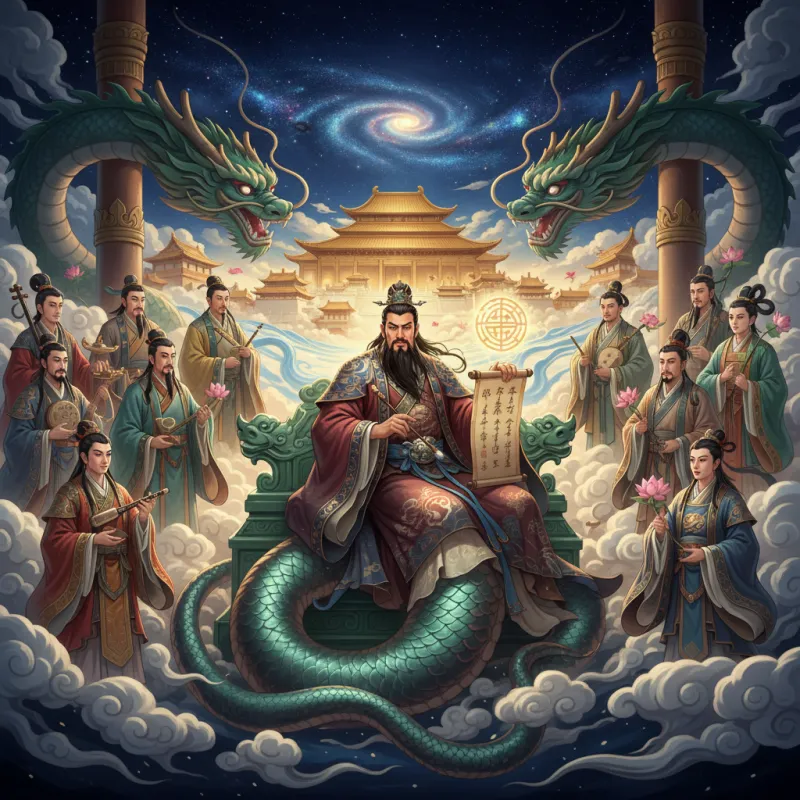
The first human beings had fire, but they didn't know what to do with it. They had hands, but no tools. They had voices, but no way to record their thoughts. Then came Fuxi (伏羲 Fúxī), half-man and half-serpent, who looked at these confused creatures and decided to give them something more dangerous than fire: knowledge itself.
The Serpent-Bodied Teacher
Fuxi appears in Chinese mythology with a human head and the coiling body of a snake — a form he shares with his sister-wife Nüwa, though their roles couldn't be more different. Nüwa molded humans from yellow clay and patched the broken sky with melted stones. Fuxi taught those humans how to stop being helpless. If Nüwa was the mother, Fuxi was the stern instructor who refused to let humanity remain children forever.
The earliest references to Fuxi appear in texts from the Warring States period (475-221 BCE), though his mythology likely predates written records. The Shiben (世本 Shìběn), a genealogical text from around the 3rd century BCE, names him as the first of the Three Sovereigns (三皇 Sānhuáng) — the legendary rulers who preceded even the Five Emperors of Chinese tradition. But unlike later emperors who ruled through law and ritual, Fuxi ruled through innovation. He didn't command obedience; he made obedience unnecessary by making survival possible.
The Eight Trigrams and the Birth of Divination
Fuxi's most profound gift to humanity wasn't practical — it was philosophical. According to the Xici (系辞 Xìcí), the commentary attached to the Yijing (易经 Yìjīng, Book of Changes), Fuxi created the Eight Trigrams (八卦 Bāguà) by observing patterns in nature: the markings on a turtle's shell, the arrangement of stars, the flow of rivers, the shapes of mountains.
Each trigram consists of three lines, either broken (yin) or unbroken (yang), creating eight possible combinations. These eight trigrams represent the fundamental forces of the cosmos: heaven, earth, thunder, wind, water, fire, mountain, and lake. By combining them in pairs, Fuxi created the sixty-four hexagrams that form the basis of the Yijing, the oldest of the Chinese classics and still consulted today for divination and philosophical insight.
This wasn't just fortune-telling. Fuxi gave humanity a language for understanding change itself — the idea that the universe operates according to patterns that can be observed, recorded, and predicted. Before Fuxi, humans lived in a world of chaos. After Fuxi, they lived in a world of systems.
Nets, Traps, and the Technology of Survival
But Fuxi didn't only deal in abstractions. Chinese tradition credits him with inventing the fishing net (罟 gǔ) and hunting traps, transforming humans from scavengers into hunters. Before Fuxi, people ate whatever they could find or catch with their bare hands. After Fuxi, they could feed entire communities.
The Yizhoushu (逸周书 Yìzhōushū), a collection of historical texts from the Zhou dynasty, describes Fuxi teaching humans to knot cords to create nets — a technology so fundamental that it appears in nearly every human culture, yet Chinese mythology insists it had a single divine origin. The fishing net represents more than just a tool; it represents the concept of leverage, of using intelligence to multiply human effort.
He also taught humans to domesticate animals, particularly the "six livestock" (六畜 liùchù): horses, cattle, sheep, pigs, dogs, and chickens. This wasn't just about food security — it was about transforming humanity's relationship with the natural world from parasitic to symbiotic.
The First Calendar and the Ordering of Time
Fuxi created the first calendar, organizing time into measurable units and allowing humans to predict the seasons. This might seem mundane compared to inventing divination or writing, but consider what it meant: before Fuxi, humans lived in an eternal present, unable to plan beyond the next meal. After Fuxi, they could plant crops in spring knowing they would harvest in autumn. They could prepare for winter. They could think in terms of years and generations.
The calendar also established the ritual year, the cycle of festivals and sacrifices that would become central to Chinese religious life. By marking time, Fuxi made history possible — and with history came culture, tradition, and the accumulated wisdom of generations.
Music, Marriage, and Social Order
Fuxi invented the guqin (古琴 gǔqín), the seven-stringed zither that would become the instrument of scholars and sages. But more than just creating an instrument, he established music as a tool for cultivating virtue and harmonizing society. The Liji (礼记 Lǐjì, Book of Rites) connects Fuxi's musical innovations to the establishment of ritual propriety — the idea that civilization requires not just survival skills but aesthetic and moral education.
He also instituted marriage customs, establishing the practice of formal unions between families rather than casual pairing. Some texts claim he invented the matchmaker's role and the exchange of gifts between families. This wasn't about controlling sexuality — it was about creating kinship networks, alliances, and social structures that extended beyond the nuclear family.
Writing and the Preservation of Knowledge
The most contested of Fuxi's inventions is writing itself. Some traditions credit him with creating the earliest form of Chinese characters, while others attribute this to Cangjie, the legendary historian of the Yellow Emperor. The truth is probably that both myths reflect the same cultural anxiety: writing is so powerful, so transformative, that it must have divine origins.
What's certain is that Fuxi created something related to recording information. The Yijing commentary describes him inventing knotted cords (结绳 jiéshéng) as a memory aid — a system where different knots represented different concepts or numbers. This proto-writing allowed humans to keep records, maintain accounts, and transmit information across time and space.
The Dragon-Horse and the River Diagram
One of the most evocative Fuxi myths describes him sitting by the Yellow River when a dragon-horse (龙马 lóngmǎ) emerged from the water carrying a diagram on its back — the Hetu (河图 Hétú, River Diagram). This mystical pattern of dots and lines revealed the mathematical relationships underlying the cosmos, which Fuxi used to create the Eight Trigrams.
This story appears in the Shanhaijing (山海经 Shānhǎijīng, Classic of Mountains and Seas) and later commentaries, and it establishes a crucial principle: knowledge comes from careful observation of nature, not from arbitrary human invention. Fuxi didn't impose order on chaos — he discovered the order that was already there.
The Legacy of the First Teacher
Fuxi's mythology reveals something essential about Chinese civilization's self-understanding: culture is not natural. Humans are not born knowing how to fish, how to marry, how to mark time, or how to divine the future. These skills must be taught, and teaching them is a divine act.
Unlike the Prometheus of Greek mythology, who stole fire from the gods and was punished for it, Fuxi gave humanity knowledge freely and was honored for it. There's no sense in Chinese tradition that humans weren't meant to have these gifts, no original sin of forbidden knowledge. Instead, Fuxi represents the idea that civilization is humanity's birthright — we just needed someone to show us how to claim it.
Temples to Fuxi still exist throughout China, particularly in Tianshui, Gansu Province, where he is said to have been born. Every year, people gather to honor the god-emperor who looked at naked, ignorant humans and decided they deserved better. He gave them nets and trigrams, calendars and music, marriage and writing — everything they needed to stop being animals and start being human.
That's the real miracle of Fuxi: not that he was half-snake, but that he believed humans were capable of learning.
Related Reading
- Exploring Chinese Deities and Immortals in Daoist and Buddhist Creation Myths
- Pangu Opens Heaven and Earth: The Chinese Creation Story
- Nüwa Repairs the Sky: The Goddess Who Saved the World
- Pangu and the Cosmic Egg: How the Chinese Universe Began
- Creation Myths in Chinese Religion: How Gods Made the World
- The Quest for the Elixir of Life: From Emperor Qin to Modern Fiction
- Chinese Gods in Anime and Manga: Eastern Mythology Goes Global
- The Eight Immortals: China's Most Beloved Supernatural Team