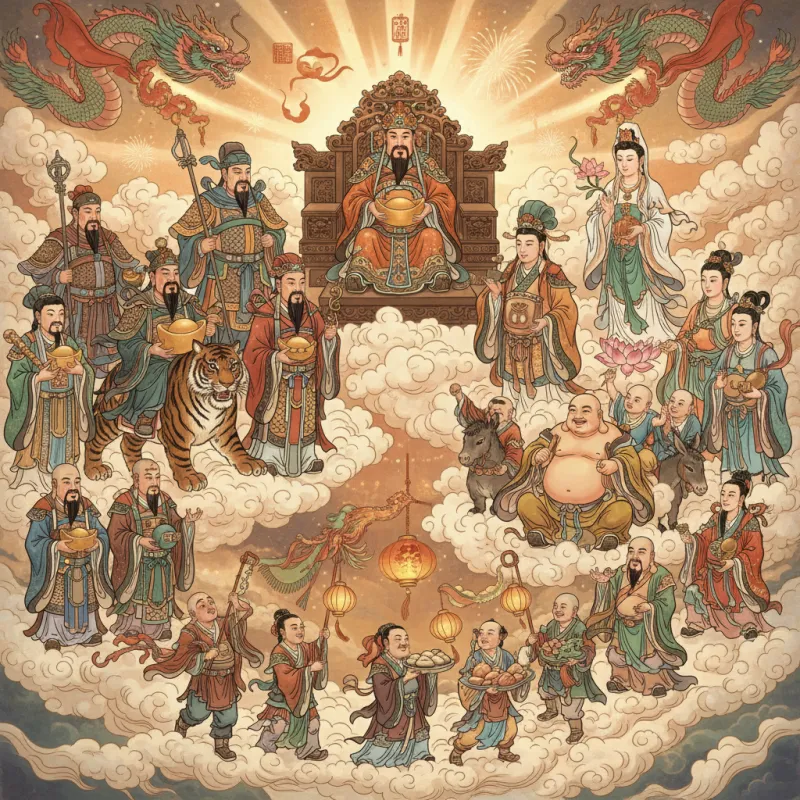
The Kitchen God is leaving your house in three days, and he's about to snitch on you to the Jade Emperor. This isn't folklore — for millions of Chinese families, the week before Lunar New Year triggers a carefully choreographed sequence of divine departures, arrivals, and appeasements that would make airport logistics look simple. Welcome to the most deity-dense holiday on the Chinese calendar, where your household becomes a revolving door for gods.
The Kitchen God's Annual Performance Review
Every year on the 23rd or 24th day of the twelfth lunar month, the Kitchen God (灶神 Zàoshén) — also called Zao Jun (灶君) — leaves his post above your stove and flies to heaven for his annual report. His job? Monitor your family's behavior for 365 days and deliver a comprehensive assessment to the Jade Emperor (玉皇大帝 Yùhuáng Dàdì). This is not a deity you want filing a negative review.
The solution, refined over centuries, is brilliantly pragmatic: bribe him with sugar. Families smear malt candy (麦芽糖 màiyátáng) or honey on the Kitchen God's paper image before burning it to send him skyward. The logic operates on two levels — either his mouth is too sticky to speak clearly, or the sweetness puts him in such a good mood that he only reports favorable things. Some families add wine to the offering, hoping to get him pleasantly drunk before his celestial commute.
The Kitchen God's wife often appears in these images too, though her role remains ambiguous in most traditions. Some texts suggest she accompanies him to heaven; others imply she stays behind to mind the house. The Ming dynasty novel Fengshen Yanyi (封神演义) doesn't clarify this particular domestic arrangement, being more concerned with the Kitchen God's origin story as Jiang Ziya's disciple Zhang Kui.
The Wealth God's Competitive Market
On the fifth day of the New Year (正月初五 Zhēngyuè Chūwǔ), businesses and households compete to "receive the Wealth God" (接财神 jiē cáishén) as early as possible — preferably at the exact moment of the day's first hour. The belief holds that whoever welcomes him first receives the best fortune for the coming year. In modern cities, this creates a peculiar phenomenon: neighborhoods erupting in coordinated firecracker symphonies at dawn, each family trying to outdo their neighbors in demonstrating enthusiasm.
But which Wealth God? The tradition splinters into multiple candidates. Zhao Gongming (赵公明), the black-faced martial deity riding a tiger, claims the most widespread following. He appears in Fengshen Yanyi as a formidable immortal who eventually receives the title "Marshal of the Mysterious Altar" (玄坛真君 Xuántán Zhēnjūn). His four subordinates — the "Four Immortals of Wealth" — handle specialized portfolios:招宝 (Zhāobǎo, "Summoning Treasure"), 纳珍 (Nàzhēn, "Accepting Valuables"), 招财 (Zhāocái, "Inviting Wealth"), and 利市 (Lìshì, "Profitable Markets").
Northern China sometimes venerates Bi Gan (比干), the Shang dynasty minister who was executed for his loyalty — his heart literally cut out by the tyrant King Zhou. The symbolic logic: a man without a heart cannot be partial or biased, making him the perfect impartial distributor of wealth. Southern traditions occasionally favor Fan Li (范蠡), the brilliant strategist who helped King Goujian of Yue defeat Wu, then retired to become a spectacularly successful merchant.
The Wealth God tradition reveals something essential about Chinese religious pragmatism: when multiple deities offer similar services, worship all of them. Why limit your options?
The Door Gods' Military Credentials
While the Kitchen God and Wealth God operate on schedules, the Door Gods (门神 Ménshén) maintain year-round posts — but New Year is when their images get refreshed. The most common pair: Qin Shubao (秦叔宝) and Yuchi Gong (尉迟恭), two generals who served Tang Emperor Taizong. According to legend, the emperor suffered nightmares of demons until these two warriors volunteered to guard his bedroom doors. After the demons ceased, the emperor had their portraits painted on the doors to spare the generals from standing watch every night.
This origin story, recorded in the Journey to the West (西游记 Xīyóu Jì), explains why Door Gods always appear in pairs, always face outward, and always look intimidating. They're not there to welcome guests — they're there to terrify malevolent spirits into choosing a different house. Their images typically show them in full armor, wielding weapons, with expressions that suggest they're not interested in negotiating.
Some households use alternative Door God pairs: Shen Shu (神荼) and Yu Lei (郁垒), ancient deities from pre-Tang traditions who supposedly lived on Mount Dushuo and commanded an army of ghost-catching tigers. These earlier Door Gods connect to even older practices of hanging peach wood charms, since peach wood was believed to repel evil spirits — a belief that persists in Daoist ritual implements today.
The Jade Emperor's Inspection Day
The ninth day of the New Year (正月初九 Zhēngyuè Chūjiǔ) marks the Jade Emperor's birthday, called "Tiangong Sheng" (天公生). This is the big one. The Jade Emperor sits at the apex of the celestial bureaucracy, and his birthday requires the most elaborate offerings: whole roasted pigs, mountains of fruit, towers of steamed cakes, and incense burned in quantities that would concern modern fire marshals.
Hokkien communities in Fujian and Taiwan treat this day with particular intensity, setting up offering tables that spill out of temples into the streets. The midnight-to-dawn worship session reflects the belief that the Jade Emperor's birthday begins at the celestial hour of Zi (子时), corresponding to 11 PM to 1 AM. Families stay up to present offerings at the optimal moment, creating a festival within the festival.
The Jade Emperor's role in Chinese New Year extends beyond his birthday. He's the one receiving the Kitchen God's report, reviewing the year's cosmic accounts, and presumably making decisions about the coming year's fortune distribution. Every other deity ultimately reports to him — he's the CEO of heaven, and New Year is his annual shareholders' meeting.
Ancestors: The Most Important "Deities"
Technically, ancestors aren't gods. Practically, they receive more attention during New Year than most deities. On New Year's Eve (除夕 Chúxī), families prepare elaborate meals and set places at the table for deceased relatives, inviting them home for the reunion dinner. The offerings must include the ancestors' favorite dishes — this isn't generic worship, it's personal hospitality.
The ancestor worship component of Chinese New Year predates most deity cults by centuries. The Shang dynasty oracle bones (1600-1046 BCE) already show elaborate ancestor veneration rituals. When Buddhism and Daoism later introduced their pantheons of gods, the ancestor cult didn't disappear — it simply expanded the household's spiritual guest list.
This creates an interesting theological situation: your ancestors might be less cosmically powerful than the Jade Emperor, but they're more personally invested in your family's welfare. They're also more likely to be offended if you forget them. The Kitchen God might report you to heaven, but your grandmother's spirit will haunt you directly.
The God of Wealth's Competitors and Colleagues
Beyond the main Wealth God candidates, regional traditions add specialized financial deities. The God of Literature (文昌帝君 Wénchāng Dìjūn) receives offerings from families with students, since academic success historically led to government positions and wealth. The Earth God (土地公 Tǔdì Gōng) gets his share too, since he controls local prosperity and agricultural yields.
Some businesses worship Guan Yu (关羽), the red-faced warrior from Romance of the Three Kingdoms (三国演义 Sānguó Yǎnyì), who became deified as Guan Di (关帝). His reputation for loyalty and righteousness made him popular with merchants and bankers who valued trustworthy business relationships. Hong Kong's police force traditionally worshiped him too, appreciating his martial prowess and incorruptible character.
The multiplication of wealth deities reflects practical hedging: if you're not sure which god controls your industry's fortune, worship all the plausible candidates. This isn't theological confusion — it's comprehensive spiritual insurance.
The Festival's Divine Logic
Chinese New Year's deity interactions follow a clear pattern: send off the monitoring gods (Kitchen God), clean and prepare the house, welcome the blessing gods (Wealth God, Door Gods), honor the supreme authority (Jade Emperor), and maintain family connections (ancestors). It's a complete spiritual reset, like rebooting your household's cosmic operating system.
The festival's genius lies in its combination of obligation and opportunity. You must appease certain deities to avoid problems (Kitchen God, ancestors), but you can also actively court blessings from others (Wealth God, Jade Emperor). The system assumes divine beings respond to proper ritual attention — not because they're easily manipulated, but because correct behavior demonstrates respect and sincerity.
This transactional element bothers some modern observers who prefer their religion more mystical and less mercenary. But the Chinese New Year deity system reflects a worldview where spiritual beings operate within comprehensible rules. Gods aren't arbitrary or capricious — they're bureaucrats, family members, and military guards doing their jobs. Treat them properly, and they'll treat you properly. It's not bribery; it's relationship maintenance.
The sheer number of deities involved also serves a psychological function: no single god controls your fate. If the Kitchen God gives a bad report, maybe the Wealth God will compensate. If you accidentally offend one deity, others might intercede. The system builds in redundancy and second chances, which is oddly comforting for a tradition that takes divine judgment seriously.
For more on specific deities mentioned here, see The Jade Emperor and Kitchen God. The relationship between New Year practices and broader Daoist traditions is explored in Daoist Festival Calendar.
Related Reading
- Exploring Chinese Deities and Immortals: Traditions of the Daoist and Buddhist Pantheon
- Dragon Boat Festival: The Poet, the River, and the Race
- The Mythology of the Mid-Autumn Festival: Chang'e, Hou Yi, and the Moon Rabbit
- The Lantern Festival: When Gods Walk Among Mortals
- Chinese Festivals and Their Gods: The Calendar of Divine Celebrations
- The Eight Immortals: China's Most Beloved Divine Group
- A Practical Guide to Visiting Chinese Temples: What to Do and What Not to Do
- Unveiling the Rich Tapestry of Chinese Deities and Immortals