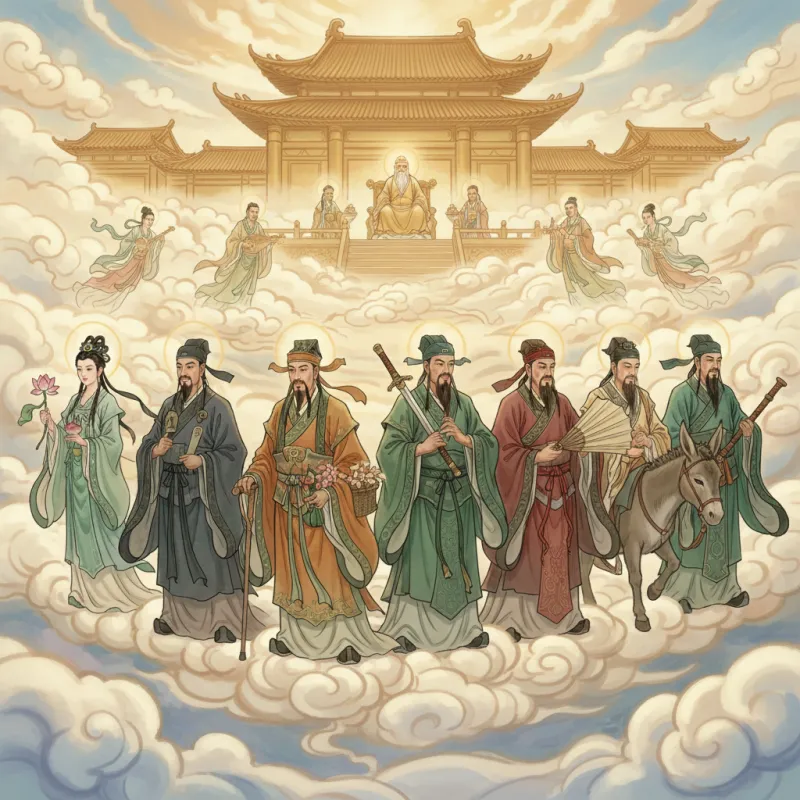
They're drunk, they're bickering, and they're about to cross the ocean without a boat. One pulls out a fan, another a flute, a third her lotus flower. The cripple waves his crutch, the beggar shakes his gourd, and the old man with the donkey just laughs. This is the Eight Immortals' idea of a road trip—and it's exactly why Chinese culture has been obsessed with them for over a thousand years.
The Eight Immortals (八仙, Bāxiān) aren't your typical pantheon of remote, marble-faced deities. They're the supernatural squad you'd actually want to hang out with: flawed, funny, and refreshingly human despite their immortality. Walk into any Chinese restaurant from San Francisco to Singapore, and you'll spot them on the walls. They're carved into temple beams, printed on New Year decorations, and yes, they've even been turned into children's cartoons. The phrase "the Eight Immortals cross the sea, each showing their special skill" (八仙过海,各显神通, Bāxiān guò hǎi, gè xiǎn shéntōng) is such a common idiom that Chinese speakers use it without thinking—it means everyone brings their unique talents to solve a problem.
But here's what makes them genuinely interesting: they're not gods who descended from heaven. They're mortals who earned immortality, and their stories are messy, weird, and sometimes darkly funny. They represent every corner of Chinese society—male and female, young and old, rich and poor, scholar and beggar. Unlike the rigid hierarchy of the Heavenly Court, the Eight Immortals are equals. They're a found family, not a corporate org chart.
The Core Lineup: Who's Who in the Immortal Squad
Zhongli Quan (钟离权, Zhōnglí Quán) is the unofficial leader, though he'd probably deny it. Picture a fat, jolly man with his belly hanging out, carrying a fan that can revive the dead or kill the living depending on which side he uses. He's a former general from the Han Dynasty who gave up military life after a devastating defeat, retreated to the mountains, and learned the secrets of alchemy and immortality. His bare belly isn't just comic relief—it's a statement about rejecting social pretension. Zhongli Quan is the team's alchemist and teacher, the one who initiated several other immortals into the mysteries of the Dao.
Lü Dongbin (吕洞宾, Lǚ Dòngbīn) is the scholar-swordsman and arguably the most popular of the eight. He's handsome, educated, and carries a demon-slaying sword on his back, but his origin story is deliciously ironic. After failing the imperial examinations, he got drunk at an inn and had a dream where he lived an entire lifetime of success, wealth, and power—only to wake up and realize it was all illusion. That moment of clarity led him to abandon worldly ambition and seek immortality instead. He's the immortal most likely to appear in human affairs, often disguised as a beggar or wanderer to test people's character. His sword, which he keeps strapped to his back, is said to be invisible until he needs it.
Cao Guojiu (曹国舅, Cáo Guójiù) is the aristocrat of the group, literally—he was the brother of an empress during the Song Dynasty. He's always depicted in official court robes, holding a pair of jade tablets that grant him access to the imperial court. His backstory is darker than most: his brother committed murder, and Cao Guojiu was so ashamed that he gave up his wealth and status to live in the mountains. He represents the idea that even privilege and power are ultimately empty, and that true cultivation requires abandoning social status. He's the quiet one of the group, dignified and reserved.
Tieguai Li (铁拐李, Tiěguǎi Lǐ), whose name literally means "Iron Crutch Li," is the beggar immortal and the group's wild card. He's depicted as a dirty, disheveled cripple with a crutch and a gourd that releases healing vapors. The story goes that he was originally a handsome scholar who left his body to travel in spirit form. When he returned, his disciple had already cremated his corpse (thinking he was dead), so Li's soul had to inhabit the only available body—a lame beggar who had just died. He's temperamental, sometimes cruel, but also the most compassionate toward the poor and sick. His ugliness is deliberate: a reminder that spiritual power has nothing to do with physical appearance.
He Xiangu (何仙姑, Hé Xiāngū) is the only woman in the group, and she's no token female character. She carries a lotus flower and is associated with purity and household harmony, but her origin story is about rejecting marriage and family expectations. As a young woman, she ate a magical peach (or in some versions, mica powder) that made her immortal and gave her the ability to fly. When her family tried to marry her off, she refused and disappeared into the mountains. She represents female autonomy in a culture that didn't always celebrate it, and her lotus symbolizes rising above the mud of worldly concerns while remaining rooted in compassion.
Lan Caihe (蓝采和, Lán Cǎihé) is the most mysterious and gender-ambiguous of the eight. Sometimes depicted as male, sometimes female, sometimes as a young person of indeterminate gender, Lan Caihe wears one shoe on and one shoe off, carries a flower basket, and wanders around singing cryptic songs about the brevity of life. In some stories, Lan Caihe is a street performer or beggar who suddenly ascends to heaven in the middle of a wine shop, leaving behind only a shoe and a robe. The ambiguity is the point—Lan Caihe represents the transcendence of social categories and the freedom that comes from not fitting into conventional boxes.
Zhang Guolao (张果老, Zhāng Guǒlǎo) is the eccentric old man who rides a white donkey—backwards. His donkey is magical: it can travel thousands of miles in a day, and when Zhang doesn't need it, he folds it up like paper and puts it in his pocket. Pour water on the paper, and the donkey comes back to life. Zhang is associated with longevity and is often depicted with a bamboo tube drum. He's based on a possibly historical figure from the Tang Dynasty who was famous for his magical tricks and his refusal to serve at court despite multiple imperial invitations. His backwards riding symbolizes his contrary perspective on life—he sees things others don't.
Han Xiangzi (韩湘子, Hán Xiāngzǐ) is the musician of the group, always carrying a jade flute that can make flowers bloom and attract birds and animals. He's said to be the nephew of Han Yu, a famous Tang Dynasty scholar and official who was skeptical of Daoism and Buddhism. The irony of the rationalist uncle having a Daoist immortal nephew is not lost on anyone. Han Xiangzi represents the power of art and music to transform consciousness and connect with the natural world. His flute playing can calm storms, heal the sick, and even make plants grow out of season.
Why This Team Works: The Power of Diversity
Here's what makes the Eight Immortals more than just a random collection of magical beings: they're a deliberate representation of social diversity working in harmony. You've got the general and the beggar, the aristocrat and the street performer, the scholar and the illiterate, the beautiful and the ugly, the young and the old, male and female and ambiguous. This wasn't accidental—the stories evolved during the Yuan and Ming Dynasties (13th-17th centuries) when Chinese society was grappling with questions about hierarchy, merit, and social mobility.
The Eight Immortals offer a radical alternative to the Confucian social order: they're a meritocracy of spiritual achievement where your background doesn't matter. The beggar is as powerful as the aristocrat. The woman is as capable as the men. The cripple is as valuable as the able-bodied. This is revolutionary stuff, even if it's wrapped in mythology and humor.
Their most famous adventure—crossing the sea—perfectly illustrates this principle. When they need to cross the ocean, each immortal uses their unique magical item as a boat: Zhongli Quan uses his fan, Lü Dongbin his sword, He Xiangu her lotus, and so on. Nobody's method is better than anyone else's; they all work. The message is clear: there are many paths to the goal, and diversity of approach is strength, not weakness.
The Cultural Impact: From Temple to Pop Culture
The Eight Immortals have been everywhere in Chinese culture for centuries, but their popularity really exploded during the Ming Dynasty (1368-1644) when their stories were collected and standardized in texts like "The Eight Immortals Cross the Sea" (東遊記, Dōngyóujì). They appeared in plays, novels, paintings, and folk tales. By the Qing Dynasty, they were so ubiquitous that they became a standard decorative motif—you'd see them on porcelain, embroidery, furniture, and architecture.
What's fascinating is how they've adapted to modern times. In contemporary China, they've been turned into animated characters, video game heroes, and even advertising mascots. There's something about their combination of power and approachability that translates across centuries. They're not distant gods demanding worship; they're quirky mentors who might show up in disguise to teach you a lesson or help you out of a jam.
The idiom about them crossing the sea has taken on a life of its own in modern Chinese. When a company talks about leveraging everyone's unique skills, when a teacher discusses different learning styles, when a family figures out how to solve a problem together—they're all invoking the Eight Immortals whether they realize it or not. The phrase has become shorthand for collaborative problem-solving that respects individual differences.
What They Teach Us: Immortality as Metaphor
Here's my take after years of studying these figures: the Eight Immortals aren't really about literal immortality. They're about transformation and transcendence. Each of them gave up something—status, beauty, family, ambition—to gain something more valuable. They're teaching stories about what it means to live authentically, to reject social pressure, to find your own path.
Zhongli Quan gave up military glory. Lü Dongbin gave up scholarly ambition. Cao Guojiu gave up aristocratic privilege. Tieguai Li gave up physical beauty. He Xiangu gave up marriage and family expectations. Lan Caihe gave up gender conformity. Zhang Guolao gave up conventional wisdom. Han Xiangzi gave up his uncle's rationalist worldview. And in giving up these things, they became more fully themselves—which is its own kind of immortality.
The fact that they're a team matters too. Chinese culture often emphasizes individual cultivation and self-improvement, but the Eight Immortals show that enlightenment doesn't have to be a solitary journey. They drink together, travel together, get into trouble together, and help each other out. They prove that you can be spiritually advanced and still enjoy a good party, that transcendence doesn't require abandoning friendship and humor.
In a world that increasingly values conformity and hierarchy, the Eight Immortals remain relevant precisely because they reject both. They're misfits and outcasts who found each other and became legendary. They're proof that the people who don't fit in might be the ones who change everything. And they're a reminder that the best teams aren't made up of identical people with identical skills—they're made up of radically different individuals who respect each other's unique contributions.
That's why, after more than a thousand years, we're still telling their stories. And why, when we face a challenge that requires everyone's best effort, we still say: the Eight Immortals cross the sea, each showing their special skill.
Related Reading
- Lü Dongbin: The Most Beloved Immortal in Chinese Culture
- The Eight Immortals: China's Most Beloved Supernatural Team
- The Eight Immortals: China's Most Beloved Divine Group
- Symbols of the Eight Immortals: Hidden Meanings in Chinese Art
- Guardians of the Night Sky: The Star Gods in Chinese Daoist and Buddhist Traditions
- Unraveling the Mystique of Chinese War Gods in the Daoist and Buddhist Pantheon
- Ancient Chinese Underworld Deities: Guardians of Death and Afterlife Realms