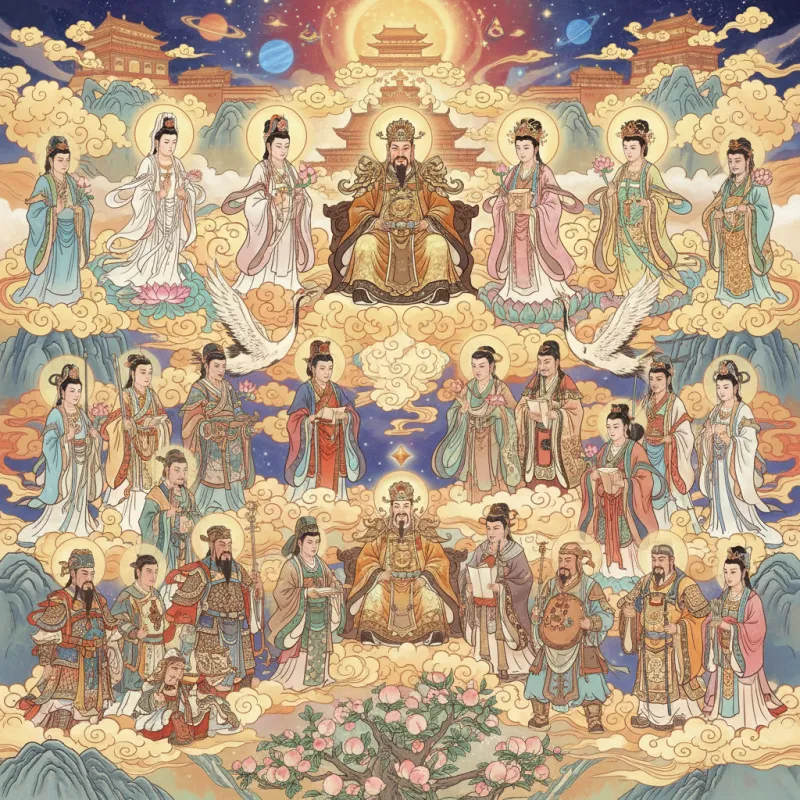
A peasant kneels before a weathered statue in a village temple, burning incense for the Jade Emperor while a Buddhist monk chants sutras to Guanyin in the adjacent hall. This scene—repeated millions of times across China—reveals something profound: the Chinese pantheon isn't a tidy hierarchy but a living, breathing ecosystem where Daoist immortals, Buddhist bodhisattvas, and folk gods coexist in creative chaos. Understanding this divine landscape means abandoning Western expectations of theological consistency and embracing the pragmatic spirituality that has defined Chinese religious life for millennia.
The Daoist Immortals: Transcendence Through Cultivation
The Daoist tradition gave China its most distinctive divine figures: the xian (仙, xiān)—immortals who achieved transcendence through alchemical practice, meditation, and moral cultivation. Unlike the omnipotent gods of monotheistic traditions, these immortals were once human, making their divinity aspirational rather than absolute.
The Eight Immortals (八仙, Bāxiān) epitomize this accessible divinity. Lü Dongbin (吕洞宾, Lǚ Dòngbīn), the scholarly swordsman, reportedly lived during the Tang Dynasty and achieved immortality after encountering Zhongli Quan in a wine shop. His story—complete with failed imperial examinations and eventual enlightenment—resonates because it mirrors the frustrations of countless scholars throughout Chinese history. He Xiangu (何仙姑, Hé Xiāngū), the only female among the Eight, achieved immortality by consuming powdered mica and swearing off grains, embodying the Daoist principle of dietary refinement.
The Jade Emperor (玉皇大帝, Yùhuáng Dàdì) sits atop the Daoist celestial bureaucracy, a cosmic administrator who mirrors the earthly imperial system. This parallel isn't coincidental—the Daoist pantheon evolved alongside Chinese statecraft, with heavenly officials managing departments for thunder, wealth, longevity, and even kitchen affairs. The Kitchen God (灶神, Zàoshén) reports annually to the Jade Emperor about each household's behavior, a divine surveillance system that reinforced social norms more effectively than any law code.
Buddhist Bodhisattvas: Compassion Made Manifest
Buddhism arrived in China during the Han Dynasty, bringing a radically different conception of divinity. Bodhisattvas—enlightened beings who postpone nirvana to save all sentient beings—introduced the revolutionary idea that divine power flows from compassion rather than cosmic authority.
Guanyin (观音, Guānyīn), the Bodhisattva of Compassion, underwent a remarkable transformation on Chinese soil. Originally the male Indian deity Avalokiteśvara, Guanyin became predominantly female in Chinese Buddhism by the Song Dynasty, absorbing characteristics from indigenous mother goddesses and Daoist female immortals. Her thousand arms and eyes symbolize infinite compassion, but her true power lies in accessibility—she responds to any sincere call for help, regardless of the supplicant's moral status or religious affiliation.
Dizang (地藏, Dìzàng), known as Ksitigarbha in Sanskrit, vowed not to achieve Buddhahood until all hells are emptied. This impossible commitment made him the patron of the dead and the protector of travelers, particularly relevant during the Ghost Festival when the boundaries between worlds grow thin. His presence in Chinese temples alongside Daoist deities illustrates the syncretic genius of Chinese religious practice—why choose between traditions when both offer valuable spiritual technologies?
The Syncretic Reality: When Pantheons Collide
The theoretical boundaries between Daoist and Buddhist deities dissolve in actual practice. Village temples routinely house statues of the Jade Emperor, Guanyin, and Guan Yu (关羽, Guān Yǔ)—the deified general from the Three Kingdoms period—under one roof. This isn't theological confusion but practical wisdom: different deities offer different benefits, and devotees approach them based on specific needs rather than doctrinal purity.
The Ming Dynasty novel Journey to the West (西游记, Xīyóujì) captures this syncretic reality brilliantly. The Monkey King Sun Wukong rebels against the Jade Emperor's heavenly bureaucracy, gets imprisoned by Buddha, and eventually escorts the Buddhist monk Xuanzang to India—all while encountering a rogues' gallery of Daoist immortals, Buddhist arhats, and folk demons. The novel's enduring popularity stems from its accurate reflection of how ordinary Chinese people experienced their pantheon: as an interconnected network of divine powers rather than competing theological systems.
This syncretism extends to festival celebrations where families might pray to Buddhist deities for spiritual merit while simultaneously consulting Daoist priests for auspicious dates and burning incense to folk gods for practical blessings. The Qingming Festival (清明节, Qīngmíng Jié) blends Confucian ancestor veneration with Buddhist merit-making and Daoist cosmology, creating a ritual ecosystem that defies simple categorization.
The Celestial Bureaucracy: Heaven as Imperial Administration
The Daoist pantheon's bureaucratic structure reveals deep truths about Chinese political philosophy. Every aspect of natural and social life has its divine administrator: Wenchang (文昌, Wénchāng) oversees literature and examinations, Caishen (财神, Cáishén) manages wealth, and Leigong (雷公, Léigōng) controls thunder. This divine civil service mirrors the earthly bureaucracy so precisely that emperors could claim to govern by heavenly mandate while simultaneously shaping the heavenly hierarchy through official canonizations.
The City God (城隍, Chénghuáng) system exemplifies this political-religious fusion. Each city had its own City God, often a historical figure posthumously deified for virtuous governance. These deities maintained order in the afterlife's local jurisdiction, judging souls and managing ghostly affairs. When officials took up new posts, they would report to the local City God's temple, acknowledging the parallel authority structure. This wasn't mere superstition—it was a sophisticated system for legitimizing political power through religious authority.
Female Divinity: Power Beyond Patriarchy
Despite operating within a patriarchal society, the Chinese pantheon features remarkably powerful female deities. Xiwangmu (西王母, Xīwángmǔ), the Queen Mother of the West, predates organized Daoism, appearing in Shang Dynasty oracle bones. She controls the peaches of immortality and presides over a paradise in the Kunlun Mountains, wielding power independent of any male consort—a rarity in ancient pantheons.
Mazu (妈祖, Māzǔ), the sea goddess, began as Lin Moniang, a Song Dynasty woman from Fujian who reportedly saved her father and brothers from drowning through shamanic powers. Her cult spread with Chinese maritime trade, and she now protects sailors from Taiwan to Southeast Asia. Her temples outnumber those of many officially sanctioned deities, demonstrating how folk religion could elevate local figures to cosmic significance regardless of gender.
The prominence of female deities like Guanyin, Xiwangmu, and Mazu suggests that Chinese religious practice offered women spiritual authority unavailable in Confucian social structures. Women dominated spirit mediumship and often served as ritual specialists, channeling divine power in ways that transcended their limited social roles.
Contemporary Relevance: Ancient Gods in Modern China
The Chinese pantheon didn't vanish with modernization—it adapted. Temples across Taiwan, Hong Kong, and overseas Chinese communities maintain active worship of traditional deities. Even in mainland China, where official atheism once suppressed religious practice, temple reconstruction and pilgrimage tourism have surged since the 1980s. The Jade Emperor still receives offerings during Chinese New Year, and Guanyin's birthday draws massive crowds to Buddhist temples.
Modern devotees approach these deities with the same pragmatic spirituality as their ancestors. A businessperson might pray to Caishen for prosperity while also consulting a Buddhist monk for karmic guidance and visiting a Daoist temple for a protective talisman. This isn't hedging bets—it's recognizing that different spiritual technologies serve different purposes, a wisdom that Western religious exclusivism often misses.
The pantheon also evolves. Guan Yu, the Three Kingdoms general, became a god of war, then a god of wealth, and now serves as a patron deity for police officers and triad members alike—his moral flexibility matching the complexity of human affairs. New deities emerge from popular culture and local needs, while ancient gods acquire contemporary relevance through reinterpretation.
The Philosophical Foundation: Why Multiple Deities?
The Chinese pantheon's diversity reflects a fundamentally different approach to ultimate reality than monotheistic traditions. Rather than seeking a single, all-powerful deity, Chinese religious thought embraces multiplicity as a feature, not a bug. The Dao that can be named is not the eternal Dao—so why not approach the ineffable through multiple divine manifestations, each revealing different aspects of cosmic truth?
This philosophical pluralism enabled Chinese civilization to absorb Buddhism without religious warfare, incorporate folk deities without theological crisis, and maintain Confucian ethics alongside Daoist mysticism and Buddhist compassion. The pantheon's flexibility became a source of strength, allowing Chinese religious culture to adapt to changing circumstances while maintaining continuity with ancient traditions.
The deities and immortals aren't competing for exclusive worship—they're collaborating in a cosmic ecosystem where each plays a necessary role. Understanding this collaborative divinity means recognizing that Chinese religious thought prioritizes practical efficacy and social harmony over theological consistency. The peasant burning incense to multiple deities isn't confused—they're engaging with a sophisticated religious system that has sustained Chinese civilization for thousands of years.
Related Reading
- Dragon Boat Festival: The Poet, the River, and the Race
- Gods of Chinese New Year: The Deities Behind the Festival
- Chinese Festivals and Their Gods: The Calendar of Divine Celebrations
- The Mythology of the Mid-Autumn Festival: Chang'e, Hou Yi, and the Moon Rabbit
- The Lantern Festival: When Gods Walk Among Mortals
- Exploring the Rich Tapestry of Chinese Deities and Immortals
- The Kitchen God: Heaven's Spy in Every Chinese Home
- Pangu and the Cosmic Egg: How the Chinese Universe Began