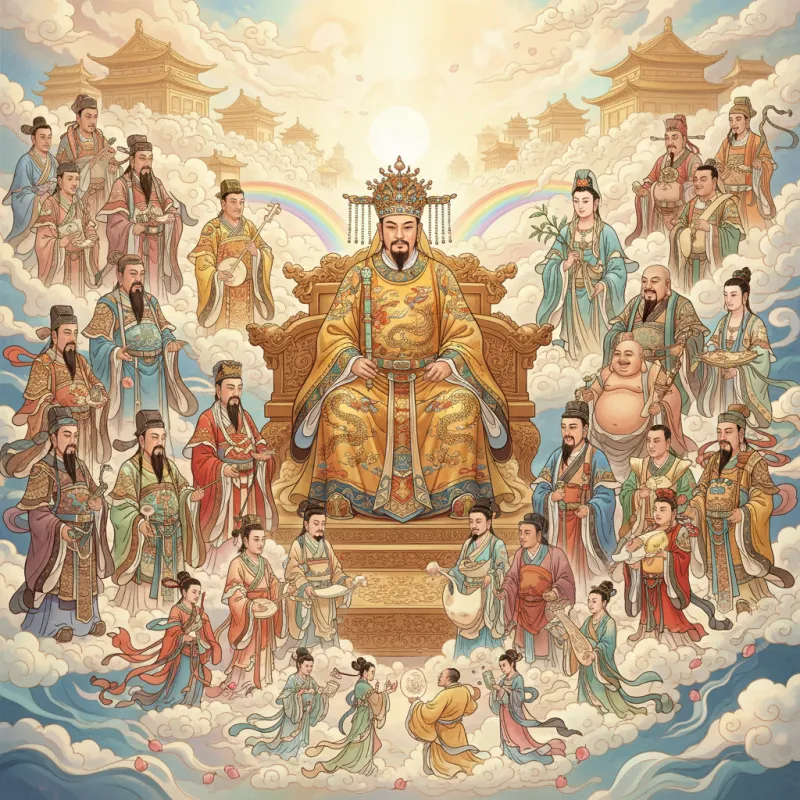
Picture this: the most powerful being in the Chinese cosmos, ruler of heaven and earth, commander of gods and demons alike — and he's buried in paperwork. The Jade Emperor (玉皇大帝, Yù Huáng Dà Dì) sits atop the celestial hierarchy not as a thunderbolt-hurling tyrant, but as the ultimate bureaucrat, stamping documents and delegating tasks to an army of divine officials. It's a distinctly Chinese vision of supreme power: not raw omnipotence, but administrative mastery over an impossibly complex system.
From Prince to Supreme Deity
The Jade Emperor's backstory reads like the ultimate cultivation novel — because that's essentially what it is. According to the Yuhuang benxing jijing (玉皇本行集經, Scripture of the Original Deeds of the Jade Emperor), a Daoist text that emerged during the Song Dynasty (960-1279 CE), he began as the crown prince of the Kingdom of Pure Felicity and Majestic Heavenly Lights. When his father died, the young prince could have taken the throne. Instead, he walked away from earthly power to pursue something greater: immortality and enlightenment.
What followed was a cultivation journey that makes modern xianxia protagonists look like slackers. The prince meditated for 3,200 trials, each trial lasting millions of years. We're talking about a commitment to self-improvement that spans geological epochs. Only after proving himself through this incomprehensible span of spiritual refinement did he ascend to become the supreme ruler of all existence.
But here's where it gets interesting: this origin story is relatively late to the game. The Jade Emperor as we know him today is largely a Song Dynasty invention, a theological retrofit to explain who exactly sat at the top of an increasingly complex celestial bureaucracy. Earlier Daoist texts barely mention him, and when they do, he's just one deity among many. His rise to supreme status mirrors the centralization of imperial power in medieval China — as earthly emperors consolidated authority, so too did the heavenly one.
The Celestial Bureaucracy
If you want to understand the Jade Emperor, forget Zeus or Odin. Think instead of a Chinese emperor during the height of the imperial examination system, surrounded by ministers, secretaries, and officials managing every conceivable aspect of governance. The Jade Emperor doesn't personally smite mortals or seduce maidens — he has departments for that.
The celestial administration mirrors the earthly one with almost comical precision. There's a Ministry of Thunder, a Department of Epidemics, a Bureau of Time, and offices managing everything from rainfall to reincarnation. The Four Heavenly Kings guard the cardinal directions. The Three Pure Ones represent higher philosophical principles but generally leave day-to-day management to the Jade Emperor. Even the fearsome Erlang Shen, the three-eyed warrior god, technically reports to him.
This bureaucratic structure isn't just window dressing — it's fundamental to how Chinese folk religion operates. When you pray to the Jade Emperor, you're essentially filing a petition with the highest court. Your request gets reviewed, stamped, and passed down through the appropriate channels. It's why Chinese temples often feature elaborate rituals that look suspiciously like submitting official documents, complete with formal language and proper protocols.
The Monkey King Problem
The Jade Emperor's most famous appearance in literature is in Journey to the West (西遊記, Xī Yóu Jì), the 16th-century novel by Wu Cheng'en, and it's not exactly flattering. When Sun Wukong, the Monkey King, rebels against heaven, the Jade Emperor's response is... to form a committee. He tries appeasement (giving the monkey a meaningless title), then military force (which fails spectacularly), and finally has to call in the Buddha himself to solve the problem.
Critics have read this as satire of Ming Dynasty imperial incompetence, and they're probably right. The Jade Emperor comes across as a ruler more concerned with maintaining face and protocol than actually wielding power. He's surrounded by yes-men, his generals are ineffective, and he seems perpetually surprised when his carefully laid plans fall apart. It's a far cry from the enlightened sage who supposedly cultivated for millions of years.
Yet this portrayal stuck. In Chinese popular culture, the Jade Emperor is often depicted as somewhat out of touch, a distant authority figure who means well but doesn't quite grasp what's happening on the ground. He's the cosmic equivalent of upper management — necessary, theoretically wise, but also kind of clueless about the day-to-day chaos his subordinates deal with.
Birthday Celebrations and Folk Worship
Despite his bureaucratic image, the Jade Emperor commands genuine devotion. His birthday, celebrated on the ninth day of the first lunar month, is one of the most important festivals in traditional Chinese religion. Families stay up past midnight, set off firecrackers, and offer elaborate sacrifices of fruit, incense, and paper money. In Hokkien communities, particularly in Taiwan and Fujian, the celebration reaches fever pitch with massive temple processions and theatrical performances.
The timing is significant — coming shortly after Chinese New Year, it marks the moment when the Jade Emperor is believed to return to heaven after his annual inspection tour of the mortal realm. During this tour, he's supposedly been taking notes on everyone's behavior, which will factor into their fortunes for the coming year. It's cosmic performance review season.
What's fascinating is how this worship varies by region and community. In some areas, the Jade Emperor is the supreme focus of devotion, the deity you turn to for the biggest requests. In others, he's more of a distant figurehead, and people direct their prayers to more specialized or accessible gods. This flexibility is characteristic of Chinese folk religion — the theological hierarchy exists, but practical worship follows local needs and traditions.
The Daoist Philosophical Dimension
Here's where things get metaphysically interesting. In Daoist philosophy, particularly in the Shangqing (上清, Supreme Clarity) school, the Jade Emperor isn't just a powerful deity — he's a personification of cosmic principles. He represents the organizing force of the universe, the Dao manifesting as structure and order.
This philosophical interpretation sits somewhat awkwardly alongside the folk religion version. On one hand, you have sophisticated Daoist practitioners viewing the Jade Emperor as a meditation focus, a symbol of the mind's ability to organize and transcend chaos. On the other, you have villagers burning paper money and asking him to cure their sick water buffalo. Both are valid expressions of Chinese religious culture, but they're operating on very different wavelengths.
The tension between these interpretations has never been fully resolved, and maybe that's the point. Chinese religion has always been comfortable with multiple, sometimes contradictory truths existing simultaneously. The Jade Emperor can be both the supreme cosmic principle and the harried administrator, both the enlightened sage and the out-of-touch bureaucrat. He contains multitudes.
Modern Relevance and Pop Culture
The Jade Emperor remains a fixture in contemporary Chinese culture, though his image continues to evolve. In Hong Kong cinema, he's often played for laughs — a stuffy authority figure whose rigid rules create problems for more dynamic heroes. Video games and web novels treat him as a high-level boss or quest-giver, the ultimate authority who sends protagonists on world-saving missions.
What's interesting is how his bureaucratic nature has become almost endearing in modern retellings. In an age of corporate hierarchies and government red tape, there's something relatable about a supreme deity who also has to deal with paperwork and office politics. He's become a symbol of how even ultimate power can't escape the mundane realities of administration.
The Jade Emperor's enduring presence in Chinese culture speaks to something deeper than just religious tradition. He represents a distinctly Chinese approach to cosmic order — not through raw power or divine caprice, but through structure, hierarchy, and proper procedure. In a universe governed by the Jade Emperor, even the gods have to file the right forms.
Related Reading
- Exploring the Rich Tapestry of Chinese Deities and Immortals in the Heavenly Court
- Sun Wukong: The Great Sage Who Challenged Heaven — Shenxian Perspective
- The Heavenly Court: How Chinese Mythology Organized the Universe Like a Government Office
- Celestial Warriors: The Mightiest Fighters in Chinese Heaven
- The Heavenly Court: How Chinese Heaven Is Organized
- Unveiling the Rich Tapestry of Chinese Deities and Immortals
- Nezha: From Ancient Deity to Box Office Hit
- Exploring the Rich Pantheon of Chinese Deities and Immortals in Daoism and Buddhism