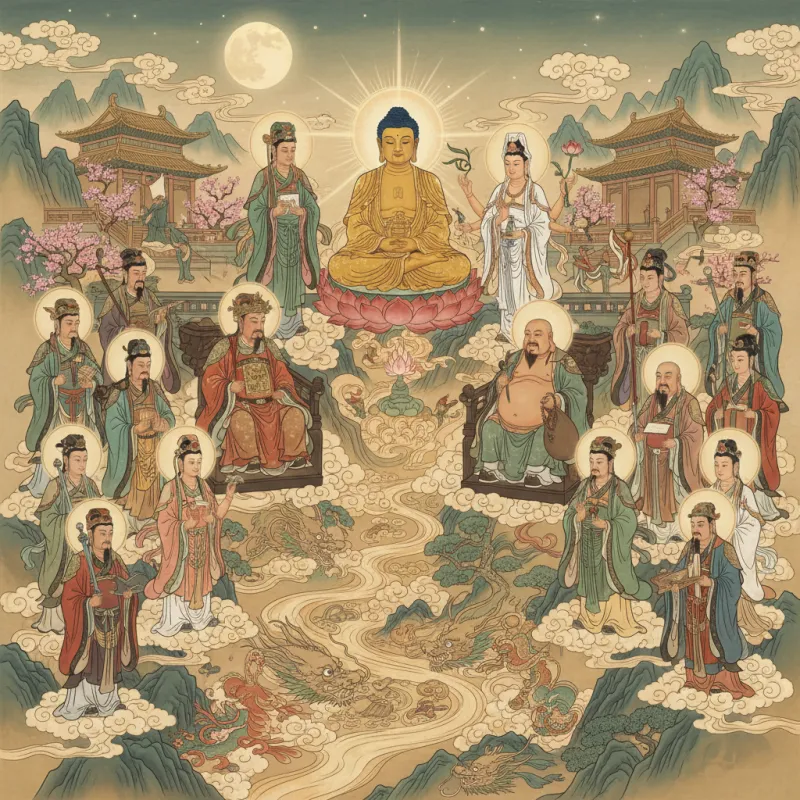
When a religion crosses borders, its gods don't just translate—they transform. The Buddhist deities who journeyed from India to China underwent one of history's most dramatic divine makeovers, emerging with new faces, new genders, and entirely new personalities. What happened wasn't mere translation. It was reinvention.
The Collision of Two Worlds
Buddhism crashed into Chinese civilization around the 1st century CE, carrying an entire pantheon that made no sense to Chinese sensibilities. Indian buddhas sat in meditation poses unfamiliar to Confucian scholars. Bodhisattvas wore jewelry that seemed excessive to Daoist hermits. The very concept of nirvana—extinction of the self—contradicted everything Chinese philosophy held dear about ancestor worship and family continuity.
Yet within a few centuries, these foreign gods had Chinese names, Chinese faces, and Chinese backstories. They lived in Chinese-style palaces, wore Chinese robes, and solved distinctly Chinese problems. The transformation wasn't imposed from above by imperial decree. It bubbled up from below, from ordinary people who needed their gods to speak their language—literally and figuratively.
Guanyin's Gender Revolution
The most spectacular transformation belongs to Avalokiteśvara, the bodhisattva of compassion. In Indian Buddhism, he's unambiguously male—a princely figure adorned with jewels and a mustache. Early Chinese translations kept this masculine identity intact. Tang Dynasty (618-907) paintings show Guanyin (观音, Guānyīn) with a thin mustache and the bearing of a celestial prince.
Then something shifted. By the Song Dynasty (960-1279), Guanyin was appearing in feminine form—soft features, flowing robes, sometimes holding a child. By the Ming Dynasty (1368-1644), the transformation was complete. Guanyin had become the goddess of mercy, the divine mother who answered prayers for children, protected sailors, and comforted the dying.
Why the gender change? Chinese culture already had a template for compassionate female deities. The Queen Mother of the West (西王母, Xī Wángmǔ) had been dispensing mercy and immortality for centuries. A male god of compassion felt foreign; a female one felt natural. The legend of Princess Miaoshan—a Chinese princess who became Guanyin after sacrificing her eyes and arms to save her father—sealed the transformation. This story appears nowhere in Indian Buddhism. It's pure Chinese invention, grafted onto an Indian deity to make her comprehensible.
The Heavenly Kings Get Chinese Armor
The Four Heavenly Kings (四大天王, Sì Dà Tiānwáng) arrived from India as lokapālas—world protectors who guarded the four cardinal directions. In Indian art, they wear dhoti and turbans, carry Indian weapons, and stand on demons with distinctly South Asian features.
Chinese artists looked at these figures and thought: "These guys need an upgrade." By the Tang Dynasty, the Heavenly Kings wore Chinese military armor, carried Chinese weapons, and trampled demons that looked suspiciously like Central Asian invaders. They became generals in a celestial army, organized along Chinese military hierarchy. Their faces grew fiercer, their poses more dynamic, their armor more elaborate.
Visit any Chinese Buddhist temple today and you'll find them flanking the entrance—Virupaksha in the west with a snake or dragon, Dhritarashtra in the east with a pipa (琵琶, pípa, a Chinese lute), Virudhaka in the south with a sword, and Vaisravana in the north with an umbrella and mongoose. These attributes mix Indian symbolism with Chinese military iconography in ways that would baffle an Indian Buddhist monk.
Yama Becomes Yanluo Wang
Yama, the Indian god of death, underwent perhaps the most bureaucratic transformation. In Indian Buddhism, he's a relatively straightforward figure—the lord of the underworld who judges the dead. When he arrived in China, he encountered a civilization obsessed with administrative hierarchy and governmental procedure.
The result? Yanluo Wang (阎罗王, Yánluó Wáng), who presides over a underworld that looks like an imperial bureaucracy. The Chinese hell isn't just a place of punishment—it's a vast governmental apparatus with ten courts, each presided over by a judge-king. Yanluo Wang became the fifth court's magistrate, complete with clerks, runners, and mountains of paperwork. The dead don't just suffer; they get processed through an administrative system that mirrors earthly Chinese government.
This transformation reveals something profound about Chinese culture: even the afterlife must be properly organized. The Indian concept of karmic justice wasn't enough. Chinese Buddhists needed forms, procedures, and a clear chain of command. They needed hell to make administrative sense.
Maitreya's Laughing Buddha Makeover
Maitreya, the future Buddha who will appear to save humanity, started as a princely figure in Indian Buddhism—serious, regal, seated in meditation. In China, he became the Laughing Buddha (弥勒佛, Mílè Fó), a fat, jolly figure with a huge belly and an infectious grin.
This transformation stems from a 10th-century Chinese monk named Budai (布袋, Bùdài), who wandered around with a cloth sack, laughing at everything. After his death, people claimed he was an incarnation of Maitreya. His image—rotund, cheerful, utterly un-princely—became the standard Chinese representation of the future Buddha.
The change reflects Chinese values: spiritual attainment shouldn't make you grim and austere. True enlightenment brings joy, laughter, and the ability to enjoy a good meal. The Laughing Buddha embodies a distinctly Chinese approach to Buddhism—one that values happiness in this life, not just liberation in the next.
Wei Tuo: The Invented Protector
Some Chinese Buddhist deities have no Indian equivalent at all. Wei Tuo (韦驮, Wéituó) supposedly derives from Skanda, a minor Indian war god. But the Chinese Wei Tuo bears almost no resemblance to his alleged Indian ancestor. He's a young, handsome general who protects Buddhist monasteries and the dharma itself.
His iconography is purely Chinese: he wears Song Dynasty armor, carries a vajra staff, and stands in a martial pose borrowed from Chinese military traditions. His legends involve protecting Chinese monks, defending Chinese temples, and battling demons that threaten Chinese Buddhism specifically. He's less a translation than a creation—a Chinese deity wearing Buddhist clothing.
This pattern repeats throughout the Chinese Buddhist pantheon. Deities get invented, back-filled with Indian origins, and seamlessly integrated into the tradition. The line between "authentic" Indian Buddhism and "sinicized" Chinese Buddhism becomes impossible to draw.
The Deeper Pattern
These transformations weren't random. They followed consistent patterns that reveal how Chinese culture processes foreign ideas. Male deities associated with compassion became female. Warrior deities got Chinese military ranks and armor. Bureaucratic deities got more bureaucracy. Austere deities learned to smile.
Chinese Buddhism didn't just translate Indian Buddhism—it digested it, broke it down, and rebuilt it using Chinese cultural DNA. The process mirrors how Chinese culture has historically handled foreign influences: absorb, adapt, claim as your own. The Mongols conquered China and became Chinese. Buddhism arrived from India and became Chinese. The pattern holds across centuries.
Today's Chinese Buddhist temples house deities who would confuse their Indian creators. Guanyin looks nothing like Avalokiteśvara. Yanluo Wang runs an underworld Yama wouldn't recognize. The Laughing Buddha bears no resemblance to the princely Maitreya. Yet these transformations aren't corruptions—they're adaptations that allowed Buddhism to survive and thrive in Chinese soil.
Living Transformations
The transformation continues today. Modern Chinese Buddhists add new legends to old deities, create new iconography, and find new ways to make ancient Indian gods relevant to contemporary Chinese life. Guanyin appears in movies, video games, and popular novels, each iteration adding new layers to her mythology. The Buddhist pantheon keeps evolving, proving that religious transformation isn't a historical artifact—it's an ongoing process.
Walk into any Chinese Buddhist temple and you're witnessing cultural translation in physical form. Those statues with Chinese faces and Indian names represent one of humanity's most successful experiments in religious adaptation. They prove that gods, like people, can cross borders and become something new—something that honors their origins while embracing their adopted home.
The Buddhist deities didn't just become Chinese. They became proof that culture is fluid, identity is negotiable, and even the divine can learn to speak a new language.
Related Reading
- The Four Heavenly Kings: Guardians at Every Temple Gate
- Dizang Bodhisattva: The Buddha Who Chose Hell
- Guanyin: The Goddess of Mercy Who Hears Every Cry
- Buddha in China: How Buddhism Was Transformed by Chinese Culture
- Ancient Chinese Underworld Deities: Guardians of Death and Afterlife Realms
- How to Pray at a Chinese Temple: A Respectful Visitor's Guide
- The Heavenly Court: China's Divine Bureaucracy