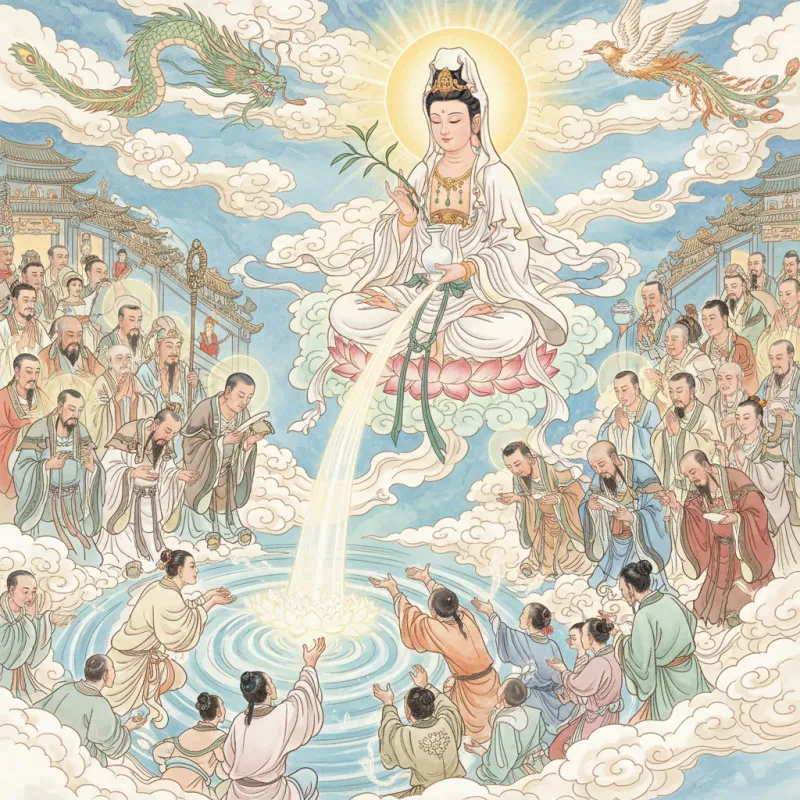
A woman kneels before a white-robed figure on a rocky island, waves crashing below. She whispers a desperate prayer—and the statue's eyes open. This isn't fantasy. For over a thousand years, millions across East Asia have believed that Guanyin (观音, Guān Yīn) truly hears every cry for help. But here's what makes her story extraordinary: this "Goddess of Mercy" started as a male Indian prince, transformed through one of history's most dramatic religious metamorphoses, and became the most beloved deity in Chinese Buddhism.
From Indian Prince to Chinese Goddess
Guanshiyin (观世音, Guānshìyīn—"One Who Perceives the Sounds of the World") began as Avalokiteshvara, a male bodhisattva in Indian Buddhism. When Buddhism entered China during the Han Dynasty (206 BCE–220 CE), early translators faced an immediate problem: how do you explain a being who postpones enlightenment out of compassion? The concept was foreign to Chinese thought, which emphasized filial duty and ancestor worship over universal compassion.
The early Chinese solution was straightforward—they kept Avalokiteshvara male. Tang Dynasty (618-907) paintings show Guanyin with a mustache. Statues from this period depict a princely figure in Indian dress. But something remarkable happened between the Tang and Song dynasties: Guanyin underwent a complete gender transformation.
By the Song Dynasty (960-1279), Guanyin was predominantly female. By the Ming Dynasty (1368-1644), the transformation was absolute. Today, suggesting Guanyin was ever male would shock most Chinese worshippers. This wasn't a gradual shift—it was a cultural revolution that rewrote religious iconography.
Why China Needed a Goddess
The gender transformation wasn't random. Chinese culture had a goddess-shaped hole in its pantheon. Confucianism and Daoism offered powerful male deities and immortals, but lacked a maternal figure of universal compassion. The Buddhist concept of Avalokiteshvara arrived at precisely the right moment—but needed localization.
Several factors drove the change. First, the Chinese association between compassion and motherhood was too strong to ignore. The character for "compassion" (慈, cí) itself evokes maternal love. Second, the legend of Princess Miaoshan (妙善, Miàoshàn) provided a perfect origin story. According to this tale, which emerged during the Song Dynasty, Miaoshan was a princess who defied her father to pursue Buddhist practice, eventually sacrificing her own eyes and arms to save him. This story of filial piety wrapped in Buddhist compassion was irresistible to Chinese audiences.
Third, women needed a deity who understood their suffering. In imperial China, women faced arranged marriages, high maternal mortality, and legal subordination. A male deity of compassion felt abstract. A goddess who had been a woman, who understood a daughter's duty and a mother's pain—that was revolutionary.
The Thousand Arms of Compassion
Walk into any Chinese Buddhist temple, and you'll likely encounter Guanyin's most dramatic form: Thousand-Armed Guanyin (千手观音, Qiānshǒu Guānyīn). Each hand holds a different implement—swords, lotus flowers, prayer beads, vases—and each palm contains an eye. The symbolism is profound: Guanyin sees all suffering and has the means to address every type of need.
This form connects directly to the Princess Miaoshan legend. After she sacrificed her arms and eyes to cure her father, she was transformed into a bodhisattva with a thousand arms and a thousand eyes—supernatural compensation for her earthly sacrifice. The image captures something essential about Guanyin's appeal: she's not distant or abstract. She's actively, almost frantically, reaching out to help.
Other popular forms include White-Robed Guanyin (白衣观音, Báiyī Guānyīn), often depicted seated on a rock by the sea, and Child-Giving Guanyin (送子观音, Sòngzǐ Guānyīn), who holds an infant. This last form reveals Guanyin's practical role in Chinese religious life. Women desperate for children would pray to Guanyin, making her as much a fertility goddess as a bodhisattva. Buddhism adapted to Chinese needs, and Guanyin was the vehicle.
The Island Where Prayers Are Answered
Mount Putuo (普陀山, Pǔtuó Shān), an island off the coast of Zhejiang Province, is Guanyin's earthly residence. According to legend, a Japanese monk tried to take a Guanyin statue back to Japan in 863 CE, but his ship became stuck near the island. Taking this as a sign, he built a shrine there. Today, Mount Putuo is one of China's four sacred Buddhist mountains and receives millions of pilgrims annually.
The island's geography reinforces Guanyin's mythology. Surrounded by the East China Sea, with waves constantly crashing against rocky shores, it's easy to imagine Guanyin hearing the cries of drowning sailors. The Purple Bamboo Forest (紫竹林, Zǐzhúlín) temple complex features a statue of Guanyin standing on a rock in the sea—the iconic image reproduced in temples worldwide.
What's remarkable is how Mount Putuo blends Buddhism with Chinese folk religion. Pilgrims burn incense, make offerings, and pray for everything from business success to romantic relationships. Guanyin has become a universal problem-solver, far beyond her original Buddhist role. This syncretism would horrify purists, but it's precisely why Guanyin remains relevant in modern China.
Guanyin in Daily Life
Unlike more esoteric Buddhist figures like Manjushri, Guanyin is intensely practical. Chinese people invoke her name in moments of danger—"Nánwú Guānyīn Púsà" (南无观音菩萨, "Homage to Guanyin Bodhisattva") is a reflexive prayer during earthquakes, accidents, or illness. Taxi drivers hang Guanyin amulets from rearview mirrors. Restaurants display Guanyin statues for prosperity. She's everywhere.
This ubiquity has a theological implication: Guanyin has effectively become a goddess in Chinese popular religion, despite Buddhism's non-theistic philosophy. She grants wishes, intervenes in worldly affairs, and receives offerings—all behaviors more associated with gods than bodhisattvas. The Lotus Sutra describes Avalokiteshvara manifesting in thirty-three different forms to save beings, but Chinese practice has taken this flexibility to extremes.
The most common prayer to Guanyin is simple: "Guanyin, save me" (观音救我, Guānyīn jiù wǒ). No elaborate rituals, no priestly intermediaries—just direct appeal to a compassionate listener. This accessibility explains her enduring popularity. While Amitabha Buddha offers salvation in the next life, Guanyin offers help right now.
The Bodhisattva Who Became More Than Buddhism
Guanyin's transformation reveals something profound about how religions adapt across cultures. She's simultaneously a Buddhist bodhisattva, a Daoist immortal (appearing in Daoist texts as Cihang Zhenren, 慈航真人), and a folk goddess. This religious fluidity would be heretical in more rigid traditions, but in China, it's normal.
The Journey to the West (西游记, Xīyóu Jì), China's most famous novel, features Guanyin as a key character who guides the monk Xuanzang and occasionally rescues Sun Wukong from trouble. She's portrayed as wise, powerful, and slightly mischievous—more like a celestial administrator than a figure of pure compassion. This literary Guanyin has shaped popular understanding as much as any sutra.
Modern China presents interesting contradictions. Despite decades of official atheism, Guanyin worship has resurged. Temples are packed during festivals. New Guanyin statues—some over 100 meters tall—have been erected across China. Young people who claim no religious affiliation still pray to Guanyin during exams or job interviews. She's become cultural heritage as much as religious figure.
Why Guanyin Still Matters
In an age of rationalism and technology, why does Guanyin endure? Perhaps because the human need for compassion never becomes obsolete. Guanyin represents the hope that someone is listening, that suffering isn't meaningless, that mercy exists in the universe. These aren't primitive superstitions—they're fundamental human longings.
Guanyin's gender transformation also carries contemporary relevance. She demonstrates that religious traditions can evolve, that cultural adaptation isn't corruption but survival. The Indian Avalokiteshvara would have remained foreign and abstract to Chinese worshippers. Guanyin, shaped by Chinese needs and imagination, became beloved.
Whether you view her as a bodhisattva, goddess, or cultural symbol, Guanyin's message remains consistent: compassion is the highest virtue, and no cry for help goes unheard. In a world that often feels indifferent to suffering, that's a message worth preserving—even if the messenger has changed forms across centuries and cultures.
Related Reading
- Buddha in China: How Buddhism Was Transformed by Chinese Culture
- The Four Heavenly Kings: Guardians at Every Temple Gate
- Dizang Bodhisattva: The Buddha Who Chose Hell
- Buddhist Deities in Chinese Culture: How India's Gods Became Chinese
- The Chinese Religious Calendar: When to Worship What
- Pangu Opens Heaven and Earth: The Chinese Creation Story
- Unveiling the Mystique of Chinese Animal Spirits in Daoist and Buddhist Beliefs