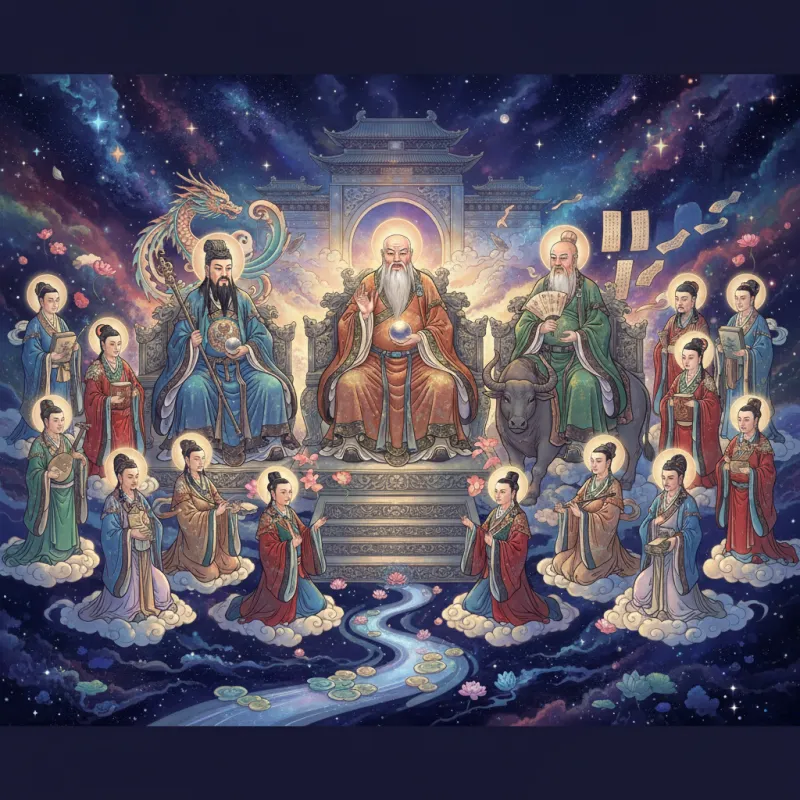
Picture this: three celestial beings seated in perfect stillness atop mountains that exist beyond space and time, each radiating light that predates the universe itself. They don't move, don't speak, yet their mere presence sustains every star, every breath, every thought that has ever existed. These are the Sanqing (三清), the Three Pure Ones—and if you think Taoism is just about going with the flow and reading cryptic poetry, meeting these cosmic heavyweights will completely reshape your understanding.
Who Are the Three Pure Ones?
The Sanqing represent the highest tier of the Taoist pantheon, far above the colorful cast of immortals, kitchen gods, and demon-quellers that populate Chinese temples. Each of the Three Pure Ones embodies a different aspect of the Tao's manifestation, arranged in a cosmic hierarchy that mirrors the unfolding of existence itself.
Yuanshi Tianzun (元始天尊), the Celestial Venerable of the Primordial Beginning, sits at the apex. He represents the Tao in its most primordial, undifferentiated state—pure potential before anything existed. Think of him as the cosmic "before" button, the silence before the first note of creation. In temple iconography, he's typically shown holding a pearl or sphere, symbolizing the universe in its embryonic form.
Lingbao Tianzun (靈寶天尊), the Celestial Venerable of Numinous Treasure, occupies the middle position. He represents the Tao as it begins to differentiate and take form, the bridge between pure potential and manifest reality. He's often depicted holding a ruyi scepter or the sacred texts themselves—the Lingbao scriptures that bear his name and emerged during the 4th-5th centuries CE as some of Taoism's most influential liturgical texts.
Daode Tianzun (道德天尊), the Celestial Venerable of the Way and its Virtue, completes the trinity. Here's where things get interesting: this deity is none other than Laozi himself, deified and elevated to cosmic status. He represents the Tao as it manifests in the world, teaching and guiding humanity. He's usually shown holding a fan or, appropriately enough, a copy of the Daodejing.
The Historical Evolution of the Trinity
The Three Pure Ones didn't spring fully formed from ancient mists—they're actually a relatively late development in Taoist theology, crystallizing during the Tang Dynasty (618-907 CE) when Taoism was competing with Buddhism for imperial patronage and popular devotion. The concept likely emerged as Taoism's answer to Buddhism's Trikaya (three bodies of Buddha) doctrine, though Taoist scholars would bristle at this suggestion.
Earlier Taoist texts from the Han Dynasty (206 BCE - 220 CE) mention Laozi as a cosmic figure, but the full Sanqing formulation appears in texts like the Daomen Jingfa Xiangcheng Cixu from around the 6th century. By the Song Dynasty (960-1279 CE), the Three Pure Ones had become firmly established in Taoist cosmology and temple architecture, with their images occupying the central hall of major Taoist temples—a position they maintain to this day.
What's fascinating is how this theological development reflects Taoism's transformation from a philosophical tradition into an organized religion. The early Daoist philosophers like Zhuangzi would have found the idea of worshipping personified deities somewhat absurd, yet by the medieval period, Taoism had developed an elaborate celestial bureaucracy that would make any imperial court jealous. The Three Pure Ones sit at the top of this hierarchy, beyond even the Jade Emperor, who functions more as a cosmic administrator than an ultimate source.
The Three Pure Realms
Each of the Sanqing presides over their own celestial realm, arranged vertically in the Taoist cosmos. These aren't just heavenly neighborhoods—they represent different levels of spiritual refinement and proximity to the Tao itself.
Yuqing (玉清), the Jade Pure Realm, is the highest heaven where Yuanshi Tianzun resides. This is the realm of absolute purity, where the Tao exists in its most rarefied form. Time doesn't exist here in any meaningful sense—it's the eternal now before creation began. Taoist texts describe it as being beyond description, which is convenient when you're trying to explain the unexplainable.
Shangqing (上清), the Upper Pure Realm, is home to Lingbao Tianzun. This realm represents the first stirrings of differentiation, where cosmic principles begin to take shape. The Shangqing school of Taoism, which flourished during the 4th-6th centuries, claimed special access to the revelations and practices associated with this realm, including elaborate visualization techniques and celestial bureaucracy navigation.
Taiqing (太清), the Great Pure Realm, is where Daode Tianzun dwells. This is the closest of the three realms to our mundane world, the realm where the Tao's teachings become accessible to humanity. It's no coincidence that this is Laozi's domain—he's the one who supposedly wrote the Daodejing to explain the Tao to a border guard, making the ineffable somewhat effable.
Worship and Ritual Practice
Walk into any major Taoist temple in China, Taiwan, or overseas Chinese communities, and you'll likely find the Three Pure Ones occupying the main altar in the central hall. They're arranged in a specific order: Yuanshi Tianzun in the center (or sometimes on the left from the viewer's perspective), with Lingbao Tianzun and Daode Tianzun flanking him. The exact arrangement can vary by temple and regional tradition, which has sparked more than a few scholarly debates.
Unlike the more approachable deities in the Taoist pantheon—gods you might petition for wealth, health, or a good marriage—the Three Pure Ones are rarely the focus of personal supplication. They're too cosmic, too abstract for "please help me pass my exam" prayers. Instead, they receive offerings of incense and reverence as acknowledgments of the ultimate source of all things. It's like the difference between asking your local mayor for help with a pothole versus acknowledging the existence of natural law.
During major Taoist ceremonies, particularly the elaborate jiao rituals that can last for days, priests invoke the Three Pure Ones as witnesses and sources of cosmic authority. These rituals often involve complex choreography, chanting, and visualization practices designed to align the earthly realm with the celestial order. The priests essentially act as intermediaries, channeling the power and blessing of the Sanqing down through the celestial hierarchy to benefit the community.
Philosophical Significance
Here's where the Three Pure Ones reveal their deeper significance: they represent a sophisticated theological solution to a fundamental problem in Taoist thought. How do you reconcile the Tao as described in the Daodejing—nameless, formless, beyond all description—with the human need for something concrete to relate to?
The Sanqing provide a graduated pathway. Yuanshi Tianzun is the Tao at its most abstract, barely distinguishable from the philosophical Tao of Laozi's text. Lingbao Tianzun represents the Tao as it begins to manifest cosmic principles and sacred teachings. Daode Tianzun brings it all the way down to earth, literally embodying the sage who taught humanity about the Way.
This isn't just theological cleverness—it reflects a profound understanding of how humans engage with the transcendent. We need stepping stones, intermediate forms that bridge the gap between our limited understanding and ultimate reality. The Three Pure Ones function like a spiritual ladder, each rung bringing the ineffable Tao closer to human comprehension without completely domesticating it.
Compare this to how the Eight Immortals function in popular Taoism—they're relatable, flawed, human (or formerly human) figures who achieved transcendence. The Three Pure Ones operate at the opposite end of the spectrum, so transcendent they're barely personified at all. Together, they span the full range of Taoist religious experience, from the most abstract cosmic principle to the most concrete exemplar of spiritual achievement.
The Three Pure Ones in Art and Iconography
Taoist art depicting the Sanqing follows strict conventions that have remained remarkably consistent since the Tang Dynasty. All three are shown as elderly men with long beards, seated in meditation posture, wearing elaborate robes and crowns that mark their celestial status. The similarity in their appearance is intentional—they're meant to be seen as different aspects of the same ultimate reality, not as distinct personalities.
The objects they hold, however, distinguish them. Yuanshi Tianzun's pearl or sphere represents the undifferentiated cosmos. Lingbao Tianzun's ruyi scepter symbolizes the power to manifest wishes and cosmic principles. Daode Tianzun's fan represents the gentle, natural way of teaching—or sometimes he holds a yin-yang symbol, making his connection to the Daodejing explicit.
Temple murals often show the Three Pure Ones surrounded by attendants, celestial officials, and other deities, emphasizing their position at the apex of a vast cosmic hierarchy. Some temples include elaborate ceiling paintings showing the three Pure Realms stacked vertically, with the Sanqing presiding over their respective domains while lesser deities and immortals populate the space between heaven and earth.
Modern Relevance and Practice
In contemporary Taoist practice, the Three Pure Ones remain central to temple liturgy and monastic training, even as popular Taoism focuses more on accessible deities like Guanyin (borrowed from Buddhism) or Mazu, the sea goddess. Taoist priests still undergo initiation ceremonies that involve visualization of the Sanqing and receiving their cosmic mandate to perform rituals.
What's particularly interesting is how the Three Pure Ones have been reinterpreted by modern practitioners. Some see them as psychological archetypes representing different aspects of consciousness—the unconscious (Yuanshi), the subconscious (Lingbao), and the conscious mind (Daode). Others view them through a more philosophical lens, as conceptual tools for understanding the relationship between the absolute and the relative, the transcendent and the immanent.
The Sanqing also appear in contemporary Chinese popular culture, though usually in simplified or distorted forms. Fantasy novels, video games, and films set in mythological China often reference them, though rarely with the theological sophistication of traditional Taoist texts. They've become part of the broader cultural vocabulary, recognized even by Chinese people who don't actively practice Taoism.
The Paradox at the Heart of the Trinity
Here's the beautiful contradiction that makes the Three Pure Ones so philosophically rich: they're both three and one, distinct and unified, personal and impersonal. They represent the Tao's attempt to know itself, to manifest in forms that can be contemplated and revered, while never fully abandoning the formless mystery at the heart of existence.
This paradox mirrors the central tension in all Taoist thought—the Tao that can be named is not the eternal Tao, yet we must name it to speak of it at all. The Three Pure Ones embody this tension, giving form to the formless while constantly pointing beyond themselves to the ultimate reality they represent. They're not meant to be the final answer but rather elegant fingers pointing at the moon, reminding us that the map is never the territory, and the deity is never the Tao itself.
In the end, whether you approach the Sanqing as literal cosmic beings, as philosophical concepts, or as psychological archetypes, they offer a profound meditation on the nature of ultimate reality and how humans can relate to it. They stand as monuments to Taoism's theological sophistication, proof that this tradition developed far beyond its philosophical origins into a complete religious system capable of addressing humanity's deepest spiritual questions.
Related Reading
- The Daoist Pantheon: A Bureaucracy of Gods
- The Three Pure Ones: Supreme Deities of Daoism — Shenxian Perspective
- The Mountain Gods: Nature Deities in the Daoist Pantheon — Shenxian Perspective
- Queen Mother of the West: Goddess of Immortality
- The Complete Guide to Chinese Gods and Immortals
- Fuxi: The God-Emperor Who Gave Humanity Civilization
- Unveiling the Mystique of Chinese Animal Spirits in Daoist and Buddhist Beliefs
- Nezha: From Rebellious Child God to China's Biggest Animated Film