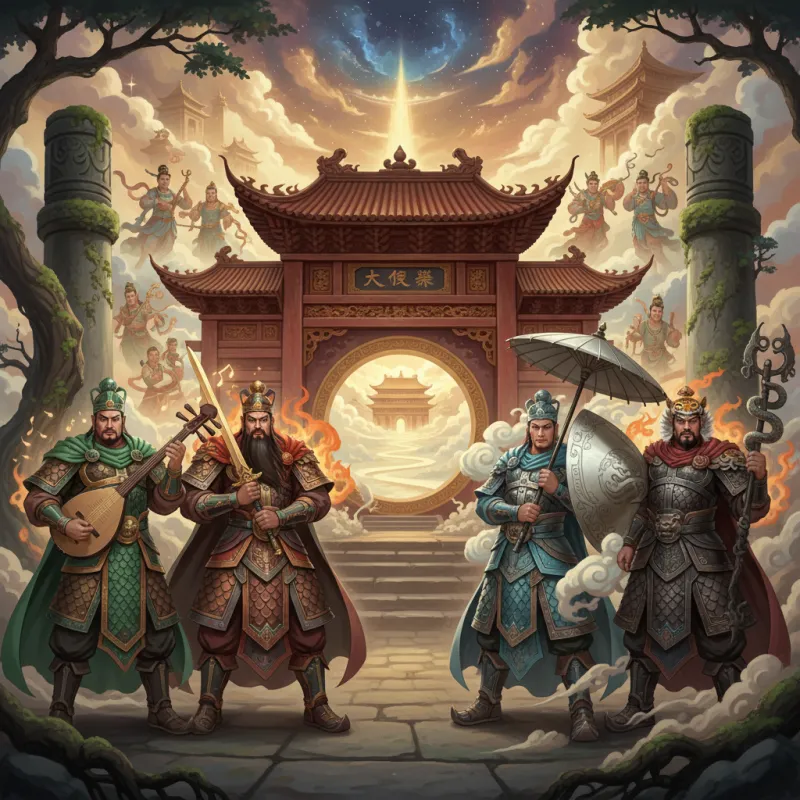
Stand at the entrance of any Chinese Buddhist temple and you'll face four towering figures, each ten feet tall, their faces twisted in expressions somewhere between fury and divine authority. These aren't mere decorations gathering incense smoke. They're the Four Heavenly Kings (四大天王, Sì Dà Tiān Wáng), cosmic bouncers who've been checking credentials at temple gates for over a thousand years. Miss them, and you've missed the entire point of the threshold you're crossing.
The Original Security Detail
The Four Heavenly Kings didn't start their careers in China. They arrived via the Silk Road, imported from Indian Buddhism where they were known as the Lokapalas — "World Protectors." But something happened when they crossed the Himalayas. Chinese artisans and monks transformed these relatively minor deities into something grander, more theatrical, more unmistakably Chinese. By the Tang Dynasty (618-907 CE), they'd become fixtures in every major temple, their iconography standardized, their roles expanded beyond simple guardianship into symbols of cosmic order itself.
What makes them fascinating isn't just their size or their scowls. It's their job description. These four kings rule the lowest of the heavenly realms, stationed on the slopes of Mount Sumeru, the cosmic mountain at the center of Buddhist cosmology. They're middle management in the celestial bureaucracy, reporting to the Jade Emperor above while commanding armies of supernatural beings below. Think of them as the bridge between the human world and the divine — close enough to care about earthly affairs, powerful enough to do something about them.
Meet the Four
Dhritarashtra (持国天王, Chíguó Tiānwáng), the Guardian of the East, holds a pipa — a Chinese lute. This isn't a weapon in the traditional sense. The pipa represents harmony, and Dhritarashtra's role is to maintain balance in the eastern quarter of the world. His name means "He Who Maintains the Nation," and in Chinese temples, he's often depicted with a white face, strumming his instrument as if the universe itself needs tuning. The symbolism runs deeper: just as a pipa requires precise tension in its strings, so too does a kingdom require balance between firmness and flexibility.
Virudhaka (增长天王, Zēngzhǎng Tiānwáng) guards the South with a sword that can slice through ignorance itself. His name translates to "He Who Causes Growth," and he's associated with wind — that invisible force that can nurture crops or level cities. Chinese artists typically give him a blue or green face, and his sword isn't just for show. In Buddhist cosmology, he commands an army of kumbhandas, dwarfish spirits who can cause nightmares. The sword keeps them in line, but it also represents the sharp edge of wisdom that cuts through delusion.
The Western guardian, Virupaksha (广目天王, Guǎngmù Tiānwáng), has the most unusual attributes. His name means "He Who Sees All," and he's often shown holding a snake in one hand and a pearl or stupa in the other. The snake isn't a threat — it's a naga, a serpent deity that controls rain and water. The pearl represents the eye of wisdom, the ability to see through illusions. In some temples, he's depicted with a red face, his eyes wide open, scanning the western horizon for threats. He commands an army of nagas, making him the go-to deity for farmers praying for rain.
Vaishravana (多闻天王, Duōwén Tiānwáng), the Northern guardian, is the heavyweight champion of the four. His name means "He Who Hears Everything," and unlike his brothers, he's developed an independent cult following. In Chinese tradition, he's also known as Bishamon or Vaisravana, and he's associated with wealth and prosperity. He typically holds a pagoda in one hand — sometimes containing a relic of the Buddha — and a mongoose or staff in the other. The mongoose is said to spit jewels, linking him to material abundance. His face is usually painted yellow or gold, and he's the only one of the four who sometimes appears alone in temples, particularly those focused on wealth and protection. Some scholars argue he's actually a separate deity who got absorbed into the Four Kings system, which would explain his outsized importance.
The Symbolism Game
Here's where it gets interesting. Each king doesn't just guard a direction — they embody a concept that Chinese Buddhism considers essential for spiritual progress. The pipa represents harmony and the need for balance in practice. The sword symbolizes the cutting away of attachments and ignorance. The snake and pearl represent the dual nature of wisdom — dangerous if mishandled, precious if understood. The pagoda and mongoose combine spiritual authority with material well-being, acknowledging that monks still need to eat.
This isn't accidental. Chinese Buddhism has always been more practical than its Indian parent, more willing to acknowledge that enlightenment doesn't happen on an empty stomach or in a chaotic society. The Four Heavenly Kings embody this pragmatism. They're not asking you to transcend the world — they're protecting the world so you have the space to practice in it.
Temple Architecture and Placement
Walk into a traditional Chinese Buddhist temple, and you'll find the Four Heavenly Kings in the first hall, called the Hall of Heavenly Kings (天王殿, Tiānwáng Diàn). They're positioned in pairs, two on each side, facing inward toward the path that leads deeper into the temple complex. This placement is deliberate. They're the first test, the initial checkpoint. If you can walk past these fierce guardians without flinching, you're ready for what lies ahead — the more serene figures of Guanyin or the Buddha himself in the main hall.
Behind the Four Kings, facing backward toward the entrance, you'll often find Weituo (韦驮, Wéituó), another guardian deity who serves as the general of the Four Kings' armies. He's usually depicted as a young warrior in armor, holding a vajra staff. His position is strategic — while the Four Kings face outward to repel external threats, Weituo faces inward to protect against internal corruption. It's a complete security system, cosmic and psychological.
Cultural Evolution and Modern Presence
The Four Heavenly Kings have transcended their religious origins to become cultural icons. In Hong Kong cinema, four major actors in the 1990s were nicknamed the "Four Heavenly Kings" — a title that implied they dominated their field completely, just as the original kings dominated their cardinal directions. The metaphor stuck because everyone understood the reference. These weren't just popular actors; they were guardians of Hong Kong's cultural identity during a turbulent period.
In video games and anime, the Four Heavenly Kings appear constantly as boss characters or elite guards, their iconography instantly recognizable even when stripped of religious context. This secular adoption speaks to their visual power and the clarity of their concept — four powerful beings, each with distinct attributes, working together to protect something valuable.
The Deeper Teaching
But here's what most visitors miss: the Four Heavenly Kings aren't just protecting the temple from demons and evil spirits. They're protecting you from yourself. Each king represents a quality you need to cultivate before you can progress on the Buddhist path. Harmony, growth, clear seeing, and attentive listening — these aren't just nice ideas. They're prerequisites.
The pipa reminds you to tune your practice, to find the
Related Reading
- Buddha in China: How Buddhism Was Transformed by Chinese Culture
- Guanyin: The Goddess of Mercy Who Hears Every Cry
- Buddhist Deities in Chinese Culture: How India's Gods Became Chinese
- Dizang Bodhisattva: The Buddha Who Chose Hell
- Exploring the Rich Pantheon of Chinese Deities and Immortals in Daoism and Buddhism
- Lü Dongbin: The Most Beloved Immortal in Chinese Culture
- The Peaches of Immortality: Xi Wangmu Garden