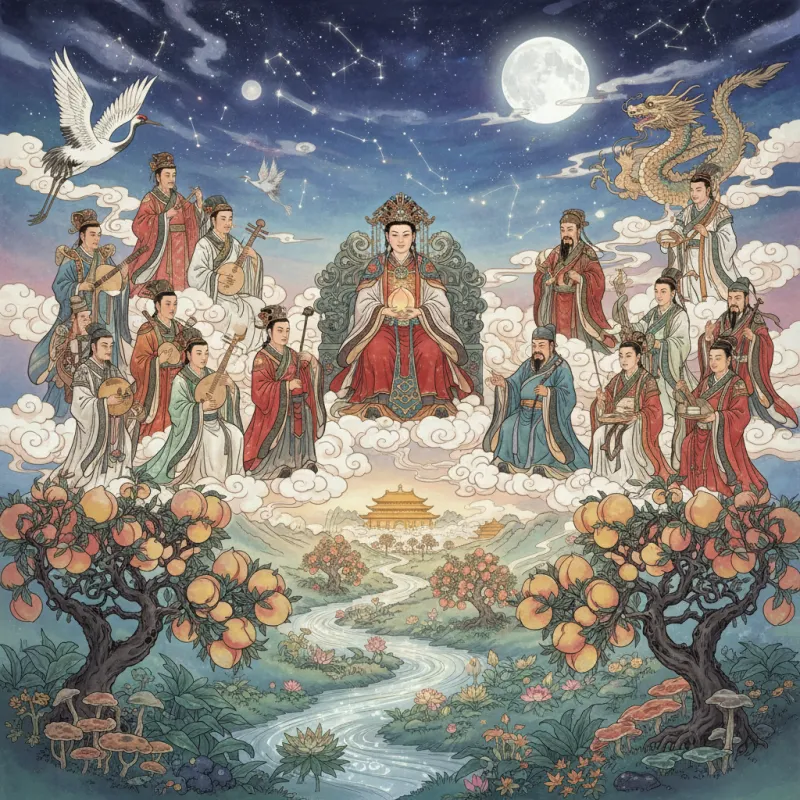
The monkey knew he wasn't invited. Sun Wukong had crashed plenty of parties before, but this one — the Peach Banquet (蟠桃會, Pán Táo Huì) — was different. This wasn't just any celestial gathering. This was the gathering, the one event where immortals from every corner of heaven assembled to eat the fruit that made them immortal in the first place. And when the Great Sage Equal to Heaven discovered he'd been deliberately excluded from the guest list, he did what any self-respecting trickster would do: he ate all the peaches himself, drank the wine meant for the gods, and kicked off a war that would shake the cosmos.
That story from Journey to the West (西遊記, Xī Yóu Jì) might be fiction, but the peaches at its center are deadly serious. The Peaches of Immortality (蟠桃, pán táo) represent the ultimate prize in Chinese mythology — the literal fruit of eternal life, growing in a garden that exists beyond the reach of ordinary mortals, tended by a goddess who decides who gets to live forever and who doesn't.
The Garden at the Edge of the World
Xi Wangmu's (西王母, Xī Wángmǔ) garden doesn't exist in any place you can reach by walking. Mount Kunlun (崑崙山, Kūnlún Shān), where the garden supposedly grows, is described in texts like the Classic of Mountains and Seas (山海經, Shān Hǎi Jīng) as a cosmic axis — the pillar connecting earth to heaven. To reach it, you'd have to cross the Weak Water (弱水, ruò shuǐ), a river so insubstantial that even a feather would sink. You'd have to pass through walls of flame. You'd have to navigate a landscape where the normal rules of physics simply don't apply.
The garden itself is described with obsessive detail in various texts. Some sources say it covers hundreds of acres. Others claim it's infinite. But everyone agrees on the trees: there are 3,600 of them, divided into three distinct varieties. The trees in the front of the garden bloom once every three thousand years and grant three hundred years of life. The middle trees bloom once every six thousand years and grant perpetual youth. The trees in the back — the really good ones — bloom once every nine thousand years, and eating their fruit makes you "as eternal as Heaven and Earth, as enduring as the Sun and Moon."
Think about that timeline. Nine thousand years between harvests. The entire span of recorded human history would barely cover two harvest cycles. Xi Wangmu has been tending this garden since before the first Chinese dynasty, before the first emperor, before anyone thought to write anything down.
The Goddess Who Guards the Gate
Xi Wangmu herself is older than most of the gods in the Chinese pantheon. Early texts describe her as a wild, fearsome figure — part human, part leopard, with tiger's teeth and a howling voice. By the Han Dynasty (206 BCE - 220 CE), she'd been thoroughly domesticated into the elegant, regal Queen Mother of the West we know from later mythology. But that transformation tells you something important: she's powerful enough that even the official state religion had to accommodate her, had to smooth her rough edges and fit her into their cosmic bureaucracy.
She doesn't just grow the peaches. She controls access to them. Every immortal in heaven owes their immortality to her generosity — or her political calculations. The Peach Banquet, held once every six thousand years when the middle trees bear fruit, is essentially a renewal ceremony. Miss the banquet, and your immortality might start to wear off. Offend Xi Wangmu, and you might not get invited next time.
This makes her arguably more powerful than the Jade Emperor (玉皇大帝, Yù Huáng Dàdì) himself. He might run the celestial bureaucracy, but she controls the one resource that bureaucracy can't function without. It's like owning the only water source in a desert kingdom. You might not sit on the throne, but everyone knows who really holds power.
The Monkey Who Ruined Everything
Sun Wukong's raid on the Peach Garden is the most famous peach-related incident in Chinese literature, and it's worth examining in detail because it reveals how the peach mythology actually works in narrative practice.
In Journey to the West, the Jade Emperor makes a catastrophic political miscalculation. To keep the troublesome monkey under control, he gives Sun Wukong a job: Guardian of the Peach Garden. It's meant to be a meaningless title, a way to flatter the monkey while keeping him busy. But it backfires spectacularly, because now Sun Wukong has unlimited access to the one thing that can make him truly unstoppable.
He eats the peaches systematically, starting with the front trees and working his way back. By the time he reaches the nine-thousand-year peaches, he's already consumed enough immortality to make him effectively unkillable. Then he crashes the Peach Banquet, eats the food meant for the gods, drinks the wine, and — in a final act of cosmic vandalism — breaks into Laozi's (老子, Lǎozǐ) laboratory and eats all the Pills of Immortality stored there.
The resulting war requires the combined forces of heaven, the intervention of the Buddha himself, and five hundred years of imprisonment under a mountain to resolve. All because someone gave the monkey access to the peaches.
The Real-World Peach Obsession
Here's what's fascinating: the mythological obsession with peaches mirrors a very real historical obsession. Chinese emperors actually sent expeditions to find these peaches. The First Emperor of Qin (秦始皇, Qín Shǐ Huáng) dispatched Xu Fu (徐福, Xú Fú) with a fleet of ships and three thousand young men and women to find the islands of the immortals and bring back the peach of immortality. Xu Fu never returned — some legends say he ended up in Japan, others that he found the islands and decided to stay there rather than return to serve a tyrant.
The Han Dynasty emperors were equally obsessed. They built elaborate gardens trying to recreate Xi Wangmu's paradise on earth. They commissioned paintings and sculptures of the Queen Mother. They performed rituals hoping to attract her attention. The famous Mawangdui tomb, sealed in 168 BCE, contains a silk banner showing Xi Wangmu in her garden, suggesting the deceased hoped to join her in the afterlife.
This wasn't just superstition. This was state policy. The imperial court employed alchemists who spent decades trying to create synthetic versions of the peaches through alchemical elixirs. They ground up cinnabar and mercury, mixed them with gold and jade, and fed the resulting concoctions to emperors who desperately wanted to live forever. Many of those emperors died of heavy metal poisoning, but that didn't stop their successors from trying the same thing.
The Peach as Political Symbol
By the Ming (1368-1644) and Qing (1644-1912) dynasties, the peach had become thoroughly embedded in Chinese visual culture. You see them everywhere: on birthday gifts, in paintings celebrating longevity, on ceramics and textiles. The character for longevity (壽, shòu) is often depicted growing from a peach or surrounded by peaches.
But this ubiquity actually diluted the original mythological power. The peach went from being the exclusive property of Xi Wangmu — the one thing that separated immortals from mortals — to being a generic symbol of long life that anyone could put on a teacup. It's like how the word "awesome" used to mean "inspiring awe and terror" and now means "pretty good."
The original mythology was much more specific and much more dangerous. Those peaches weren't just symbols. They were actual objects with actual power, guarded by an actual goddess who made actual decisions about who deserved immortality and who didn't. The stakes were cosmic. The consequences were eternal.
Why the Peaches Matter
The Peaches of Immortality represent something fundamental about Chinese approaches to immortality: it's not automatic, it's not democratic, and it's not guaranteed. Unlike some Western concepts of an afterlife where everyone gets sorted into heaven or hell based on moral behavior, Chinese immortality is exclusive, competitive, and requires either extraordinary virtue, extraordinary power, or extraordinary connections.
Xi Wangmu's peaches make this explicit. There are only so many peaches. They only ripen every few thousand years. Not everyone gets invited to the banquet. And even if you do get invited, you're dependent on the continued goodwill of the goddess who controls the supply. Your immortality isn't a right — it's a privilege that can be revoked.
This creates a very different mythological dynamic than you find in other traditions. The gods in Chinese mythology aren't immortal by nature — they're immortal by consumption. They have to keep eating the peaches, keep taking the elixirs, keep performing the rituals. Stop doing those things, and even a god can die.
Sun Wukong understood this instinctively. That's why he didn't just eat one peach — he ate as many as he could, from all three varieties, and then supplemented them with Laozi's pills for good measure. He was building redundancy into his immortality, making sure that even if one source failed, he'd have backups. It's the same logic that drives modern preppers stockpiling supplies, except the stakes are literally eternal life instead of just surviving a disaster.
The Garden That Never Was
Here's the uncomfortable truth: Xi Wangmu's garden probably never existed. Mount Kunlun, in the mythological sense, isn't a real place. The Weak Water isn't a real river. The peaches that bloom once every nine thousand years don't grow anywhere on earth.
But that doesn't make them less important. The peaches represent an idea that's been central to Chinese culture for millennia: that immortality is possible, that it's worth pursuing, and that it requires both extraordinary effort and extraordinary luck to achieve. They're the carrot dangling in front of every alchemist, every Daoist cultivator, every emperor who ever wondered if they could cheat death.
The fact that Sun Wukong — a fictional monkey in a novel written in the 16th century — remains the most famous person to actually eat the peaches tells you everything you need to know. The peaches are powerful precisely because they're unattainable. They're the ultimate MacGuffin, the prize that drives the plot but can never really be won.
Except by a monkey who didn't know any better, who crashed the party, ate the peaches, and became immortal through sheer audacity. Maybe that's the real lesson: immortality doesn't come to those who wait politely for an invitation. It comes to those who kick down the door and take it.
Related Reading
- Types of Immortals (仙): A Classification Guide
- The Eight Immortals: Complete Guide to China's Most Beloved Gods
- The Quest for the Elixir of Life: From Emperor Qin to Modern Fiction
- The Quest for Immortality: Why Chinese Mythology Is Obsessed With Living Forever
- Unveiling Chinese Deities and Immortals in Daoist and Buddhist Traditions
- The Chinese Religious Calendar: When to Worship What
- Yanluo Wang: The Chinese King of Hell