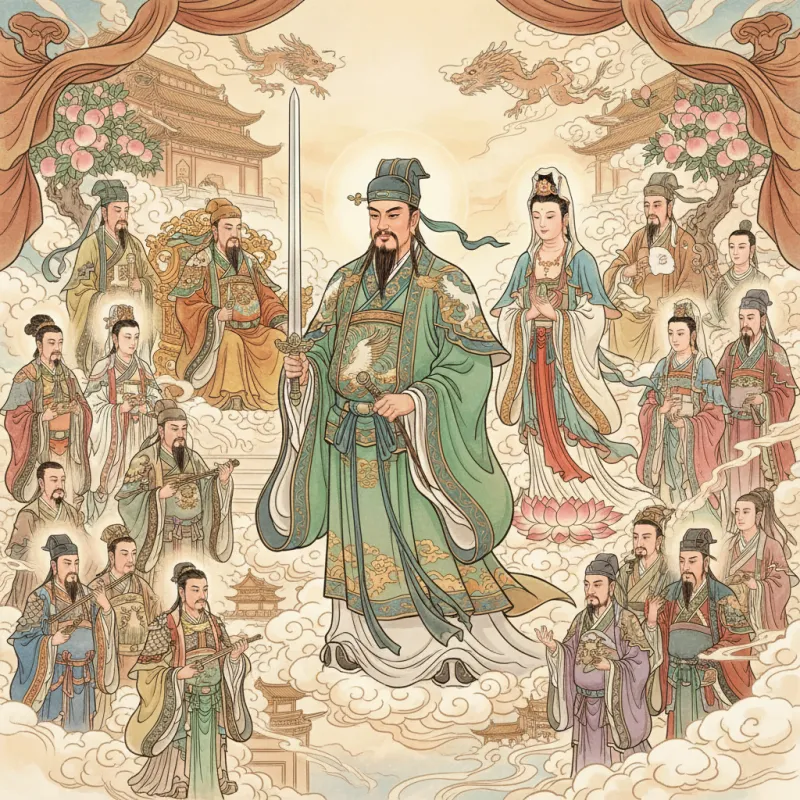
A young scholar sits in a roadside inn, watching rice cook in a pot. He's just failed the imperial examinations—again—and his mind churns with fantasies of future glory. An old Daoist offers him a ceramic pillow. The scholar rests his head and dreams an entire lifetime: he passes the exams, becomes a high official, marries well, fathers sons, accumulates wealth and honors. Then scandal strikes. He's accused of corruption, stripped of rank, exiled. His family suffers. In his dream's final moments, old and broken, he understands that everything he chased was smoke. He wakes. The rice isn't even cooked yet. This is the Yellow Millet Dream (黄粱梦 Huángliáng Mèng), and the man who dreamed it—Lü Dongbin (吕洞宾 Lǚ Dòngbīn)—would become the most beloved immortal in Chinese culture.
Why Lü Dongbin Matters More Than Other Immortals
The Eight Immortals each represent different paths to transcendence, but Lü Dongbin stands apart. He's not a folk hero like Tieguai Li or a symbol of feminine grace like He Xiangu. He's the immortal of second chances, of intellectual awakening, of the specific moment when ambition transforms into wisdom.
His worship spread far beyond Daoist temples. During the Song Dynasty (960-1279 CE), Lü Dongbin temples appeared in nearly every major city. Scholars prayed to him before examinations—not for success, but for clarity about whether success even mattered. Merchants invoked him when making difficult business decisions. His image hung in homes as a reminder that the ladder you're climbing might be leaning against the wrong wall.
What makes Lü Dongbin exceptional is his relatability. He wasn't born divine. He didn't achieve immortality through extreme asceticism or supernatural birth. He was a regular person who got tired of the game everyone else was still playing. In a culture that simultaneously venerates scholarly achievement and spiritual detachment, Lü Dongbin embodies the tension between these values—and offers a resolution.
The Historical Lü Dongbin
The historical evidence for Lü Dongbin is frustratingly thin, which is perhaps appropriate for someone who represents the abandonment of worldly recognition. Most scholars place him in the late Tang Dynasty (618-907 CE), possibly living from 796 to 1016 CE, though these dates are disputed. He was likely born in Jingzhao (京兆, modern-day Xi'an) to a family of minor officials.
What we know with more certainty is that by the Song Dynasty, stories about Lü Dongbin had proliferated wildly. The scholar Hong Mai (洪迈 Hóng Mài, 1123-1202) recorded numerous accounts of Lü Dongbin appearing to people in dreams, offering cryptic advice, or testing their character. These weren't ancient legends—they were contemporary sightings. People in the 12th century claimed to have met Lü Dongbin the way modern people claim to have seen UFOs.
The Daoist tradition credits him with founding the Quanzhen School (全真教 Quánzhēn Jiào) of internal alchemy, though this attribution is historically questionable. What matters more is that Lü Dongbin became the patron saint of a particular approach to Daoism: one that emphasized inner transformation over ritual, personal experience over institutional authority, and the possibility of enlightenment within ordinary life rather than through monastic withdrawal.
The Yellow Millet Dream and Its Cultural Impact
The Yellow Millet Dream story appears in countless variations, but the core remains consistent: Lü Dongbin experiences an entire lifetime of worldly success and failure in the time it takes to cook a pot of rice. The old Daoist who gives him the pillow is Zhongli Quan (钟离权 Zhōnglí Quán), who would become his teacher and another member of the Eight Immortals.
This story became one of the most referenced narratives in Chinese literature. The Tang Dynasty poet Li Bai (李白 Lǐ Bái) wrote about the futility of ambition, but Lü Dongbin's dream gave that futility a narrative structure that anyone could understand. The Ming Dynasty novel Journey to the West (西游记 Xīyóujì) references it. Qing Dynasty examination candidates wrote essays analyzing it. Modern Chinese still use the phrase "yellow millet dream" (黄粱梦) to describe ambitious plans that come to nothing.
What makes the story powerful isn't just its message about the emptiness of worldly achievement—plenty of religious traditions offer that. It's the specificity of the experience. Lü Dongbin doesn't receive abstract wisdom from a deity. He lives through the entire cycle himself. He feels the pride of success and the shame of failure. The dream doesn't tell him that ambition is empty; it lets him discover this truth through experience compressed into a moment.
The story also introduces a key theme in Lü Dongbin's legend: the importance of the right teacher appearing at the right moment. Zhongli Quan doesn't lecture Lü Dongbin or try to convince him of anything. He simply creates the conditions for realization. This teaching method—experiential rather than doctrinal—became central to how Lü Dongbin himself was portrayed as a teacher in later stories.
Lü Dongbin's Sword and the Ten Trials
After awakening from the Yellow Millet Dream, Lü Dongbin became Zhongli Quan's disciple. But his path to immortality wasn't immediate. According to legend, Zhongli Quan subjected him to ten trials designed to test whether he had truly transcended worldly attachments.
These trials are worth examining because they reveal what Chinese culture considered the hardest attachments to break:
- His entire family suddenly dies. Can he remain calm?
- He sells goods in the market, and buyers constantly cheat him. Does he get angry?
- A beggar demands everything he owns. Will he give it?
- A madman threatens to kill him. Does he fear death?
- He finds his wife in bed with another man. Can he let go of jealousy?
- Someone accuses him of a crime he didn't commit. Will he defend himself?
- He discovers treasure, then someone else claims it. Does he argue?
- Someone offers him immortality pills that are actually poison. Will he take them?
- A beautiful woman tries to seduce him. Can he resist?
- He encounters a demon disguised as his teacher. Can he see through the illusion?
Lü Dongbin passed all ten trials, demonstrating complete equanimity. Only then did Zhongli Quan give him the sword that became his signature attribute—a demon-slaying blade that represents the cutting away of delusion.
This sword appears in virtually every depiction of Lü Dongbin. But it's not a weapon of violence. In Daoist internal alchemy, the sword represents discriminating wisdom—the ability to distinguish between what's real and what's illusion, between genuine spiritual progress and self-deception. Lü Dongbin's sword cuts through the lies we tell ourselves about what will make us happy.
Lü Dongbin in Popular Religion
While Daoist texts present Lü Dongbin as a master of internal alchemy and spiritual cultivation, popular religion transformed him into something more accessible and immediate. By the Ming Dynasty (1368-1644), Lü Dongbin had become a god who actively intervened in people's lives.
Temples dedicated to Lü Dongbin offered divination services. Worshippers would ask questions, then draw lots or interpret signs to receive his guidance. Unlike the remote celestial bureaucrats of official religion, Lü Dongbin was approachable. He appeared in dreams. He left cryptic messages. He tested people's character by appearing as a beggar or a drunk.
One popular story tells of a merchant who prayed to Lü Dongbin for business success. That night, a filthy beggar appeared at his door demanding food and shelter. The merchant, despite his prayers, turned the beggar away. The next morning, he found a message written in the dust: "You pray for wisdom but can't recognize it when it knocks." The beggar had been Lü Dongbin in disguise.
These stories served a social function. They reminded people that spiritual worth couldn't be separated from ethical behavior. You couldn't pray to Lü Dongbin for success while treating others poorly. The immortal who had transcended worldly ambition became, paradoxically, a judge of how people pursued their worldly ambitions.
Lü Dongbin also became associated with healing, particularly mental and spiritual ailments. People suffering from anxiety, depression, or what we might now call existential crisis would pray to him. This makes sense given his origin story—he's the patron saint of people who've realized that what they're chasing won't actually make them happy but don't yet know what else to do.
The Literary Lü Dongbin
Chinese literature is saturated with Lü Dongbin references. He appears as a character in plays, novels, and poetry. The Yuan Dynasty (1271-1368) drama The Yellow Millet Dream (黄粱梦 Huángliáng Mèng) by Ma Zhiyuan (马致远 Mǎ Zhìyuǎn) brought his story to the stage. Ming Dynasty novels featured him as a wandering immortal who helps protagonists at crucial moments.
But Lü Dongbin's literary influence goes beyond direct appearances. He became a archetype—the wise figure who appears when the protagonist is at a crossroads, offering not solutions but perspective. This character type appears throughout Chinese fiction, from classical novels to modern literature.
The Qing Dynasty novel The Scholars (儒林外史 Rúlín Wàishǐ) by Wu Jingzi (吴敬梓 Wú Jìngzǐ) doesn't feature Lü Dongbin directly, but its entire satirical critique of the examination system and scholarly ambition operates in the shadow of the Yellow Millet Dream. The novel's scholars chase success that proves hollow—they're living the dream Lü Dongbin woke up from.
Modern Chinese writers continue to reference Lü Dongbin when exploring themes of ambition, disillusionment, and the search for meaning beyond conventional success. His story provides a vocabulary for discussing these experiences that feels culturally authentic rather than imported from Western psychology or philosophy.
Why Lü Dongbin Endures
In contemporary China, Taiwan, Hong Kong, and Chinese communities worldwide, Lü Dongbin remains relevant. His temples still receive worshippers. His image still appears in homes and businesses. But his appeal has evolved.
For modern people navigating hyper-competitive educational systems and career pressures, Lü Dongbin represents permission to question the race everyone else is running. He's not anti-achievement—he was a brilliant scholar himself. He's anti-delusion. He asks: Are you chasing this because you genuinely want it, or because you've been told you should want it?
This question resonates in an era of burnout, anxiety, and what some call the "rat race." Lü Dongbin offers an alternative that isn't simply dropping out or giving up. He achieved immortality not by rejecting the world but by seeing through it. He didn't become a hermit in the mountains—he remained engaged with human society, teaching and helping others.
The Yellow Millet Dream also speaks to modern experiences of disillusionment. How many people have achieved the success they thought they wanted—the degree, the job, the promotion, the house—only to feel empty? Lü Dongbin's story validates that experience and suggests it's not failure but awakening.
Perhaps most importantly, Lü Dongbin represents the possibility of transformation at any moment. He wasn't special from birth. He didn't have supernatural powers or divine lineage. He was an ordinary person who woke up—literally and figuratively. If he could do it, maybe anyone can.
The immortal who abandoned the imperial examinations remains the patron saint of everyone who's ever wondered whether the ladder they're climbing is leaning against the right wall. In a culture that simultaneously demands achievement and venerates transcendence, Lü Dongbin offers a way to hold both truths: pursue excellence, but don't mistake success for enlightenment. The rice is still cooking. You have time to wake up.
Related Reading
- Meet the Eight Immortals: Profiles of China's Favorite Supernatural Squad
- The Eight Immortals: China's Most Beloved Supernatural Team
- The Eight Immortals: China's Most Beloved Divine Group
- Symbols of the Eight Immortals: Hidden Meanings in Chinese Art
- Burning Ghost Money: The Complete Guide to Afterlife Offerings
- Gods of Chinese New Year: The Deities Behind the Festival
- The Dragon Kings of the Four Seas