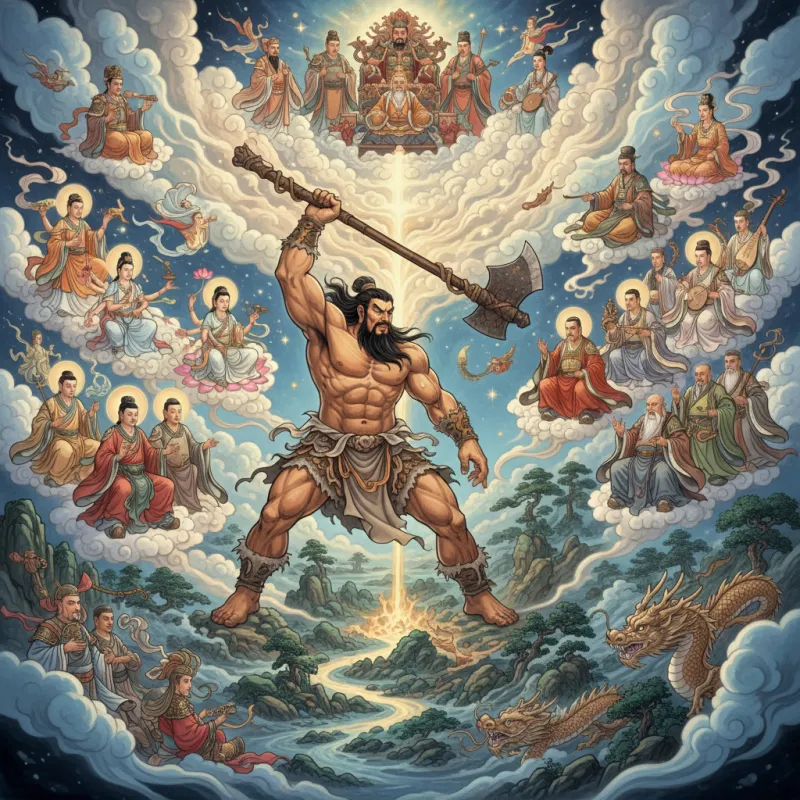
Before time had a name and space had boundaries, there was only an egg floating in absolute nothingness. Not a chicken egg or even a dragon egg, but a cosmic egg the size of everything that would ever exist—because it was everything that would ever exist. And inside that egg, curled up like a fetus, slept a giant named Pangu (盘古 Pángǔ). He slept for eighteen thousand years. When he finally woke up, he was understandably cranky about the accommodations.
The Cosmic Egg Cracks
The creation myth of Pangu is one of the most visceral origin stories in Chinese mythology. Unlike the more philosophical accounts of creation found in Daoist texts like the Daodejing, where the universe emerges through abstract principles, Pangu's story is physical, violent, and exhaustingly literal. He wakes up in darkness, realizes he's trapped inside chaos (混沌 hùndùn), and does what any reasonable giant would do: he grabs an axe and starts swinging.
Some versions say he used a chisel and hammer. Others claim he simply pushed with his enormous hands. The 述异记 (Shùyìjì, "Account of Strange Things"), compiled during the Southern Dynasties period (420-589 CE), gives us one of the earliest written accounts of this myth, though scholars believe the story itself is much older, possibly originating among the Miao and Yao peoples of southern China before being absorbed into Han Chinese mythology.
When Pangu's axe struck, the cosmic egg shattered. The light, pure energy (清气 qīngqì) rose upward to form heaven (天 tiān). The heavy, turbid energy (浊气 zhuóqì) sank downward to form earth (地 dì). For the first time in existence, there was an up and a down, a sky and a ground, a separation between things.
Eighteen Thousand Years of Standing
But here's where the story gets interesting—and exhausting. Heaven and earth, freshly separated, wanted to collapse back together. They were like magnets with opposite poles, drawn to reunite into chaos. Pangu, standing between them, realized that if he didn't do something, his entire demolition project would be for nothing.
So he stood there. He stood with his feet planted on the earth and his hands pushing up the sky. And he stood there for another eighteen thousand years.
Each day, heaven rose ten feet higher. Each day, earth grew ten feet thicker. And each day, Pangu grew ten feet taller to maintain the separation. By the time he was done, heaven and earth were separated by ninety thousand li (about 30,000 miles), and Pangu had grown to match that distance. Imagine the loneliness of that task—standing alone in the void between two worlds, growing larger and larger, with no one to talk to, no one to relieve you, nothing to do but hold up the sky for millennia.
This detail always struck me as the most profound part of the myth. Pangu doesn't create through divine will or magical words like in other traditions. He creates through sheer, stubborn endurance. Creation isn't a moment—it's eighteen thousand years of not giving up.
The Giant Becomes the World
After eighteen thousand years of holding up the sky, Pangu finally died. Some versions say he died of exhaustion. Others suggest he simply completed his purpose and let go. But what happened next transforms this from a creation story into something more like a cosmic sacrifice.
Pangu's body didn't simply decay—it transformed into the features of the world itself. His breath became the wind and clouds. His voice became thunder. His left eye became the sun, his right eye the moon. His four limbs and five extremities became the four cardinal directions and five sacred mountains (五岳 wǔyuè). His blood flowed into rivers, his muscles formed the earth's soil, his hair and beard became the stars in the sky.
The Wuyun Linian Ji (五运历年记, "Record of the Cycles of Five Movements"), another text from the Three Kingdoms period (220-280 CE), provides extensive details about these transformations. His bones became minerals and precious stones. His bodily fluids became rain and dew. His skin and body hair became vegetation and trees. Even the parasites on his body—in a detail that's either profound or slightly gross depending on your perspective—became human beings.
This last detail is particularly interesting because it positions humanity not as the crown of creation but as an almost accidental byproduct, the fleas on a dead giant's corpse. It's a far cry from the more anthropocentric creation myths found in other cultures, and it reflects a certain humility about humanity's place in the cosmos that runs through much of Chinese philosophical thought.
The Late Arrival of Pangu
Here's something that surprises many people: Pangu is actually a relatively late addition to Chinese mythology. While figures like Nüwa and Fuxi appear in texts dating back to the Warring States period (475-221 BCE) and earlier, Pangu doesn't show up in written records until the Three Kingdoms period, nearly seven hundred years later.
This has led some scholars to suggest that the Pangu myth was imported from Southeast Asian or South Asian traditions, where similar cosmic giant creation myths exist. The Miao people's creation stories, for instance, feature a remarkably similar figure. Others argue that the myth existed in oral tradition long before it was written down, and that its absence from earlier texts simply reflects the biases of the literate elite who didn't consider southern folk traditions worth recording.
What's undeniable is that once Pangu entered the Chinese mythological canon, he stuck. By the Tang Dynasty (618-907 CE), he was firmly established in popular consciousness. By the Ming Dynasty (1368-1644 CE), he was appearing in novels, plays, and artwork. The Journey to the West (西游记 Xīyóujì), written in the 16th century, references Pangu in its opening chapter, treating him as an established and well-known figure.
Pangu and the Problem of Origins
The Pangu myth does something philosophically interesting: it provides a concrete, narrative answer to the question of origins while simultaneously raising new questions. If Pangu was inside the cosmic egg, where did the egg come from? If chaos existed before creation, what created chaos? The myth doesn't answer these questions—it simply pushes the mystery back one step.
This is actually consistent with Daoist philosophy, which tends to be comfortable with paradox and mystery. The Daodejing famously opens with "The Dao that can be spoken is not the eternal Dao"—an acknowledgment that ultimate origins might be beyond human comprehension or language. Pangu gives us a story we can grasp, a giant we can visualize, but he doesn't pretend to explain everything.
Compare this to the creation account in the Huainanzi (淮南子), a philosophical text from the Western Han Dynasty (206 BCE - 9 CE), which describes creation as an impersonal process of energy differentiation without any giant involved. Or consider the various Daoist cosmogonies that describe the universe emerging from the Dao through a series of increasingly complex differentiations. Pangu's story exists alongside these other accounts, not replacing them but offering a different kind of truth—a mythological truth rather than a philosophical one.
The Giant in Popular Culture
Today, Pangu remains a powerful symbol in Chinese culture. His name is invoked whenever someone wants to reference the very beginning of things—"since Pangu opened heaven and earth" (自盘古开天地以来 zì Pángǔ kāi tiāndì yǐlái) is a common expression meaning "since the beginning of time." He appears in video games, television shows, and movies as the ultimate primordial force.
But I think the most interesting modern interpretations are the ones that focus on his loneliness and sacrifice. Standing alone for eighteen thousand years, holding up the sky with no guarantee that anyone would ever exist to appreciate it—that's a particular kind of heroism. He didn't create humanity deliberately. He didn't know we would emerge from the parasites on his corpse. He simply did what needed to be done to keep heaven and earth apart, and then he died, and his death gave rise to everything we know.
There's something almost tragic about it. Pangu never got to see a sunrise, because he became the sun. He never got to climb a mountain, because he became the mountains. He never got to meet another person, because people didn't exist yet. His entire existence was spent in service of a world he would never experience.
The Axe That Split the World
The image of Pangu with his axe, splitting chaos into heaven and earth, has become iconic. But it's worth noting that the axe itself is rarely described in detail in the original texts. We don't know if it was made of stone or metal, if it was magical or mundane, if Pangu brought it with him into the cosmic egg or found it there waiting.
This vagueness is actually typical of Chinese mythology, which tends to be more interested in the meaning and consequences of actions than in the specific details of how they were accomplished. The axe is important not as an object but as a symbol—the tool that makes differentiation possible, that turns chaos into cosmos, that creates the fundamental distinction between up and down, light and heavy, heaven and earth.
In this sense, Pangu's axe is related to other mythological tools of creation and separation, like the sword that Nüwa used to cut the legs off a giant turtle to prop up the sky, or the various magical weapons wielded by gods and immortals throughout Chinese mythology. These aren't just weapons—they're instruments of cosmic ordering, tools that impose structure on chaos.
The act of splitting, of creating distinction and separation, is fundamental to Chinese cosmology. The Yijing (易经, "Book of Changes") is built on the interplay between yin and yang, the two fundamental forces that emerged when the primordial unity was divided. Pangu's splitting of the cosmic egg is the mythological version of this philosophical principle—the moment when the undifferentiated became differentiated, when the one became two, when creation became possible.
Standing Between Heaven and Earth
In the end, what makes the Pangu myth endure isn't its answers but its image: a giant standing between heaven and earth, growing larger each day, holding the two apart through sheer determination. It's an image of creation as labor, as sacrifice, as the willingness to stand in an impossible position for an impossible length of time because someone has to do it.
We are, according to this myth, living in the body of that giant. The ground beneath our feet is his flesh. The sky above our heads is held up by his final effort. Every breath we take is his breath, transformed. Every mountain we climb is his bones, every river we cross is his blood. We are literally made of Pangu, the parasites on his corpse who somehow became conscious and started telling stories about where we came from.
It's a strange kind of creation myth—one that makes us small and accidental, but also intimately connected to the cosmos itself. We didn't ask to be created, and Pangu didn't plan to create us, but here we are anyway, living in the world his death made possible. The least we can do is remember him, the lonely giant who stood between heaven and earth for eighteen thousand years so that we could have a world to stand in.
Related Reading
- Pangu and the Cosmic Egg: How the Chinese Universe Began
- Creation Myths in Chinese Religion: How Gods Made the World
- Nüwa Repairs the Sky: The Goddess Who Saved the World
- Fuxi: The God-Emperor Who Gave Humanity Civilization
- Exploring Chinese Deities and Immortals in Daoist and Buddhist Creation Myths
- Unveiling the Rich Tapestry of Chinese Deities and Immortals
- The Eight Immortals: China's Most Beloved Divine Group
- Animal Deities in Chinese Religion: When Foxes, Snakes, and Turtles Become Gods