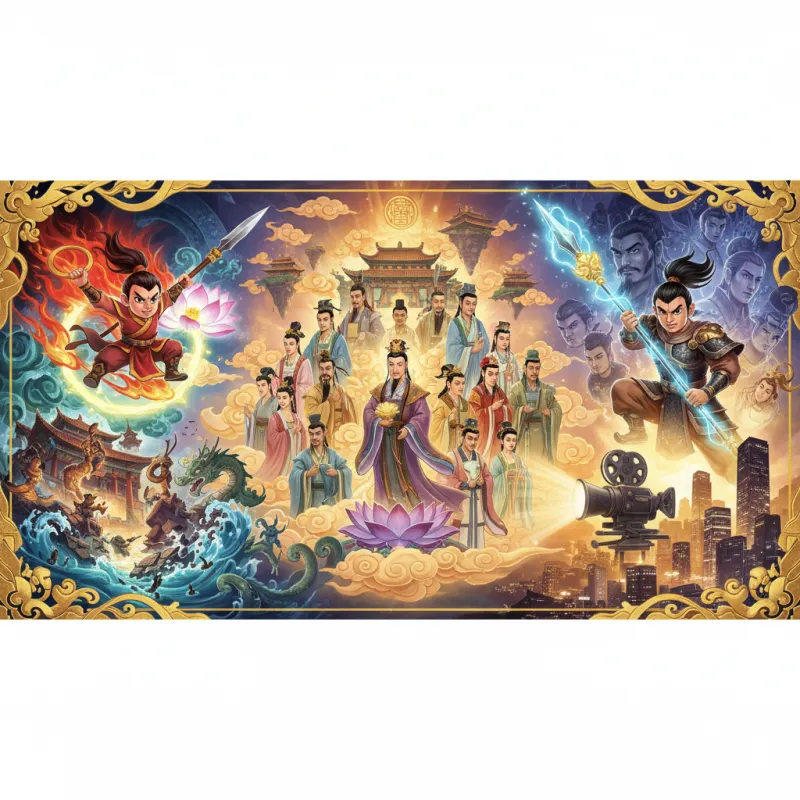
A seven-year-old strips the skin from a dragon prince, pulls out his tendons to make a belt for his father, and when the Dragon King demands justice, the boy commits suicide by slicing his own flesh and breaking his bones to repay his debt to his parents. This is Nezha (哪吒 Nézhā), and somehow, this violent deity from the Fengshen Yanyi (封神演义 Investiture of the Gods) became the star of China's highest-grossing animated film ever.
The transformation of Nezha from ancient mythological rebel to modern cultural icon reveals something fascinating about how China reimagines its traditional stories for contemporary audiences. The 2019 film Ne Zha (哪吒之魔童降世 Nezha: Birth of the Demon Child) earned over 5 billion yuan at the box office, but it did so by fundamentally rewriting the character's core mythology. Understanding what changed — and what stayed the same — tells us as much about modern China as it does about this three-thousand-year-old deity.
The Original: A Child God Who Chose Death Over Dishonor
Nezha's classical story, as told in the 16th-century novel Fengshen Yanyi, is shockingly brutal. His mother, Lady Yin (殷夫人 Yīn Fūrén), carried him for three years and six months before giving birth to what appeared to be a ball of flesh. His father, the military commander Li Jing (李靖 Lǐ Jìng), slashed it open with his sword, and out stepped a fully formed boy wearing a golden bracelet and wrapped in red silk — the magical treasures Qiankun Quan (乾坤圈 Universe Ring) and Huntian Ling (混天绫 Red Armillary Sash).
At seven years old, Nezha went to bathe in the sea and accidentally killed Ao Bing (敖丙), the third son of the Dragon King Ao Guang (敖广 Áo Guǎng). When the Dragon King's soldiers came for revenge, Nezha killed them too. Then he skinned Ao Bing, pulled out his tendons, and brought them home to make a belt for his father. The Dragon King demanded Li Jing hand over his son or face the flooding of the entire region. Nezha's response was radical: he committed suicide, cutting his flesh and breaking his bones, returning his body to his parents to absolve them of responsibility.
But death wasn't the end. His master, the immortal Taiyi Zhenren (太乙真人 Tàiyǐ Zhēnrén), reconstructed Nezha's body from lotus roots and leaves, giving him a new form and even greater power. The reborn Nezha then sought revenge against his father, who had refused to build him a temple, chasing Li Jing across the heavens until the Jade Emperor (玉皇大帝 Yùhuáng Dàdì) intervened.
This is not a story about redemption or finding your inner hero. It's about filial piety taken to its most extreme conclusion, about a child so powerful and so righteous that he would rather die than bring shame to his family — and then come back to punish his father for not honoring that sacrifice.
From Ming Dynasty Novel to Communist-Era Hero
Nezha's journey through Chinese popular culture tracks the country's own ideological transformations. The 1979 animated film Nezha Conquers the Dragon King (哪吒闹海 Nézhā Nào Hǎi), produced by Shanghai Animation Film Studio during the late Cultural Revolution period, kept the suicide but reframed it entirely. In this version, Nezha becomes a hero of the people, standing up against the tyrannical Dragon King who oppresses the common folk. His suicide is an act of revolutionary sacrifice, and his father becomes a symbol of the old feudal order that must be overthrown.
The 1979 film was visually stunning, using traditional Chinese painting techniques and operatic movement styles. It introduced Nezha to an entire generation as a symbol of youthful rebellion against corrupt authority — a reading that resonated deeply in post-Mao China. The image of Nezha standing on his Wind Fire Wheels (风火轮 Fēnghuǒlún), wielding his Fire-tipped Spear (火尖枪 Huǒjiānqiāng), became iconic.
But even this revolutionary interpretation maintained the core tragedy: Nezha dies, is reborn, and remains fundamentally at odds with his father. The conflict between individual righteousness and family obligation, between power and control, stayed intact.
The 2019 Rewrite: Destiny Is Not Predetermined
Director Yang Yu (饺子 Jiǎozi) made a bold choice with Ne Zha: he kept almost nothing of the original story except the character names and magical weapons. In his version, Nezha is born as the Demon Orb (魔丸 Mówán) rather than the Spirit Pearl (灵珠 Língzhū) — a mix-up orchestrated by the villain Shen Gongbao (申公豹 Shēn Gōngbào). The film's Nezha is destined to become a demon and destroy the world, but he fights against this fate with the film's central message: "My fate is mine to decide, not heaven's" (我命由我不由天 Wǒ mìng yóu wǒ bù yóu tiān).
More radically, Yang Yu completely rewrites the father-son relationship. Li Jing becomes a loving, protective father who secretly trades his life to save Nezha from the Heavenly Lightning Tribulation. When Nezha discovers this, he's moved to tears and fights to save his father in return. The film ends with Nezha and Ao Bing — now his friend rather than his victim — sacrificing themselves together to save their families and the village.
This is not just a different interpretation. It's a fundamental inversion of the original mythology. The classical Nezha's power came from his willingness to destroy himself to maintain cosmic order and filial duty. The 2019 Nezha's power comes from rejecting predetermined fate and choosing love over destiny. One is about accepting your place in the hierarchy; the other is about smashing that hierarchy entirely.
Why the Changes Worked (And What They Mean)
The film's massive success suggests it struck a chord with contemporary Chinese audiences, particularly millennials and Gen Z viewers who grew up as only children under the one-child policy. The theme of parental pressure and predetermined expectations resonates deeply in a society where children face intense academic competition and family obligations. "My fate is mine to decide" became a viral slogan precisely because it articulates a desire many young Chinese people feel but rarely express openly.
Yang Yu also made Nezha ugly — with heavy dark circles under his eyes, crooked teeth, and a perpetual scowl — specifically to make him more relatable. In interviews, he explained that he wanted to show that heroes don't have to be conventionally attractive or naturally good. They just have to choose to do the right thing, even when the world has already decided they're monsters. This Nezha is lonely, misunderstood, and desperate for acceptance — far more like a modern teenager than an ancient deity.
The film also softened the violence considerably. There's no skinning, no tendon-pulling, no suicide. The most violent act Nezha commits is accidentally destroying part of the village while fighting a demon, and he immediately feels guilty about it. This Nezha doesn't need to die and be reborn because he was never truly evil — just misunderstood and mislabeled.
The Lotus Rebirth: What Survives Across Versions
Despite all the changes, certain elements of Nezha's mythology prove remarkably persistent. The lotus rebirth appears in nearly every version, though its meaning shifts. In the original Fengshen Yanyi, the lotus body represents Nezha's transcendence of normal human limitations — he's no longer bound by flesh and blood, by family ties, by the normal rules of filial piety. He becomes something other than human, which is why he can challenge his father without cosmic punishment.
In the 2019 film, the lotus imagery appears differently but still centrally. Nezha and Ao Bing are both shown with lotus-themed powers, and their final transformation involves lotus petals. The lotus remains a symbol of rebirth and purity, but now it represents the possibility of redemption rather than transcendence. You can be born as a demon and still bloom into something beautiful.
The magical weapons also persist: the Universe Ring, the Red Armillary Sash, the Wind Fire Wheels, and the Fire-tipped Spear appear in virtually every adaptation. These aren't just cool accessories — they're markers of Nezha's identity, gifts from his master Taiyi Zhenren that represent his connection to the divine realm. Even when everything else about the story changes, Nezha keeps his weapons, suggesting that some aspects of identity are non-negotiable.
Nezha in the Broader Pantheon
Nezha's evolution also reflects his unique position in the Chinese divine hierarchy. Unlike figures such as Guan Yu, who represents loyalty and righteousness, or the Eight Immortals, who embody Daoist transcendence, Nezha has always been the wild card — the deity who doesn't quite fit. He's technically a Buddhist figure (his name derives from the Sanskrit Nalakūbara), but he appears most prominently in Daoist texts. He's a child god in a pantheon dominated by ancient sages. He's a military deity who killed his own father's soldiers.
This liminal status makes Nezha perfect for reinterpretation. He's not so central to religious practice that changing his story feels sacrilegious, but he's famous enough that everyone knows who he is. He exists in the sweet spot between sacred and secular, between tradition and innovation.
The 2019 film's success has spawned a new wave of Nezha content, including a 2021 sequel New Gods: Nezha Reborn (新神榜:哪吒重生) that reimagines him in a cyberpunk setting, and multiple video games featuring the character. Each version adds new layers while maintaining some connection to the original mythology. Nezha has become a canvas for exploring contemporary Chinese identity — what it means to be young, powerful, and trying to find your place in a society with very clear expectations.
The Rebel Who Became a Brand
Today, Nezha is everywhere in Chinese popular culture: toys, video games, theme park attractions, fashion collaborations. The character has become a multibillion-yuan intellectual property, with the 2019 film's success proving that Chinese animation could compete with Hollywood on a global scale. But this commercialization raises questions about what happens when a mythological figure becomes a brand.
The classical Nezha was dangerous precisely because he couldn't be controlled or commodified. He represented the terrifying power of youth, the violence that erupts when filial piety is pushed to its breaking point, the chaos that comes from giving a child god-like abilities. The modern Nezha is still rebellious, but it's a safe rebellion — one that ultimately reinforces family values and social harmony rather than threatening them.
Perhaps that's the real story here: not that Nezha changed, but that China found a way to domesticate its most uncontrollable deity. The boy who killed himself rather than submit to authority now tells children that they can choose their own destiny — as long as that destiny includes loving their parents and protecting their community. It's a more hopeful message, certainly, but also a more conservative one.
Still, something of the original Nezha persists in even the most sanitized versions. That spark of genuine rebellion, the sense that this character could at any moment do something shocking and irreversible, never quite disappears. Maybe that's why audiences keep coming back to him, generation after generation, adaptation after adaptation. We want to believe that somewhere under all the lotus petals and merchandising deals, there's still a seven-year-old boy who looked at the Dragon King's army and decided he'd rather die than back down.
That boy is still in there, wrapped in red silk, waiting to be reborn.
Related Reading
- Nezha: From Ancient Deity to Box Office Hit
- Chinese Gods in Anime and Manga: Eastern Mythology Goes Global
- Chinese Gods in Marvel and DC Comics
- Journey to the West: From Novel to Netflix — Every Major Adaptation
- Chinese Temple Architecture: What Every Symbol Means
- Ancient Chinese Underworld Deities: Guardians of Death and Afterlife Realms
- The Chinese Religious Calendar: When to Worship What