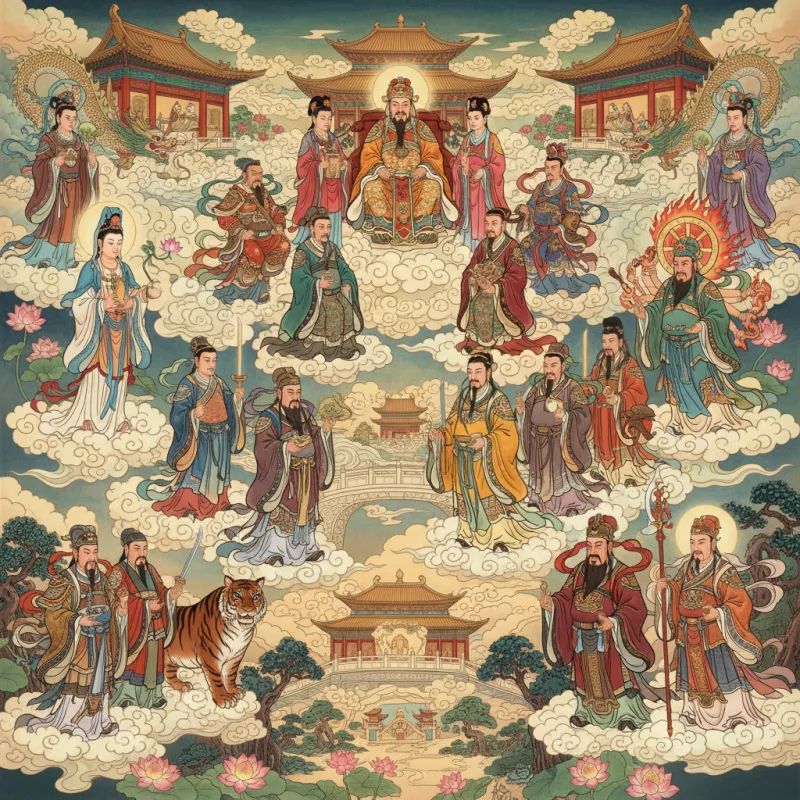
A grandmother in rural Fujian lights incense before a weathered statue, murmuring prayers to a deity whose name appears in no official Daoist canon. Her grandson, visiting from Shanghai, asks who she's praying to. "Ah," she says, "this is Lord Chen, who saved our village from bandits three hundred years ago." This scene repeats across China in countless variations—a living testament to how Chinese folk religion transforms history into divinity, and neighbors into immortals.
The Fluid Boundary Between Human and Divine
Unlike the rigid hierarchies of Western monotheism, Chinese folk religion operates on a fundamentally different principle: the boundary between mortal and immortal is permeable, even negotiable. A righteous official becomes Guan Yu, the God of War. A filial daughter transforms into Mazu (媽祖, Māzǔ), protector of sailors. A skilled physician ascends as the Medicine King. This isn't metaphor—it's the actual mechanism by which the Chinese pantheon expands.
The process follows a recognizable pattern. First comes exceptional virtue or ability in life. Then, miraculous events after death—a drought ends when villagers pray at someone's grave, or a plague stops after offerings to a deceased healer. Local worship spreads. If the deity proves "efficacious" (靈驗, língyàn)—meaning prayers get answered—the cult grows. Eventually, the imperial court might grant official recognition, bestowing titles like "Duke" or "Emperor" on what began as a village spirit.
This system created thousands of local deities, each with specific jurisdictions. The City God (城隍, Chénghuáng) manages the underworld bureaucracy for his municipality. The Earth God (土地公, Tǔdìgōng) oversees a neighborhood or even a single street. Specific deities handle childbirth, examinations, weather, livestock, and every conceivable human concern. It's spirituality as practical problem-solving.
The Three Teachings Melt Into One
Walk into any traditional Chinese temple and you'll witness theological chaos that would horrify systematic theologians. Buddhist bodhisattvas share altar space with Daoist immortals and Confucian worthies. Guanyin (觀音, Guānyīn), the Buddhist goddess of mercy, receives offerings alongside the Jade Emperor (玉皇大帝, Yùhuáng Dàdì), Daoism's supreme deity, while Confucius watches from a side shrine. This isn't confusion—it's the principle of "Three Teachings Harmonized as One" (三教合一, Sānjiào Héyī) in action.
The syncretism runs deeper than shared temple space. Take the Eight Immortals (八仙, Bāxiān), those beloved figures who cross the sea on their magical implements. Their stories blend Daoist cultivation practices with Buddhist compassion and Confucian social ethics. Lü Dongbin (呂洞賓), their leader, appears in Daoist scriptures as a master of internal alchemy, but folk tales show him helping scholars pass examinations and teaching moral lessons—decidedly Confucian concerns.
This theological flexibility reflects Chinese pragmatism. Why limit yourself to one tradition when you can access the benefits of all three? A merchant might pray to the Buddhist Guanyin for compassion, the Daoist God of Wealth for prosperity, and maintain Confucian ancestor rites for family harmony. It's not hypocrisy—it's comprehensive spiritual insurance.
The Bureaucratic Heavens
Chinese folk religion imagines the divine realm as a celestial bureaucracy mirroring earthly government—complete with departments, ranks, promotions, and paperwork. The Jade Emperor sits atop this hierarchy like a cosmic emperor, with ministries handling everything from thunder to epidemics. Below him, countless officials manage specific domains with the same attention to protocol and hierarchy that characterized imperial China.
This bureaucratic model has profound implications. Deities aren't omnipotent—they have limited jurisdictions and must follow procedures. When disaster strikes, it's not divine caprice but bureaucratic failure. A corrupt City God might neglect his duties. A minor deity might lack authority to solve a problem, requiring petitions to higher powers. Worshippers sometimes "sue" ineffective deities, filing formal complaints or even punishing divine images by leaving them in the sun.
The system also allows for divine career advancement. Guan Yu started as a deified general but received repeated promotions from various emperors, eventually becoming "Emperor Guan" with expanded powers. Mazu began as a local Fujian deity but her cult spread with maritime trade, earning her increasingly prestigious titles until she became "Empress of Heaven." Merit and efficacy determine divine status, not fixed theological categories.
Immortals: The Self-Made Deities
While gods receive worship due to their positions in the celestial bureaucracy, immortals (仙, xiān) represent a different path to transcendence—personal cultivation. These figures achieved immortality through Daoist practices: meditation, breath control, internal alchemy, and moral refinement. They're the spiritual entrepreneurs of Chinese religion, self-made rather than appointed.
The most famous immortals populate countless stories and operas. The Eight Immortals each represent different social classes and paths to enlightenment—from the crippled beggar Li Tieguai (李鐵拐) to the aristocratic Cao Guojiu (曹國舅). Their adventures emphasize that immortality is achievable regardless of social status, though it requires dedication and often eccentric behavior that defies conventional morality.
Historical figures blur into immortal legends. Ge Hong (葛洪, 283-343 CE), a real Daoist alchemist and author, became legendary for his pursuit of the elixir of life. Zhang Sanfeng (張三丰), possibly historical founder of Tai Chi, transformed into an ageless wanderer who appears across centuries. These figures inspire because they suggest human potential for transcendence—not through divine grace but through personal effort and esoteric knowledge.
The Village Temple Economy
Chinese folk religion isn't abstract theology—it's transactional. Worshippers and deities engage in explicit exchanges: offerings for favors, vows for miracles, temple renovations for blessings. This commercial aspect scandalized early Western missionaries, but it reflects a pragmatic spirituality where divine relationships operate like human ones—through reciprocity and mutual obligation.
Temple festivals demonstrate this economy at scale. During Mazu's birthday, fishing communities spend lavishly on processions, opera performances, and offerings. The investment isn't purely devotional—it's insurance for the coming fishing season. If catches are good, the goddess proved her efficacy and deserves even greater offerings next year. If not, worshippers might redirect their patronage to a more responsive deity.
This system creates accountability. Deities must deliver results or lose followers. Stories abound of divine images thrown into rivers or temples abandoned when gods fail to answer prayers. Conversely, effective deities attract pilgrims from vast distances, generating economic benefits for their communities. The temple becomes both spiritual center and economic engine, with the deity as the ultimate stakeholder in local prosperity.
Living Tradition in Modern China
Despite decades of official atheism and rapid modernization, Chinese folk religion persists with remarkable vitality. Temples destroyed during the Cultural Revolution have been rebuilt, often with funds from overseas Chinese communities. Urban professionals consult fortune-tellers before major decisions. Tech entrepreneurs burn incense to the God of Wealth before product launches.
The tradition adapts to contemporary concerns. New deities emerge for modern problems—some Taiwanese temples now have "Computer Gods" to protect against viruses and data loss. Traditional deities acquire new responsibilities: Guanyin now helps with IVF treatments, while Wenchang (文昌, Wénchāng), the God of Literature, assists with college entrance exams and job applications.
This resilience stems from folk religion's fundamental flexibility. It doesn't demand exclusive loyalty or systematic belief. It offers practical solutions to immediate problems through a vast menu of divine specialists. As long as people face uncertainty—illness, financial stress, relationship troubles—they'll light incense and make offerings to deities who've been answering prayers for centuries, or to new immortals still earning their celestial credentials.
The grandmother in Fujian and her Shanghai grandson represent this continuity. She maintains traditions passed through generations. He might be skeptical, but when his startup faces difficulties, he might remember Lord Chen and wonder if a little incense could hurt. That's how Chinese folk religion survives—not through dogma, but through the persistent human hope that somewhere in the vast celestial bureaucracy, there's a deity willing to help.
Related Reading
- Folk Gods of China: The Deities Your Grandmother Prays To
- Caishen: The God of Wealth and How to Welcome Prosperity
- The City God System: Local Government of the Spirit World
- The Kitchen God: Spy of Heaven
- The Earth God: Your Neighborhood Deity
- Nüwa Repairs the Sky: The Goddess Who Saved the World
- Guardians of the Night Sky: The Star Gods in Chinese Daoist and Buddhist Traditions
- Exploring the Rich Pantheon of Chinese Deities and Immortals in Daoism and Buddhism