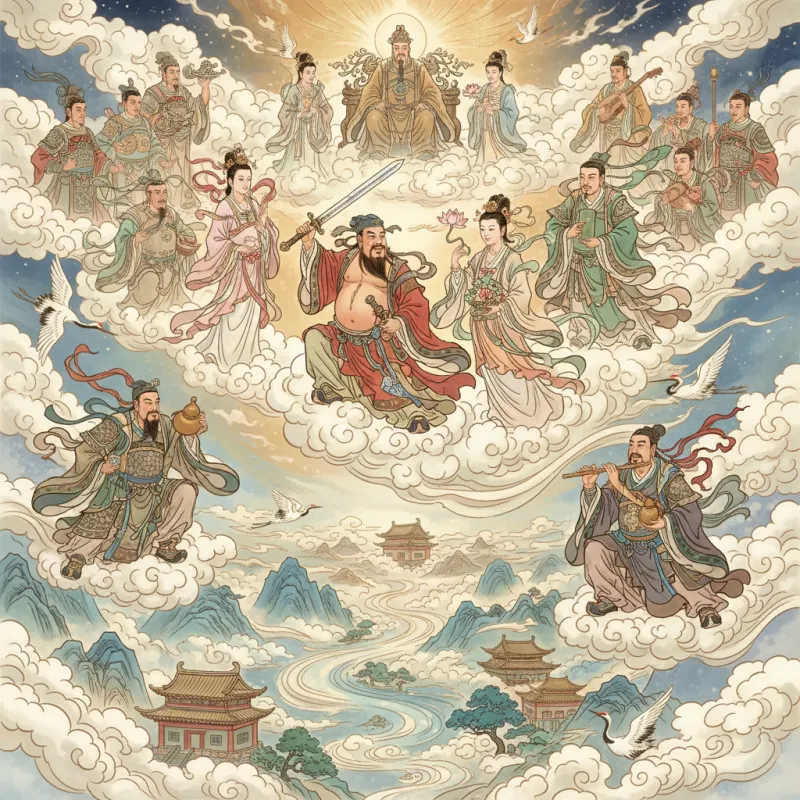
Picture this: a crippled beggar with a gourd full of medicine, a cross-dressing warrior who can't hold his liquor, and a woman who achieved immortality by eating the wrong peach walk into a celestial banquet. This isn't a joke — it's the Eight Immortals, and they've been China's most beloved supernatural squad for over a thousand years.
Why These Eight?
The Eight Immortals (八仙, Bāxiān) didn't start as a team. They were individual folk heroes, Daoist practitioners, and legendary figures who got bundled together sometime during the Song Dynasty (960-1279 CE), though their lineup didn't solidify until the Ming Dynasty (1368-1644). What's remarkable is that Chinese culture — which loves hierarchy, order, and proper social roles — chose these eight misfits as their immortal dream team.
They're not the most powerful beings in the Chinese pantheon. The Jade Emperor outranks them. They're not the wisest — that honor goes to Laozi. They're not even the most famous individually. But together? They represent something the rigid Confucian social order couldn't: the idea that anyone, regardless of gender, class, or physical ability, could achieve transcendence.
The Roster
Lü Dongbin (吕洞宾) is the de facto leader, though calling anyone the "leader" of this chaotic bunch is generous. A Tang Dynasty scholar who aced the imperial examinations, he had a dream where he lived an entire lifetime of official success that ended in disgrace and ruin. He woke up, said "no thanks" to bureaucratic life, and became an immortal instead. He carries a demon-slaying sword and appears in more Chinese art than any other immortal. His weakness? He's a bit of a womanizer, which gets him into trouble in numerous folk tales.
He Xiangu (何仙姑) is the sole woman, and her presence is more radical than it seems. In a tradition where female immortals were rare and usually achieved transcendence through male guidance, He Xiangu got there by accident — eating a supernatural peach (or mother-of-pearl, or mica powder, depending on which text you read). She carries a lotus flower and represents purity, but she's no passive maiden. In "Journey to the East" (东游记, Dōng Yóu Jì), she holds her own against demons and doesn't need rescuing.
Tieguai Li (铁拐李) — "Iron-Crutch Li" — is the immortal who proves that enlightenment doesn't require a perfect body. The story goes that his soul left his body to visit Laozi, and when he returned, his disciples had already cremated his corpse. He had to inhabit the body of a recently deceased beggar. Now he's crippled, ugly, and carries a gourd full of medicine that can cure any illness. He's grumpy, impatient, and absolutely essential to the team's appeal.
Zhongli Quan (钟离权) is the fat, jolly immortal with a fan that can revive the dead or kill the living, depending on which side he uses. A former general from the Han Dynasty, he discovered immortality after a military defeat. He's Lü Dongbin's teacher and the second-most prominent member of the group. His exposed belly is a symbol of contentment and his rejection of vanity.
Zhang Guolao (张果老) rides a white donkey that he can fold up like paper and store in his pocket. He's the oldest, possibly dating back to the 7th or 8th century CE, and he rides his donkey backward because he believes looking at where you've been is more important than where you're going. He carries a bamboo tube drum and represents the wisdom of age and the value of perspective.
Lan Caihe (蓝采和) is the gender-ambiguous immortal who wears one shoe, carries a flower basket, and is often depicted as drunk. Lan's gender fluidity (sometimes male, sometimes female, sometimes neither) made this immortal a queer icon long before modern terminology existed. Lan represents freedom from social conventions and the joy of living in the moment.
Han Xiangzi (韩湘子) is the musician, carrying a flute that can make flowers bloom and animals dance. He's supposedly the nephew of Han Yu, a famous Tang Dynasty Confucian scholar who opposed Buddhism and Daoism. The irony of a strict Confucian's nephew becoming a Daoist immortal wasn't lost on storytellers, who used Han Xiangzi to poke fun at rigid orthodoxy.
Cao Guojiu (曹国舅) is the aristocrat, brother of an empress, who gave up palace life after his brother committed murder. He wears court dress and carries castanets or a jade tablet. He represents the idea that even the privileged can achieve enlightenment — if they're willing to abandon their privilege.
The Power of the Ensemble
What makes the Eight Immortals work isn't their individual powers — it's their chemistry. They're the original found family, a group of people who shouldn't fit together but do. The crippled beggar and the aristocrat. The drunk and the scholar. The woman and the seven men who actually treat her as an equal.
Their most famous adventure, crossing the sea to attend a celestial banquet, showcases this dynamic. Instead of flying or teleporting like more powerful deities, each immortal uses their personal treasure to cross the water. Lü Dongbin rides his sword, He Xiangu floats on her lotus, Tieguai Li uses his gourd. It's not the most efficient method, but it's theirs. The phrase "Eight Immortals Crossing the Sea, Each Revealing Their Divine Powers" (八仙过海,各显神通, Bāxiān guò hǎi, gè xiǎn shéntōng) became a proverb meaning everyone contributes their unique talents to a common goal.
This is different from how other Chinese supernatural teams operate. The Four Heavenly Kings are warriors who follow orders. The Three Pure Ones are cosmic principles more than personalities. The Eight Immortals are individuals who choose to work together while remaining themselves.
Why They Endure
The Eight Immortals appear everywhere in Chinese culture — on porcelain, in opera, as decorative motifs on birthday celebrations (they're associated with longevity), and in countless folk tales. During the Qing Dynasty, they were so popular that "Eight Immortals" tables became standard furniture, with eight people sitting around an octagonal table, each position associated with one immortal.
They endure because they're aspirational without being unattainable. They're not born divine like the Jade Emperor or cosmically significant like Guanyin. They're people who achieved immortality through cultivation, luck, or sheer stubbornness. The beggar, the drunk, the woman, the disabled man — they all made it. That's a powerful message in a hierarchical society.
Modern adaptations keep finding new angles. In contemporary Chinese fantasy novels and games, the Eight Immortals appear as mentors, rivals, or even villains. Their treasures — the sword, the lotus, the gourd, the fan, the donkey, the flower basket, the flute, and the castanets — show up as legendary items players can collect. The team dynamic translates perfectly to modern ensemble storytelling.
The Deeper Magic
Here's what most casual retellings miss: the Eight Immortals aren't just folk heroes or magical beings. They're a Daoist teaching tool wrapped in entertaining stories. Each immortal represents a different path to transcendence and a different aspect of Daoist philosophy.
Tieguai Li embodies the principle that the body is just a vessel — enlightenment isn't about physical perfection. Lan Caihe represents freedom from gender roles and social expectations. Zhang Guolao's backward-riding donkey symbolizes the Daoist value of looking inward rather than chasing external goals. He Xiangu proves that women can achieve immortality without male guidance, challenging centuries of patriarchal religious practice.
The fact that they're a team rather than solitary hermits (the traditional Daoist ideal) is itself a statement. It suggests that community, friendship, and mutual support aren't obstacles to enlightenment — they're part of the path. This was a radical idea in a tradition that emphasized individual cultivation and withdrawal from society.
The Team That Shouldn't Work But Does
The Eight Immortals have survived dynasties, revolutions, and the shift from traditional to modern China because they're fundamentally about inclusion. They're the team that says you don't need to be born special, look perfect, or follow the rules to achieve something extraordinary. You just need to be yourself, find your people, and keep going.
In a mythology filled with stern emperors, fierce warriors, and remote cosmic beings, the Eight Immortals are the ones who feel human. They bicker, they drink, they make mistakes, and they show up for each other. That's not just good storytelling — it's why they've been China's favorite supernatural team for a thousand years and counting.
Related Reading
- Meet the Eight Immortals: Profiles of China's Favorite Supernatural Squad
- The Eight Immortals: China's Most Beloved Divine Group
- Symbols of the Eight Immortals: Hidden Meanings in Chinese Art
- Lü Dongbin: The Most Beloved Immortal in Chinese Culture
- Exploring the Enigmatic World of Chinese Immortals and Deities
- Dragon Worship in China: The Most Powerful Animal Deity
- Journey to the West: From Novel to Netflix — Every Major Adaptation