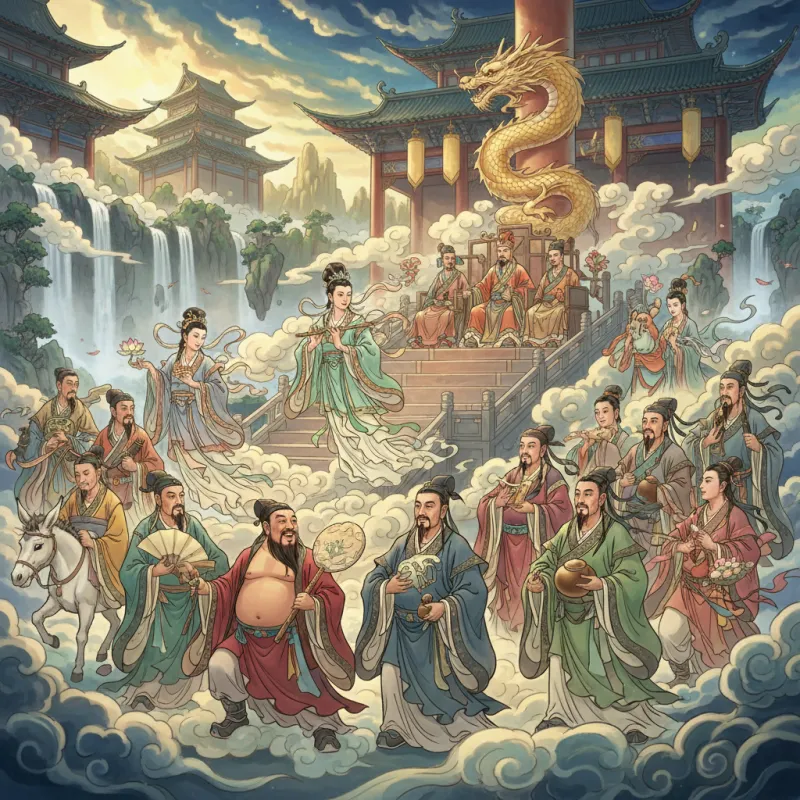
Picture this: a crippled beggar, a cross-dressing warrior, a drunken scholar, and a hermit with an iron crutch walk into a celestial banquet. No, this isn't the setup for a joke — it's the Eight Immortals, the most beloved and relatable divine squad in Chinese mythology. Unlike the remote Jade Emperor or the austere Buddha, these eight oddballs achieved immortality not through birthright but through sheer determination, moral virtue, and a healthy dose of cosmic luck.
Why the Eight Immortals Matter
The Eight Immortals (八仙, Bā Xiān) represent something radical in Chinese religious thought: the democratization of divinity. During the Tang and Song dynasties (618-1279 CE), when their legends crystallized, Chinese society was rigidly hierarchical. Yet here were eight figures — including a woman, a beggar, and a disabled man — who transcended mortality through personal cultivation rather than noble birth. This wasn't just mythology; it was social commentary wrapped in supernatural adventure.
Their popularity exploded during the Ming dynasty (1368-1644), appearing everywhere from temple murals to opera stages to the decorative arts. Even today, you'll spot them on everything from restaurant walls to lucky charms. They're the Avengers of Chinese folklore, except instead of fighting Thanos, they're battling demons, helping mortals, and occasionally getting spectacularly drunk.
The Magnificent Eight: A Closer Look
Lü Dongbin (吕洞宾) — The Heartthrob Scholar
If the Eight Immortals had a poster boy, it would be Lü Dongbin. This Tang dynasty scholar failed the imperial examinations (relatable content for centuries of Chinese students) and turned to Daoist cultivation instead. His signature weapon? A demon-slaying sword strapped to his back, which he wields while maintaining perfect scholarly composure.
Lü Dongbin's legends are deliciously complex. He's simultaneously a righteous demon-slayer and a notorious flirt who tests women's virtue — a contradiction that makes him fascinatingly human despite his immortal status. His most famous story involves the "Yellow Millet Dream," where his master Zhongli Quan showed him the futility of worldly ambition through a dream that lasted an entire lifetime but occurred in the time it took to cook millet. Talk about efficient enlightenment.
Zhongli Quan (钟离权) — The Jolly General
Zhongli Quan looks like your fun uncle who's had too much baijiu at the family reunion — portly, bare-bellied, and perpetually waving a fan. But don't let the jovial appearance fool you. This former Han dynasty general discovered the secrets of alchemy after a devastating military defeat drove him into the mountains.
His fan isn't just for cooling off; it can revive the dead and calm storms. More importantly, Zhongli Quan serves as the group's spiritual anchor and Lü Dongbin's teacher. He represents the transformation of martial power into spiritual wisdom, a common theme in Chinese philosophy where the greatest warriors eventually lay down their swords for meditation cushions.
He Xiangu (何仙姑) — The Only Woman
In a pantheon dominated by male figures, He Xiangu stands out as the sole female immortal among the eight. According to legend, she achieved immortality by eating a magical peach (or in some versions, mother-of-pearl powder) and vowed to remain celibate, dedicating herself to spiritual cultivation.
She carries a lotus flower, symbol of purity rising from muddy waters — a perfect metaphor for achieving enlightenment despite worldly obstacles. Her inclusion in the group is significant: it suggests that spiritual achievement transcends gender, a surprisingly progressive stance for medieval China. For more on female divine figures, check out The Role of Women in Chinese Immortal Traditions.
Lan Caihe (蓝采和) — The Gender-Fluid Wanderer
Lan Caihe is perhaps the most enigmatic of the eight. Depicted sometimes as male, sometimes as female, sometimes as a young person of indeterminate gender, Lan Caihe wanders the world in tattered blue robes, wearing only one shoe, singing cryptic songs about life's impermanence.
This immortal carries a flower basket and represents the arts, particularly music and poetry. But more than that, Lan Caihe embodies the Daoist principle of transcending dualities — including the binary of male and female. In a culture that traditionally emphasized rigid gender roles, Lan Caihe's fluidity was both unsettling and liberating.
Li Tieguai (李铁拐) — The Disabled Beggar
Li Tieguai might be the most visually striking of the eight: a disheveled beggar leaning on an iron crutch, often depicted with a crippled leg and wild, unkempt hair. His origin story is pure mythological gold. While his soul was traveling the celestial realms, his disciples mistakenly cremated his body. Returning to find himself homeless, Li's soul inhabited the only available corpse — that of a recently deceased beggar.
He carries a gourd that releases healing vapors and represents medicine and the aid of the poor. Li Tieguai's presence in the group sends a powerful message: physical disability doesn't preclude spiritual perfection. In fact, his very imperfection makes him more accessible to ordinary people struggling with their own limitations.
Zhang Guolao (张果老) — The Eccentric Elder
Zhang Guolao rides backward on a white donkey that can be folded up like paper and stored in his pocket when not needed. Yes, you read that right. This Tang dynasty hermit represents old age and wisdom, but with a decidedly quirky twist.
Historical records actually mention a real Zhang Guo who lived during the Tang dynasty and impressed Emperor Xuanzong with his magical abilities. The backward-riding donkey symbolizes his unconventional perspective — he sees where he's been rather than where he's going, suggesting that wisdom comes from reflecting on the past. His magical donkey that folds into his wallet? That's just showing off.
Han Xiangzi (韩湘子) — The Musical Prodigy
Han Xiangzi, the nephew of the famous Tang dynasty poet Han Yu, represents youth and the transformative power of music. His signature instrument is the flute (笛子, dízi), which can make flowers bloom and attract birds and animals.
The historical Han Yu was a Confucian scholar who opposed Buddhism and Daoism, making his nephew's transformation into a Daoist immortal deliciously ironic. Legend says Han Xiangzi tried to convert his uncle through magical demonstrations, including making flowers bloom in winter. Han Yu remained skeptical — a reminder that even immortals can't convince everyone.
Cao Guojiu (曹国舅) — The Reformed Nobleman
Cao Guojiu was born into privilege as the brother of an empress during the Song dynasty, but his family's corruption disgusted him. He abandoned wealth and status to pursue Daoist cultivation in the mountains, where he eventually achieved immortality.
He's typically depicted in court robes holding castanets or a jade tablet, representing his noble origins. Cao Guojiu's story offers hope for the privileged: even those born into corrupt systems can choose righteousness. He's the group's reminder that spiritual cultivation requires renouncing worldly power, not accumulating it.
The Eight Immortals in Action
The immortals rarely work alone. Their most famous adventure involves "The Eight Immortals Cross the Sea" (八仙过海, Bā Xiān Guò Hǎi), where each used their magical implement to traverse the ocean — Lü Dongbin on his sword, He Xiangu on her lotus, Li Tieguai in his gourd, and so on. This story spawned the proverb "八仙过海,各显神通" (Bā Xiān guò hǎi, gè xiǎn shéntōng) — "The Eight Immortals cross the sea, each displaying their divine powers" — meaning everyone has their own unique talents.
They appear throughout Chinese literature, from the Ming dynasty novel "Journey to the East" (东游记, Dōng Yóu Jì) to countless operas and folk tales. Unlike the distant gods of formal religion, the Eight Immortals regularly interact with mortals, solving problems, punishing the wicked, and rewarding the virtuous. They're the divine figures you might actually want to meet.
Why They Still Matter
The Eight Immortals endure because they represent achievable transcendence. They weren't born gods or enlightened beings — they were flawed humans who made it. A failed scholar, a defeated general, a disabled beggar, a gender-nonconforming artist — these aren't the usual suspects for divinity, and that's exactly the point.
In modern China, you'll still see their images in restaurants (especially seafood restaurants, referencing their sea-crossing adventure), on decorative arts, and in popular culture. They've been adapted into comics, video games, and films. Their message remains relevant: spiritual achievement isn't reserved for the perfect or privileged. It's available to anyone willing to cultivate virtue, practice discipline, and maybe learn a few magic tricks along the way.
For those interested in exploring more about Chinese immortal traditions, The Path to Immortality in Daoist Practice offers deeper insights into the spiritual practices these legends represent.
Related Reading
- Meet the Eight Immortals: Profiles of China's Favorite Supernatural Squad
- Lü Dongbin: The Most Beloved Immortal in Chinese Culture
- Symbols of the Eight Immortals: Hidden Meanings in Chinese Art
- The Eight Immortals: China's Most Beloved Supernatural Team
- Buddhist Deities in Chinese Culture: How India's Gods Became Chinese
- Nüwa Repairs the Sky: The Goddess Who Saved the World
- Animal Deities in Chinese Religion: When Foxes, Snakes, and Turtles Become Gods