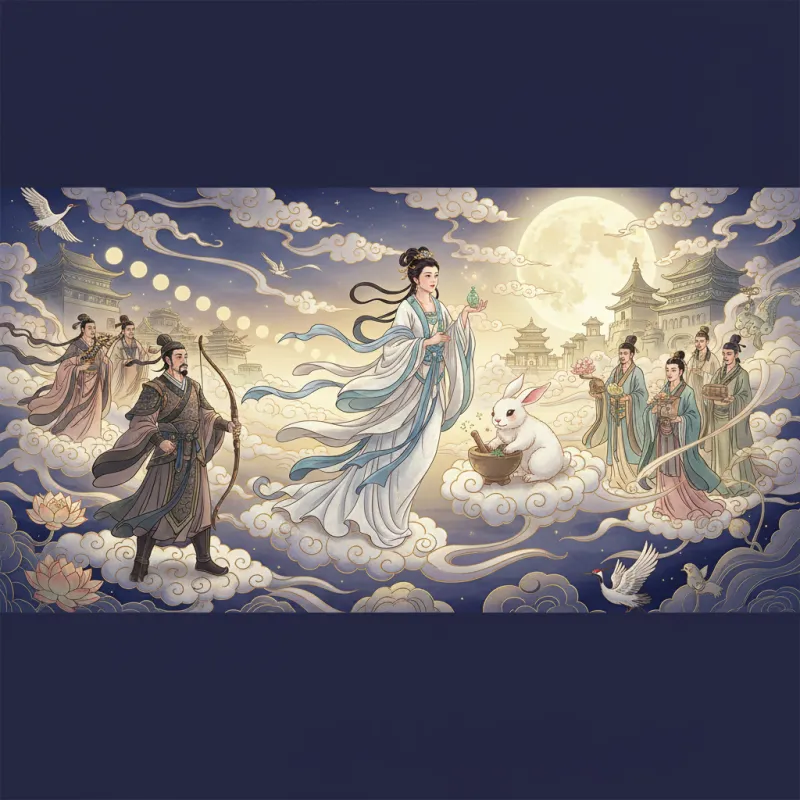
Every year on the fifteenth day of the eighth lunar month, millions of people across China step outside, tilt their heads skyward, and search the full moon for the shadow of a woman who's been trapped there for over four thousand years. They're looking for Chang'e (嫦娥 Cháng'é), the moon goddess whose story of love and separation has become so deeply woven into Chinese culture that an entire festival — complete with mooncakes, lanterns, and family reunions — exists to commemorate her loneliness.
The Archer Who Shot Down the Sky
The story doesn't start with romance. It starts with apocalypse.
In the time of the legendary Emperor Yao, ten suns appeared in the sky simultaneously. These weren't metaphorical suns — they were the actual sons of Dijun (帝俊 Dìjùn), the Eastern Heaven Emperor, and the goddess Xihe (羲和 Xīhé). The boys had gotten bored with their mother's strict schedule (one sun per day, rotating shifts) and decided to all go out at once.
The result was catastrophic. Rivers evaporated. Forests ignited. Crops turned to ash in the fields. People dropped dead from heatstroke. The earth was literally cooking.
Enter Hou Yi (后羿 Hòu Yì), the greatest archer in heaven and earth. The Jade Emperor gave him a simple mission: scare the suns into going home. Hou Yi had a different interpretation of the assignment. He drew his divine bow, took aim, and shot nine of the ten suns out of the sky, one after another. Each sun fell as a three-legged crow (金乌 jīnwū), crashing to earth in a ball of flames.
The world was saved. Hou Yi was a hero. And Dijun was absolutely furious that someone had just murdered nine of his ten children.
The Elixir of Immortality
Hou Yi's reward for saving humanity was exile. He and his wife Chang'e were stripped of their immortality and banished to live as mortals on earth. Imagine being a god, then suddenly having to worry about things like aging, disease, and death. It's the ultimate demotion.
But Hou Yi wasn't ready to accept mortality. He traveled to the Kunlun Mountains (昆仑山 Kūnlún Shān) to seek an audience with the Queen Mother of the West (西王母 Xīwángmǔ), the goddess who controlled the peaches of immortality and other life-extending treasures. After proving his worth (the texts are vague on how, but probably involved shooting something), she gave him a small bottle containing the elixir of immortality (不死药 bùsǐ yào).
There was a catch. The elixir was enough for two people to live forever, or one person to ascend directly to heaven and become a deity again. Hou Yi brought it home and hid it, planning to share it with Chang'e so they could at least live forever together, even if they couldn't return to heaven.
This is where the story fractures into multiple versions, each revealing something different about how the Chinese literary tradition has wrestled with Chang'e's choice.
The Theft: Hero or Villain?
Version One: The Selfish Wife
In the earliest version, recorded in texts like the Huainanzi (淮南子, 2nd century BCE), Chang'e simply steals the elixir and drinks it herself. No elaborate justification. No external threat. She just takes it and ascends to the moon, leaving her husband behind. This version paints her as selfish and impulsive — she chose immortality over love.
Version Two: The Desperate Escape
Later versions, particularly those from the Tang Dynasty onward, add a villain: Peng Meng (逢蒙 Péng Méng), one of Hou Yi's students. In this telling, Peng Meng breaks into their home while Hou Yi is out hunting, demanding the elixir at sword-point. Chang'e, faced with the choice of letting this violent man become immortal or drinking it herself, swallows the entire bottle. She floats up to heaven, but chooses to stop at the moon — the closest celestial body to earth, the closest she can be to her husband.
This version transforms Chang'e from selfish thief to tragic hero. She sacrifices her chance to return to heaven's glory, choosing instead a lonely exile on the moon just to remain near Hou Yi.
Version Three: The Accident
Some folk versions claim Chang'e drank the elixir by accident, mistaking it for water or wine. This strips away her agency entirely, turning the story into pure tragedy — a cosmic mistake that separated two lovers forever.
The version you believe says a lot about how you view women's choices, sacrifice, and autonomy. The Chinese literary tradition has never settled on one answer, which is perhaps why the story remains so compelling.
Life on the Moon
The moon in Chinese mythology isn't empty. It's a strange, melancholy place populated by a small cast of characters who keep Chang'e company in her exile.
The most famous is the Jade Rabbit (玉兔 Yùtù), who spends eternity grinding herbs with a mortar and pestle, trying to create another elixir of immortality. Some versions say he's grinding medicine for Chang'e. Others say he's trying to make an elixir that will let her return to earth. Either way, he never succeeds. The rabbit's endless, futile labor mirrors Chang'e's endless, futile wait.
There's also Wu Gang (吴刚 Wú Gāng), a woodcutter condemned to chop down a massive cassia tree (桂树 guìshù) that magically heals itself every time he strikes it. His crime varies by telling — some say he offended the gods, others that he tried to become immortal through forbidden means. Like the Jade Rabbit, he's trapped in an eternal loop of meaningless work.
The moon palace, called Guanghan Palace (广寒宫 Guǎnghán Gōng — literally "Vast Cold Palace"), is described as beautiful but freezing, magnificent but empty. It's a prison disguised as a palace, which feels appropriate for a goddess who may or may not have chosen to be there.
The Festival of Reunion and Separation
The Mid-Autumn Festival (中秋节 Zhōngqiū Jié) falls on the fifteenth day of the eighth lunar month, when the moon is at its fullest and brightest. Families gather to eat mooncakes, light lanterns, and admire the moon together. It's a celebration of reunion — but it exists because of a separation.
The festival's origins are murky, with evidence of moon worship dating back to the Shang Dynasty (1600-1046 BCE), but the association with Chang'e solidified during the Tang Dynasty (618-907 CE), when poets like Li Bai (李白 Lǐ Bái) wrote extensively about the moon goddess and her loneliness. The festival became official during the Song Dynasty (960-1279 CE), when mooncakes became the traditional food offering.
Mooncakes themselves carry symbolic weight. They're round like the full moon, representing completeness and reunion. During the Yuan Dynasty (1271-1368 CE), they allegedly served as vehicles for secret messages coordinating the rebellion against Mongol rule — though this story might be apocryphal. What's certain is that sharing mooncakes became a ritual of connection, a way of saying "we're together" while looking at the same moon that holds Chang'e in her solitary exile.
The festival embodies a peculiarly Chinese emotional complexity: celebrating togetherness by remembering separation, finding joy while acknowledging sorrow. You eat mooncakes with your family while thinking about a woman who can never be with hers.
Hou Yi's Fate: The Forgotten Half
While Chang'e gets all the attention, Hou Yi's story after her departure is darker and often overlooked.
In most versions, he's devastated. He sets up an altar with Chang'e's favorite foods and fruits, hoping she can somehow see or sense his offerings from the moon. This becomes the origin of the Mid-Autumn Festival's tradition of making offerings to the moon.
But some versions give Hou Yi a tragic ending. In the Huainanzi, he's eventually killed by his student Peng Meng (the same one who threatened Chang'e in some tellings) using a peach wood club. Other versions say he became a tyrannical ruler after Chang'e left, drunk on power and grief, until he was assassinated. The hero who saved the world ends up murdered by his own student or subjects — a fall from grace as dramatic as his wife's ascent to the moon.
There's a bitter irony here: Hou Yi saved humanity from the ten suns but couldn't save his own marriage. He could shoot down celestial bodies but couldn't hold onto the person he loved most.
Modern Echoes: From Myth to Moon Landing
Chang'e's story has proven remarkably durable. She appears in countless novels, films, TV shows, and even video games. The Chinese lunar exploration program is named after her — the Chang'e Project has sent multiple probes and rovers to the moon, including the Yutu (Jade Rabbit) rovers. There's something poetic about humanity finally reaching the moon that Chang'e has occupied in mythology for millennia, as if we're trying to visit her after all these centuries.
The story also resonates with anyone who's experienced separation from loved ones — whether through death, distance, or difficult choices. Chang'e's eternal gaze toward earth mirrors the experience of immigrants looking back at their homeland, or anyone separated from family by circumstances beyond their control. The moon becomes a symbol of longing itself, beautiful but unreachable.
Contemporary retellings often emphasize Chang'e's agency, framing her choice (in versions where it is a choice) as an act of defiance or self-preservation rather than selfishness. She becomes a figure of female autonomy, someone who chose her own fate even if that fate was lonely. This reading aligns with modern values while still honoring the story's emotional core.
The Unanswered Question
The Mid-Autumn Festival forces us to confront an uncomfortable question: Was Chang'e's choice worth it?
If she stole the elixir selfishly, she gained immortality but lost love. If she drank it to protect it from Peng Meng, she saved the world from a dangerous immortal but condemned herself to eternal solitude. If it was an accident, then the entire tragedy is meaningless — just cosmic bad luck.
The Chinese tradition doesn't provide a clear answer, and maybe that's the point. The story works because it's ambiguous, because it captures the reality that major life decisions often involve impossible choices between competing goods. Sometimes there is no right answer. Sometimes you choose immortality and lose love, or choose love and lose everything else.
Every Mid-Autumn Festival, when families gather under the full moon, they're participating in a ritual that's both celebration and memorial. They're together, but they're thinking about someone who's alone. They're eating mooncakes and laughing, but they're also acknowledging that sometimes love isn't enough, that sometimes people are separated by forces beyond their control, and that longing — like the moon itself — is a constant presence in human life.
Chang'e is still up there, looking down. The Jade Rabbit is still grinding his herbs. Wu Gang is still chopping his tree. And we're still looking up, searching the moon's surface for shadows that might be a woman who made a choice — or had a choice made for her — thousands of years ago.
The moon is full. The mooncakes are sweet. And somewhere in the vast cold palace, Chang'e is alone.
For more on Chinese festival traditions and their mythological origins, explore The Dragon Boat Festival and Qu Yuan's Legacy or discover The Kitchen God and Chinese New Year Customs.
Related Reading
- Dragon Boat Festival: The Poet, the River, and the Race
- Exploring Chinese Deities and Immortals: Traditions of the Daoist and Buddhist Pantheon
- Gods of Chinese New Year: The Deities Behind the Festival
- Chinese Festivals and Their Gods: The Calendar of Divine Celebrations
- The Lantern Festival: When Gods Walk Among Mortals
- Unveiling the Rich Tapestry of Chinese Deities and Immortals
- Nezha: From Rebellious Child God to China's Biggest Animated Film
- Exploring the Rich Pantheon of Chinese Deities and Immortals in Daoism and Buddhism