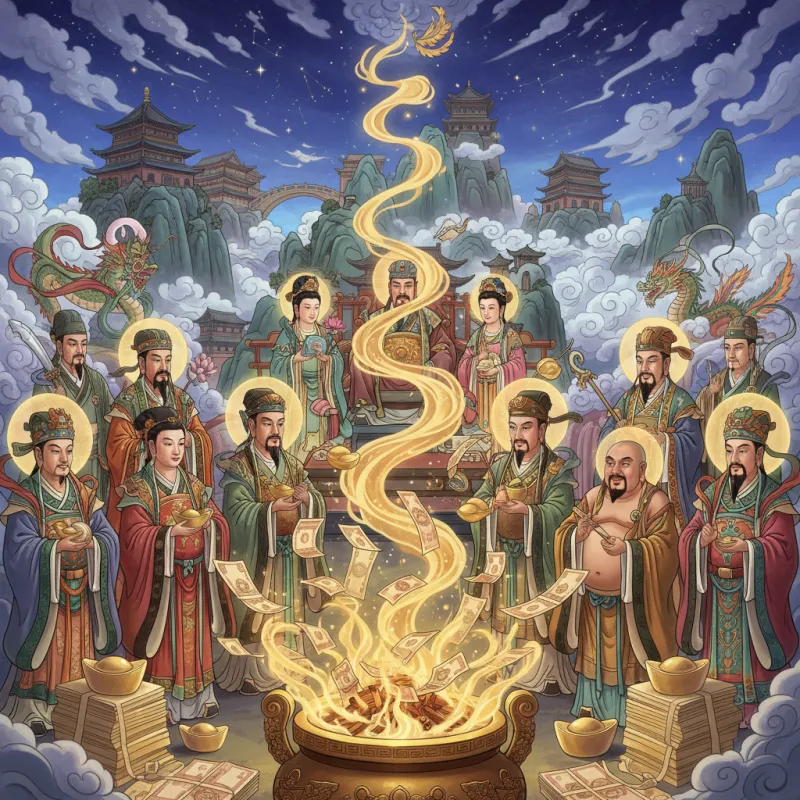
The paper crackles and blackens, curling into ash as flames lick upward from the metal basin. An elderly woman kneels on the sidewalk outside a Hong Kong apartment building, feeding stack after stack of gold-foiled joss paper into the fire. To passersby, it might look like she's burning trash. But she's doing something far more deliberate: she's making a bank transfer to her deceased husband, ensuring he has spending money in the afterlife.
This is ghost money burning, and it operates on a premise that would make perfect sense to any ancient Chinese bureaucrat: the dead have bills to pay.
The Afterlife Economy Runs on Paper
The Chinese underworld isn't some vague spiritual realm—it's a fully functioning society with its own economic system. When someone dies, they don't simply cease to exist or float off to some abstract paradise. They enter a bureaucratic afterlife governed by the Ten Courts of Hell, each presided over by a Yama King (阎罗王 Yánluó Wáng) who judges souls and assigns them to appropriate realms based on their earthly conduct.
But here's the thing: even in the afterlife, you need money. The dead must pay bribes to underworld officials, purchase food and clothing, and maintain a household. Without funds, they suffer. They go hungry. They wear rags. They become what the Chinese call "hungry ghosts" (饿鬼 èguǐ)—desperate, wandering spirits who cause trouble for the living.
This is where joss paper (金纸 jīnzhǐ) comes in. Also called spirit money, ghost money, or hell money, these paper offerings serve as currency in the afterlife. When burned, the physical paper transforms into spiritual wealth that deceased relatives can access and spend. The smoke carries the essence upward—or downward, depending on where your loved ones ended up.
The practice isn't superstition dressed up as ritual. It's a logical extension of Chinese cosmology. If the afterlife mirrors the living world in structure and function, then of course it has an economy. And if it has an economy, someone needs to fund it.
What You're Actually Burning
Walk into any Chinese temple or funeral supply shop, and you'll find an astonishing variety of joss paper products. The traditional form is simple: rectangular sheets of paper with gold or silver foil, representing gold and silver ingots (元宝 yuánbǎo). These are the standard currency, accepted everywhere in the afterlife.
But the modern ghost money market has expanded dramatically. You can now purchase paper representations of nearly anything: houses, cars, smartphones, designer handbags, credit cards, even servants. There are paper laptops, paper air conditioners, paper bottles of expensive liquor. I once saw a paper yacht in a Taipei shop, complete with a tiny paper crew.
The logic is consistent: if you can burn it, your ancestors can use it. The transformation through fire is what matters. The paper iPhone becomes a real iPhone in the spirit world. The paper mansion becomes actual real estate.
Different types of offerings serve different purposes. Hell Bank Notes (冥币 míngbì) are printed with denominations that would make hyperinflation economists weep—millions, billions, even trillions of dollars. These aren't meant to be realistic; they're meant to be generous. You're not trying to send your grandmother exactly $47.50. You're trying to make her wealthy beyond measure.
Gold paper (金纸 jīnzhǐ) is typically offered to deities and higher-ranking spirits. Silver paper (银纸 yínzhǐ) goes to ancestors and deceased family members. There's a hierarchy even in paper offerings, reflecting the stratified nature of the Chinese spiritual bureaucracy.
When and Why You Burn
The burning of ghost money follows a ritual calendar that punctuates the Chinese year. The most important occasion is Qingming Festival (清明节 Qīngmíng Jié), the tomb-sweeping day when families visit ancestral graves, clean the burial sites, and make offerings. This typically falls in early April, and if you're in any Chinese community during this time, you'll see smoke rising from cemeteries and roadsides as families burn paper money and goods.
The Hungry Ghost Festival (中元节 Zhōngyuán Jié), celebrated on the fifteenth day of the seventh lunar month, is another major burning occasion. During this month, the gates of hell open and spirits roam freely. Families burn offerings not just for their own ancestors but for wandering ghosts who have no descendants to care for them. It's both an act of filial piety and a form of spiritual insurance—you feed the hungry ghosts so they don't cause problems.
But you don't need to wait for festivals. Many families burn offerings on the first and fifteenth of each lunar month, or on the anniversary of a loved one's death. Some burn paper money weekly. The frequency depends on family tradition, religious devotion, and how much you believe your ancestors need.
Funerals are the most elaborate burning occasions. At a traditional Chinese funeral, mourners burn vast quantities of paper goods—entire paper houses, wardrobes full of paper clothing, paper servants to attend the deceased. The logic is practical: the person is starting a new life in the afterlife, and they need to be properly equipped. You wouldn't send someone to a foreign country with no money and no possessions. Why would you send them to the afterlife that way?
The Ritual Mechanics
Burning ghost money isn't just about lighting paper on fire. There's a proper way to do it, and the details matter.
First, you need the right container. A metal basin or bucket works well. Some families use special burning towers (金炉 jīnlú) designed specifically for this purpose. The container should be stable and placed in a safe location—preferably outdoors, away from flammable materials. I've seen apartment dwellers burn offerings in their building's courtyard, on sidewalks, even in parking garages. The location is less important than the intention.
Before burning, you should announce who the offering is for. Speak clearly: "This is for [name], my [relationship]." Some people write the recipient's name on the paper itself. This ensures the offering reaches the correct person. The afterlife postal system is efficient, but you still need to address your packages properly.
Light the paper and let it burn completely. Don't extinguish the flames prematurely. The transformation must be total. Partially burned paper is partially transferred wealth—useless to the recipient.
As the paper burns, you can speak to your ancestors. Tell them about your life. Ask for their blessings. Express your gratitude. The burning is a communication channel, not just a transaction. Many people find this aspect more meaningful than the material offering itself.
After the burning, dispose of the ashes respectfully. Some people scatter them in running water, symbolically sending them to the underworld. Others simply sweep them up and discard them. The ashes themselves have no power—the spiritual essence has already been transferred.
The Skeptic's Question
Does any of this actually work? Do the dead really receive these offerings?
The honest answer is: it depends on what you mean by "work." If you're asking whether paper money literally transforms into usable currency in some parallel dimension, that's a metaphysical question beyond empirical verification. But if you're asking whether the practice serves important psychological, social, and spiritual functions, the answer is unambiguously yes.
Burning ghost money is an act of remembrance. It keeps the dead present in the lives of the living. It provides a structured way to express grief, love, and ongoing connection. In cultures where ancestor veneration is central to religious life, these rituals aren't optional extras—they're how you maintain family bonds across the boundary of death.
The practice also reflects a deeply pragmatic worldview. Chinese folk religion doesn't traffic much in abstract theology. It's concerned with practical results: health, prosperity, protection, harmony. If burning paper money brings peace of mind, strengthens family cohesion, and honors the dead, then it works. The mechanism is less important than the outcome.
There's also something profound about the transformation itself. Fire is the universal transformer—it turns solid matter into smoke and ash, the physical into the immaterial. Every culture has fire rituals for precisely this reason. The Chinese simply applied this principle to economics.
Modern Adaptations and Controversies
Like all traditional practices, ghost money burning has evolved. In Singapore and Malaysia, where environmental concerns have grown, some temples now offer centralized burning services to reduce air pollution. You can drop off your paper offerings, and the temple burns them on your behalf in controlled, efficient furnaces.
Digital alternatives have emerged. Some websites offer virtual burning services—you select paper goods online, make a payment, and the site claims to transfer the spiritual essence to your ancestors. Whether this works is hotly debated. Traditionalists argue that the physical act of burning is essential. Modernists counter that intention matters more than method.
The environmental impact is a legitimate concern. During major festivals, the smoke from burning offerings can significantly affect air quality in Chinese communities. Some cities have imposed restrictions or designated burning zones. This has sparked debates about religious freedom versus public health.
There's also the question of what to burn. The proliferation of luxury paper goods—paper Ferraris, paper Rolex watches, paper mansions—strikes some as crass materialism imported into the afterlife. Critics argue that the practice has become commercialized, losing its spiritual essence. Defenders point out that Chinese folk religion has always been pragmatic and material. The dead need what the living need, and what the living need has changed.
Some Buddhist and Daoist reformers have pushed back against excessive burning, arguing that true spiritual merit comes from ethical conduct and meditation, not material offerings. They're not wrong, but they're also fighting against centuries of popular practice. For most Chinese families, burning ghost money isn't theology—it's what you do for your parents and grandparents. It's how you show respect.
The Deeper Logic
At its core, burning ghost money is about reciprocity. Chinese culture is built on networks of obligation and exchange. You care for your parents when they're old because they cared for you when you were young. You honor your ancestors because they gave you life. The relationship doesn't end at death—it transforms.
This is why the practice persists even among educated, modern Chinese people who might not believe in literal afterlife economics. It's not really about belief. It's about duty, memory, and connection. It's about saying: I haven't forgotten you. You still matter. I'm still taking care of you.
The ritual also acknowledges something uncomfortable: the dead are vulnerable. They depend on the living for sustenance and comfort. This inverts the usual power dynamic. In life, children depend on parents. In death, parents depend on children. Burning offerings is how you fulfill that reversed obligation.
There's a beautiful symmetry to it. Your ancestors gave you life, raised you, provided for you. Now you provide for them. The smoke rises, carrying your offerings upward, and in return, you receive their blessings and protection. It's an economy of care that transcends the boundary between worlds.
Whether you believe in the literal mechanics or not, the practice embodies a worldview worth considering: the dead are not gone. They're elsewhere, and they still need us. And we still need them.
Related Reading
- How to Offer Incense: A Practical Guide to Chinese Temple Worship
- Chinese Funeral Traditions: A Guide to Death Customs
- Chinese Rituals and Ceremonies: The Sacred Practices That Connect Heaven and Earth
- Chinese Rituals for the Dead: A Practical Guide to Ancestor Worship
- Exploring Chinese Deities and Immortals: Rituals in Daoist and Buddhist Traditions
- Celestial Warriors: The Mightiest Fighters in Chinese Heaven
- Exploring the Enigmatic World of Chinese Immortals and Deities
- Sun Wukong as a Real Deity: Temples and Worship of the Monkey God