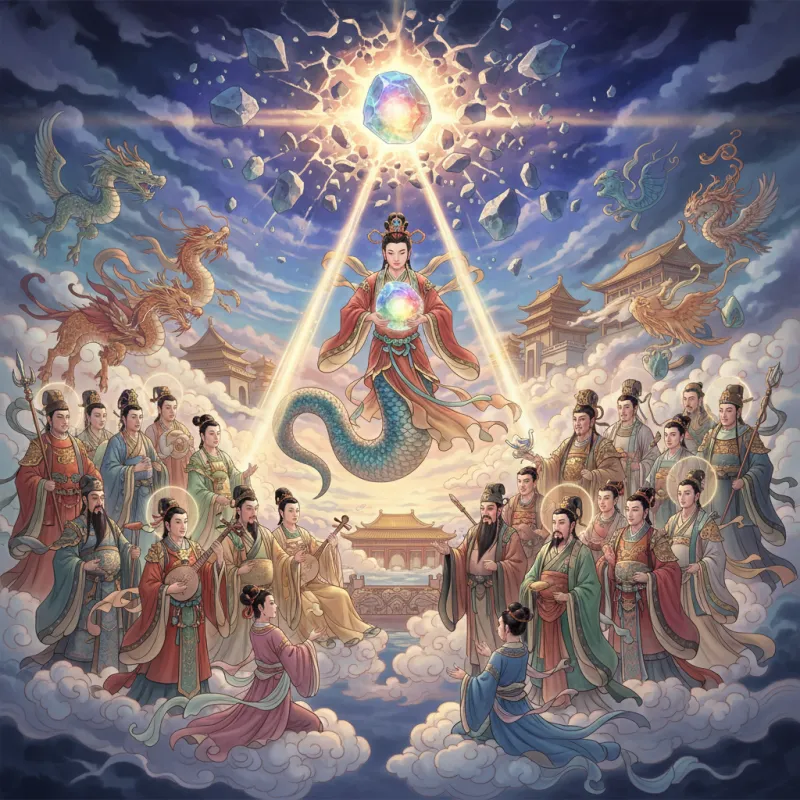
The sky was falling. Not metaphorically — literally cracking open like an eggshell, with chunks of heaven crashing down onto the earth below. Water poured through the fissures in torrents, fire erupted from the ground, and the four corners of the world tilted dangerously as their cosmic supports gave way. This wasn't some distant apocalypse or abstract catastrophe. This was the world ending in real time, and there was exactly one person who could fix it: a half-serpent goddess named Nüwa (女娲 Nǚwā), who had already created humanity on a whim and was now about to save it through sheer force of will and some very creative engineering.
The Goddess Who Builds Worlds
Nüwa doesn't fit neatly into any category. She's not a fertility goddess, though she creates life. She's not a war deity, though she fights cosmic battles. She's not a mother figure in the soft, nurturing sense — she's more like a cosmic architect who happens to care about her creations surviving. Her lower body is that of a serpent, her upper body human, and her temperament is that of someone who sees a problem and immediately starts looking for solutions rather than wringing her hands about fate or destiny.
The earliest mentions of Nüwa appear in texts like the Shanhaijing (山海经 Shānhǎijīng, "Classic of Mountains and Seas"), compiled during the Warring States period and Han Dynasty, though her myths likely predate these written records by centuries. She exists in that fascinating space where creation mythology meets practical problem-solving — less "let there be light" and more "let me grab some mud and see what happens."
Making Humans: The Casual Creation
Here's what makes Nüwa's creation of humanity so distinctly Chinese: it wasn't planned. According to the myths recorded in texts like the Fengsu Tongyi (风俗通义 Fēngsú Tōngyì) from the Eastern Han Dynasty, Nüwa found herself alone in a newly formed world and felt lonely. So she knelt by a river, scooped up some yellow clay, and shaped it into a figure that looked like her — but with legs instead of a serpent's tail.
When she set it down, it came to life. Delighted, she made more. But hand-crafting each human was tedious work, so she did what any practical deity would do: she grabbed a rope, dipped it in mud, and swung it around. The droplets that flew off became people. The carefully crafted figures became the nobles and aristocracy; the mud-splatter humans became commoners. It's a creation myth that accidentally encodes social hierarchy while also suggesting that even the gods get tired of repetitive tasks.
This casual, almost accidental quality to human creation stands in stark contrast to the deliberate acts in other mythologies. Nüwa didn't create humans to worship her, to serve some cosmic purpose, or to fulfill a divine plan. She made them because she was bored and wanted company. It's refreshingly honest.
When Heaven Broke
The myth of Nüwa repairing the sky appears in several ancient texts, most notably the Huainanzi (淮南子 Huáinánzǐ), a philosophical compilation from the Western Han Dynasty. The story goes like this: two powerful deities, Gonggong (共工 Gònggōng), the god of water, and Zhuanxu (颛顼 Zhuānxū), fought a catastrophic battle. In his rage after losing, Gonggong smashed his head against Mount Buzhou (不周山 Bùzhōu Shān), one of the cosmic pillars holding up the sky.
The mountain shattered. The northwestern corner of the sky collapsed. The earth tilted to the southeast — which is why, the myth explains, all rivers in China flow eastward and southward, and why the sun, moon, and stars appear to move toward the west. The cosmic order was literally broken, and the world was drowning in floods while burning from fires that erupted through cracks in the earth.
Most deities, faced with this scenario, might have despaired or called a council or debated the proper response. Nüwa went to work.
The Engineering Solution
What Nüwa did next is one of the most striking images in Chinese mythology: she gathered stones of five different colors from river beds, smelted them down, and used the molten material to patch the holes in the sky. Think about that for a moment. She didn't pray the sky back together or use some abstract divine power. She literally performed cosmic metallurgy.
But the sky was only part of the problem. The earth's corners were still unsupported, tilting dangerously. So Nüwa killed a giant turtle — specifically, the cosmic turtle Ao (鳌 Áo) — and cut off its four legs to use as new pillars at the corners of the world. She gathered reeds, burned them to ash, and used the ash to dam the floodwaters. She killed a black dragon that was terrorizing the Central Plains and drove away the predatory birds and beasts that had emerged from the chaos.
This is not gentle mother-goddess behavior. This is a deity who sees a broken world and fixes it through violence, craft, and sheer determination. The turtle detail is particularly striking — it's brutal, practical, and suggests that sometimes saving the world requires sacrifice, even of cosmic creatures.
The Imperfect Repair
Here's what makes this myth even more interesting: Nüwa's repair wasn't perfect. The sky still has a slight tilt. The earth still leans to the southeast. The sun and moon still move across the sky in their tilted paths. Some versions of the myth say you can still see the cracks in the sky if you look carefully at sunset, the five-colored stones visible in the clouds.
This imperfection is crucial. It suggests that even divine intervention has limits, that some damage cannot be completely undone, that the world we live in bears the scars of ancient catastrophes. It's a more honest cosmology than one where everything is perfect and ordered. The world works, but it's patched together, slightly broken, held up by improvised solutions. There's something deeply human about that, even in a myth about gods.
Nüwa's Legacy in Chinese Culture
Nüwa's influence extends far beyond ancient texts. She appears in the Fengshen Yanyi (封神演义 Fēngshén Yǎnyì, "Investiture of the Gods"), the Ming Dynasty novel where she plays a pivotal role in the fall of the Shang Dynasty. In that story, she's worshipped in a temple, and when King Zhou writes a lustful poem about her statue, she becomes furious and sets in motion the events that will destroy his kingdom. Even there, she's not a passive figure — she's an active force who demands respect and punishes those who fail to give it.
In folk religion, Nüwa is sometimes worshipped as a goddess of marriage and childbirth, which makes sense given her role as humanity's creator. But this domestication of her image misses something essential about her character. She's not primarily about fertility or family — she's about creation and repair, about seeing what needs to be done and doing it, regardless of how difficult or violent the solution might be.
Her story connects to broader themes in Chinese mythology, particularly the idea that the cosmos requires active maintenance. Unlike mythologies where creation happens once and then runs on its own, Chinese cosmology often features deities and immortals who must continually work to keep things functioning. Pangu and the Cosmic Egg tells of the first act of creation, but Nüwa's story is about the second act — the repair, the maintenance, the ongoing work of keeping a world alive.
The Goddess Who Doesn't Fit
What makes Nüwa so compelling is precisely that she resists easy categorization. She's a creator goddess who makes humans almost by accident. She's a mother figure who kills cosmic turtles and dragons. She's a feminine deity whose primary attributes are strength, skill, and determination rather than beauty or nurturing. She's a serpent-bodied goddess in a culture that would later associate dragons and serpents with masculine yang energy, yet she's undeniably female and powerful.
In some ways, she represents an older stratum of Chinese mythology, before the rigid categorizations of yin and yang, before the systematization of the pantheon into neat hierarchies. She's a reminder that the earliest Chinese deities were often more complex, more contradictory, more interesting than their later, more refined versions.
The image of Nüwa with her serpent tail, holding up stones to patch the sky, remains one of the most powerful in Chinese mythology. It's an image of divine labor, of a goddess who doesn't just command but acts, who doesn't just create but maintains, who doesn't just nurture but fights. In a world that was literally falling apart, she was the one who held it together — not through prayer or meditation or cosmic authority, but through skill, determination, and a willingness to do whatever was necessary.
The sky still bears the marks of her repair. The earth still tilts from that ancient catastrophe. And humanity still exists because a lonely goddess decided to make some companions out of mud, then refused to let them die when the heavens collapsed. That's the story of Nüwa: not a gentle mother, but a cosmic engineer who happened to care enough to save the world she'd accidentally populated. For more on the divine figures who shaped Chinese cosmology, explore The Jade Emperor: Ruler of Heaven and Earth.
Related Reading
- Pangu Opens Heaven and Earth: The Chinese Creation Story
- Creation Myths in Chinese Religion: How Gods Made the World
- Exploring Chinese Deities and Immortals in Daoist and Buddhist Creation Myths
- Fuxi: The God-Emperor Who Gave Humanity Civilization
- The Eight Immortals: China's Most Beloved Divine Group
- Unraveling the Mystique of Chinese War Gods in the Daoist and Buddhist Pantheon
- Black and White Impermanence: The Soul Collectors