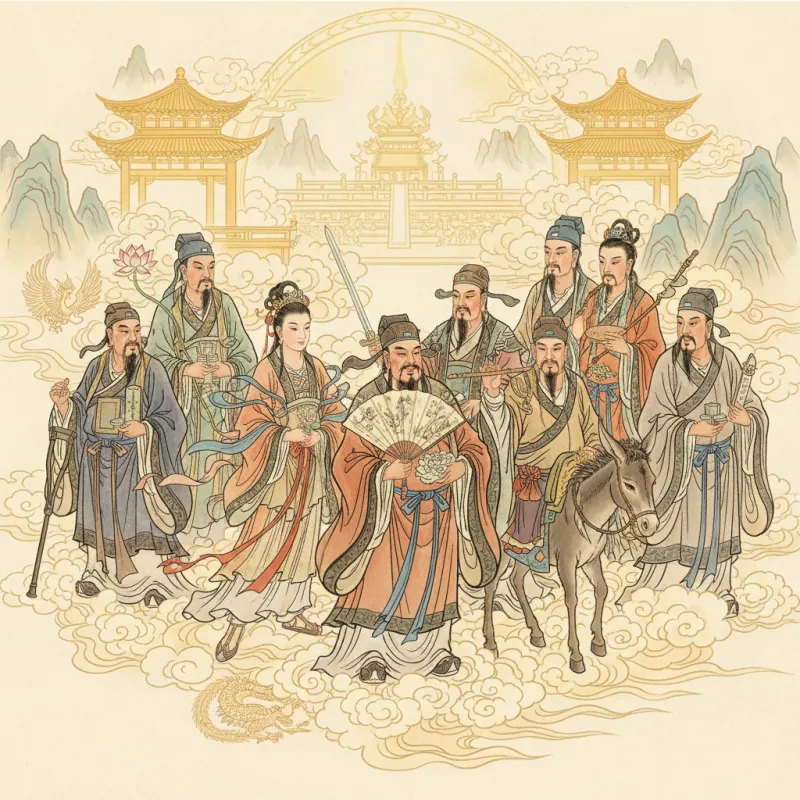
Picture this: a cripple throws his iron crutch into the sea and it becomes a boat. A drunk old man rides his donkey backward through clouds. A woman tosses a lotus flower that transforms into a flying carpet. A beggar waves his gourd and wine flows endlessly. This isn't a fever dream — it's just another Tuesday for the Eight Immortals (八仙 Bāxiān), the most beloved and accessible deities in Chinese mythology. While the Jade Emperor sits on his throne drowning in paperwork and the Buddha meditates in cosmic silence, these eight misfits are out here getting drunk, playing pranks, and proving that enlightenment doesn't require a palace or a PhD in Daoist scripture.
The Revolutionary Democracy of Heaven
The Eight Immortals shatter every expectation about who deserves divinity. In a celestial bureaucracy where most gods are former emperors, generals, or scholars who memorized the Confucian classics, the Bāxiān are aggressively ordinary. Their roster reads like a deliberate middle finger to social hierarchy: Lü Dongbin (吕洞宾), a failed scholar who turned to Daoism after flunking the imperial exams eight times. Li Tieguai (李铁拐), a beggar with a crippled leg who inhabits a corpse. He Xiangu (何仙姑), the only woman, who achieved immortality by eating powdered mica. Lan Caihe (蓝采和), whose gender remains ambiguous across centuries of stories. Zhang Guolao (张果老), an old man who literally rides backward into the future. Han Xiangzi (韩湘子), a flute-playing musician. Cao Guojiu (曹国舅), a disgraced nobleman. And Zhongli Quan (钟离权), a rotund general with his belly hanging out.
This diversity isn't accidental — it's the entire point. The Eight Immortals represent the Daoist principle that the Dao (道) is available to everyone, regardless of birth, education, or physical ability. You don't need to be born into the right family or pass bureaucratic exams. You just need to cultivate your inner nature and achieve spiritual transformation. Compare this to the rigid hierarchy of the Jade Emperor's celestial bureaucracy, where your heavenly rank depends on your earthly credentials, and you'll see why common people loved the Eight Immortals. They're proof that the cosmic game isn't rigged.
The Origin Story Nobody Agrees On
Here's where it gets messy: the Eight Immortals don't have a single origin story. They're a Frankenstein's monster of folklore, assembled over centuries from different sources, regions, and time periods. Some members appear in Tang Dynasty (618-907 CE) texts. Others don't show up until the Ming Dynasty (1368-1644 CE). The definitive lineup we know today crystallized during the Yuan and Ming dynasties, popularized by the novel "Dong You Ji" (东游记 Journey to the East), written around the 16th century — basically the Avengers: Endgame of Chinese mythology, where all the solo heroes finally team up.
Individual immortals had their own cults and legends long before they joined the group. Lü Dongbin, for instance, was already a rock star in Daoist circles by the Song Dynasty (960-1279 CE), with temples dedicated to him and stories about his supernatural sword skills and his habit of testing people's virtue by appearing as a beggar or a beautiful woman. Li Tieguai's legend involves his soul leaving his body to visit Laozi (老子), only to return and find his original body cremated, forcing him to inhabit a dead beggar's corpse — a story that explains both his crippled appearance and his perpetual bad mood. The genius of grouping them together was that it created a divine team that covered all bases: male and female, young and old, rich and poor, able-bodied and disabled.
The number eight itself carries weight. In Chinese numerology, eight (八 bā) sounds like "prosper" (发 fā) and represents balance and cosmic harmony. Eight trigrams form the basis of the I Ching. Eight directions define space. Eight immortals create a complete spiritual ecosystem, a portable pantheon that could be invoked for any occasion. For more on how numbers shape Chinese spiritual thinking, see Daoist Cultivation Methods.
The Personalities: A Closer Look at the Divine Misfits
Let's get specific about who these characters actually are, because their personalities matter as much as their powers.
Lü Dongbin is the unofficial leader and the most popular member. He's the immortal equivalent of a wandering ronin — a swordsman-scholar who roams the earth testing mortals and slaying demons. His signature move is the "Sword of Wisdom" that cuts through illusion. He's also famous for his "Ten Trials," a series of tests he endured to prove his enlightenment, including watching his entire family die (they were illusions) and being seduced by beautiful women (also illusions). He failed the imperial exams but passed the cosmic ones. His symbol is a sword, and he's the patron of barbers, a detail that makes zero sense until you realize barbers used to be surgeons, and Lü Dongbin is associated with healing.
Li Tieguai is the grumpy disabled immortal who proves that enlightenment doesn't require a perfect body. His iron crutch doubles as a weapon and a flying device. His gourd contains magical medicine and, depending on the story, either healing elixirs or his own soul, which he can release as a vapor. He's the patron of the sick and disabled, and his iconography — a beggar with a crutch — was revolutionary for depicting disability in divine form rather than as punishment for past-life sins.
He Xiangu achieved immortality by eating powdered mother-of-pearl and mica on a mountain, which sounds like a terrible diet plan but apparently worked. She carries a lotus flower, symbol of purity rising from mud, and a peach, symbol of longevity. She's often depicted as young and beautiful, but her real significance is being the only woman in the group, representing the Daoist belief that women can achieve the same spiritual heights as men — a radical position in Confucian-dominated imperial China.
Lan Caihe is the wild card, depicted sometimes as male, sometimes female, sometimes as a young person of indeterminate gender. They wander around singing cryptic songs, wearing only one shoe, and carrying a basket of flowers. In some stories, Lan Caihe is a street performer or a drunk. Their gender fluidity makes them a fascinating figure in Chinese mythology, suggesting that enlightenment transcends binary categories. The single shoe is never explained, which somehow makes it more perfect.
Zhang Guolao rides his donkey backward because, as he explains, going forward is actually going backward in the cosmic sense. When he's not riding, he folds the donkey up like paper and stores it in his sleeve. He's associated with longevity and is often depicted as elderly, proving that you're never too old to achieve immortality — a comforting thought. His symbol is a fish drum made from bamboo, which he plays while riding backward into enlightenment.
Han Xiangzi is the musician and poet, nephew of the famous Tang Dynasty scholar Han Yu. His flute can make flowers bloom and attract phoenixes. He represents the artistic path to enlightenment, the idea that beauty and music can be spiritual practices. He's the immortal for everyone who ever felt that art was their religion.
Cao Guojiu is the only one born into nobility — he was supposedly the brother of an empress during the Song Dynasty. He gave up his wealth and status after his brother committed crimes, choosing exile and spiritual cultivation over privilege. His symbol is a pair of castanets or a jade tablet, representing his former court rank. He's proof that even the privileged can achieve enlightenment, though they have to give up their privilege first.
Zhongli Quan is the fat, jolly general with his belly exposed, carrying a fan that can revive the dead or calm storms. He's often depicted shirtless, his rotund belly on full display — a body type rarely celebrated in divine iconography. He taught Lü Dongbin the secrets of immortality, making him the teacher of the group's most famous member. His fan and his belly represent abundance and the Daoist principle of embracing natural form rather than conforming to idealized standards.
The Famous Sea Crossing and Other Adventures
The most famous Eight Immortals story is "The Eight Immortals Cross the Sea" (八仙过海 Bāxiān Guò Hǎi), which has become a Chinese idiom meaning "each shows their special prowess" or "everyone contributes their unique skills." The story goes: the immortals decide to cross the sea to attend a festival, but instead of flying together, they each use their signature magical item as a vehicle. Lü Dongbin rides his sword. Li Tieguai uses his crutch as a raft. He Xiangu floats on her lotus. Lan Caihe sails on their flower basket. And so on. The Dragon King of the Eastern Sea takes offense at their trespassing and sends his son to stop them, which leads to a massive battle that the immortals win through teamwork and individual brilliance.
This story encapsulates their appeal: they're powerful but playful, divine but accessible, and they work together despite their differences. It's been adapted into operas, films, TV shows, and video games. The phrase "Eight Immortals cross the sea" is still used in modern Chinese to describe collaborative problem-solving where everyone brings different strengths.
Other adventures include their battles with demons, their attendance at the Queen Mother of the West's peach banquet (see Xi Wangmu: The Queen Mother of the West), and their various interventions in human affairs. Unlike distant gods who require elaborate rituals, the Eight Immortals show up in disguise to test mortals' virtue, reward the kind, and punish the wicked. They're the divine equivalent of undercover bosses, constantly checking if humans are behaving ethically when they think nobody's watching.
Cultural Impact: From Temple Walls to Modern Media
Walk into any Chinese restaurant, temple, or grandmother's house, and you'll likely see the Eight Immortals somewhere — on paintings, porcelain, embroidery, or carved wood panels. They're ubiquitous in Chinese visual culture, more recognizable than most emperors. During the Qing Dynasty (1644-1912), they appeared on everything from snuff bottles to roof tiles. Their images were believed to bring good fortune, longevity, and protection.
In traditional Chinese opera, Eight Immortals stories are crowd favorites, featuring elaborate costumes, acrobatics, and special effects. Each immortal has a distinctive costume and movement style that actors must master. Modern adaptations have exploded across media: the 1985 Hong Kong TV series "The Eight Immortals" became a cultural phenomenon. Video games like "League of Legends" and "Smite" have included them as playable characters. They appear in martial arts films, fantasy novels, and even as characters in contemporary Chinese literature exploring themes of identity and belonging.
The Eight Immortals also influenced the development of Chinese martial arts. Several kung fu styles claim inspiration from their techniques — Drunken Fist supposedly mimics Lü Dongbin's unpredictable movements, while Crutch Fighting draws from Li Tieguai's weapon. Whether these connections are historical or legendary doesn't really matter; the immortals have become archetypes that shape how Chinese culture imagines power, skill, and spiritual achievement.
Why They Still Matter
In an age of superheroes and cinematic universes, the Eight Immortals remain relevant because they represent something Marvel and DC can't quite capture: the idea that divinity is achievable through personal cultivation rather than genetic mutation or billionaire resources. They're not born special. They become special through practice, discipline, and spiritual insight. This is fundamentally hopeful.
They also represent diversity before diversity was a buzzword. A team that includes a disabled beggar, an elderly man, a woman, and a gender-ambiguous performer wasn't created by a modern sensitivity consultant — it emerged from centuries of folk tradition that recognized different paths to enlightenment. The Eight Immortals suggest that the cosmic order has room for everyone, that your starting point doesn't determine your destination.
In contemporary China, they've become symbols of cultural identity, appearing in everything from New Year decorations to tourist souvenirs. They're taught in schools, referenced in literature, and invoked in everyday speech. The phrase "Eight Immortals cross the sea" appears in business contexts, political speeches, and family discussions about problem-solving. They've transcended their religious origins to become cultural icons, proof that the best mythology adapts and survives.
The Eight Immortals remind us that the path to transcendence doesn't require perfection — it requires authenticity, persistence, and maybe a sense of humor about the whole cosmic joke. They got drunk, played pranks, made mistakes, and still achieved immortality. If that's not an encouraging message, I don't know what is.
Related Reading
- The Quest for the Elixir of Life: From Emperor Qin to Modern Fiction
- Types of Immortals (仙): A Classification Guide
- The Quest for Immortality: Why Chinese Mythology Is Obsessed With Living Forever
- The Peaches of Immortality: Xi Wangmu Garden
- Discovering Nature Spirits in Chinese Mythology: Guardians of the Earth and Sky
- Sun Wukong: The Great Sage Who Challenged Heaven — Shenxian Perspective
- Guanyin: The Goddess of Mercy