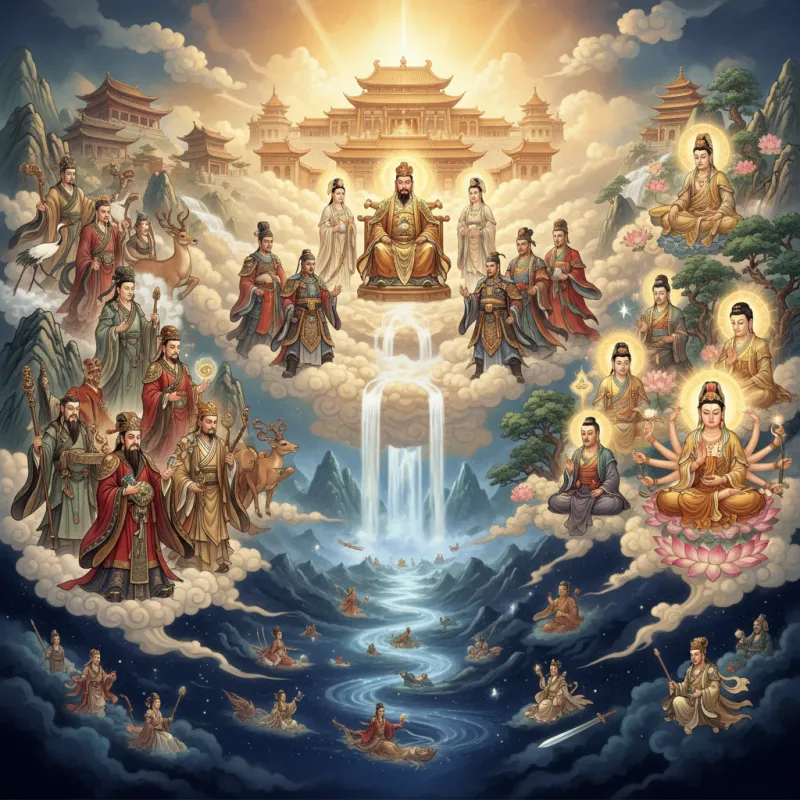
The old Daoist master once told me: "A ghost immortal is just a corpse that learned to think. A heavenly immortal commands the stars themselves." He was explaining why not all immortals deserve the same reverence—and why the path to true immortality has more levels than a bureaucrat's career ladder. In Chinese spiritual cosmology, becoming immortal isn't a simple on-off switch. It's a ranked hierarchy as complex as the imperial examination system, and just as competitive.
The Zhonglü System: Five Tiers of Transcendence
The most authoritative classification comes from the Zhonglü Chuandao Ji (钟吕传道集 Zhōnglǚ Chuándào Jí), a Tang Dynasty text that records conversations between two of the Eight Immortals—Zhongli Quan (钟离权 Zhōnglí Quán) and his disciple Lü Dongbin (吕洞宾 Lǚ Dòngbīn). Written around the 9th century CE, this text became the gold standard for understanding immortal ranks. Think of it as the Michelin Guide of transcendence.
The system divides immortals into five ascending categories: Ghost Immortals, Human Immortals, Earth Immortals, Spirit Immortals, and Heavenly Immortals. Each represents a quantum leap in spiritual achievement, and the gap between adjacent ranks is enormous. A Human Immortal might live for centuries in perfect health. A Heavenly Immortal can reshape reality with a thought.
Ghost Immortals: The Bargain Basement of Immortality
Ghost Immortals (鬼仙 Guǐxiān) occupy the lowest rung. These are practitioners who achieved some spiritual cultivation but failed to transform their physical body. When they died, their consciousness persisted—but without a body, they're essentially sophisticated ghosts. They have awareness and some supernatural abilities, but they're trapped in the spirit realm, unable to interact fully with either the living world or the higher celestial planes.
The Zhonglü Chuandao Ji is brutally honest about this rank: "They have refined the spirit but not the body. They are neither fully alive nor properly dead." It's the participation trophy of immortality. Many practitioners end up here because they focused exclusively on meditation and spiritual exercises while neglecting physical cultivation practices like internal alchemy and breath work.
In Chinese literature, ghost immortals often appear as melancholy figures—conscious of their incomplete achievement, envious of higher immortals, sometimes helpful to humans but always tinged with regret. They're the eternal graduate students of the immortal world.
Human Immortals: Perfected Health, Mortal Limitations
Human Immortals (人仙 Rénxiān) have achieved something remarkable: they've perfected their physical body and can live for centuries without aging or illness. They've mastered the flow of qi (气 qì) through their meridians, balanced their internal organs, and achieved what modern biohackers dream about—complete biological optimization.
But here's the catch: they're still fundamentally human. They live in the mortal world, eat regular food (though probably less of it), and remain subject to physical laws. A sword can still cut them. Poison can still harm them. They've extended the game, not transcended it.
Historical figures like Peng Zu (彭祖 Péng Zǔ), who supposedly lived 800 years, exemplify this category. The Zhuangzi mentions him as the paragon of longevity, but notably, he still eventually died. Human Immortals are the wellness influencers of ancient China—impressive, enviable, but not truly beyond mortality.
The cultivation path to this rank focuses heavily on yangsheng (养生 yǎngshēng) practices: dietary regulation, physical exercises like daoyin (导引 dǎoyǐn), herbal medicine, and sexual cultivation techniques. It's achievable, practical, and still leaves you very much in the world.
Earth Immortals: Hidden Masters of the Mountains
Earth Immortals (地仙 Dìxiān) represent a major breakthrough. These practitioners have transcended normal human limitations and gained genuine supernatural abilities, but they remain bound to the earthly realm. They typically retreat to sacred mountains, hidden valleys, or remote caves where they can cultivate undisturbed.
The key difference from Human Immortals: Earth Immortals have transformed their physical substance. They've completed what Daoists call "refining essence into qi" (炼精化气 liàn jīng huà qì), the first major stage of internal alchemy. Their bodies are no longer purely biological—they've become something more refined, less dependent on ordinary food and air.
Many of the hermit immortals in Chinese fiction belong to this category. They can fly short distances, become invisible, manipulate natural elements, and live indefinitely—but they can't leave Earth. They're like players who've unlocked fast travel and god mode but are still confined to the same map.
The Journey to the West features several Earth Immortals, including some of the demon kings who've achieved partial cultivation. They're powerful enough to challenge heaven's armies but not powerful enough to actually enter heaven. It's a frustrating middle management position in the cosmic hierarchy.
Spirit Immortals: Breaking Free from Earth
Spirit Immortals (神仙 Shénxiān) have achieved what Earth Immortals cannot: complete freedom from earthly constraints. They've completed the second stage of internal alchemy—"refining qi into spirit" (炼气化神 liàn qì huà shén)—and can now travel freely between the earthly and celestial realms.
This is where immortality starts looking genuinely godlike. Spirit Immortals can shapeshift, teleport across vast distances, manifest in multiple places simultaneously, and command natural forces. They're no longer bound by geography, gravity, or physical form. Many serve as celestial officials, managing specific aspects of the cosmos—river gods, mountain deities, stellar spirits.
The Eight Immortals, in most accounts, operate at this level or higher. They can attend banquets in heaven, intervene in mortal affairs, and travel to the edges of the universe. Lü Dongbin himself, co-author of the classification system, is typically considered a Spirit Immortal who occasionally ascends to the highest rank.
The cultivation required to reach this level is intense: decades of meditation, complete mastery of internal alchemy, moral perfection, and often a dramatic breakthrough experience. The Daozang (道藏 Dàozàng), the Daoist canon, contains hundreds of texts describing the technical details, and they're not for casual practitioners.
Heavenly Immortals: The Cosmic Elite
Heavenly Immortals (天仙 Tiānxiān) stand at the apex. They've completed the final stage of internal alchemy—"refining spirit and returning to void" (炼神还虚 liàn shén huán xū)—and achieved unity with the Dao itself. They're no longer individuals in any conventional sense; they've become cosmic principles with consciousness.
These immortals govern fundamental forces: time, space, destiny, creation. They rarely appear in the mortal world because they've transcended the need for form. When they do manifest, it's usually as pure light, abstract symbols, or in dreams and visions. The Queen Mother of the West (西王母 Xī Wángmǔ) and the Jade Emperor belong to this category—beings so refined they're essentially personified cosmic laws.
The Zhonglü Chuandao Ji describes them poetically: "They come and go with no trace, exist and do not exist, are present in all places and no place." It's the kind of achievement that makes you wonder if it's even desirable—you've become immortal, but have you ceased to be you?
Reaching this rank requires not just technical mastery but complete ego dissolution. You have to want to stop being yourself. Most practitioners, even successful ones, never make it here. They get comfortable at the Spirit Immortal level, where you still get to have a personality and preferences.
Alternative Classification Systems
The five-tier system isn't the only game in town. The Baopuzi (抱朴子 Bàopǔzǐ), written by Ge Hong (葛洪 Gě Hóng) in the 4th century CE, proposes a simpler three-tier system: Heavenly Immortals who ascend in broad daylight, Earth Immortals who retreat to mountains, and Corpse-Free Immortals who fake their death and transform secretly.
Some texts add categories like Water Immortals (水仙 Shuǐxiān) who achieve immortality through aquatic cultivation, or distinguish between immortals who achieved their status through Daoist cultivation versus those who were born divine. The Shenxian Zhuan (神仙传 Shénxiān Zhuàn), a 4th-century hagiography, catalogs hundreds of immortals without strictly categorizing them, suggesting the boundaries are more fluid than systematic texts admit.
Why the Hierarchy Matters
This classification system reveals something profound about Chinese spiritual philosophy: transcendence is gradual, not binary. You don't flip from mortal to immortal overnight. You climb a ladder, and each rung requires different practices, different sacrifices, different transformations.
It also democratizes immortality. You don't have to become a Heavenly Immortal to achieve something meaningful. Becoming a Human Immortal—living centuries in perfect health—is already extraordinary. The system acknowledges partial success, incremental progress, and different paths for different temperaments.
Modern practitioners still use this framework. Qigong teachers talk about refining essence, qi, and spirit. Internal alchemy schools structure their curriculum around these stages. The language has persisted for over a millennium because it maps onto actual experiences in meditation and cultivation—or at least, onto experiences practitioners believe they're having.
The old master was right: not all immortals are equal. But the beauty of the system is that it gives everyone a place to start, a next step to take, and a horizon to aim for. Even if you never command the stars, living 800 years without back pain sounds pretty good.
Related Reading
- The Eight Immortals: Complete Guide to China's Most Beloved Gods
- The Peaches of Immortality: Xi Wangmu Garden
- The Quest for the Elixir of Life: From Emperor Qin to Modern Fiction
- The Quest for Immortality: Why Chinese Mythology Is Obsessed With Living Forever
- Chinese Rituals for the Dead: A Practical Guide to Ancestor Worship
- The Underworld Gods: Who Runs Chinese Hell
- The Chinese Religious Calendar: When to Worship What