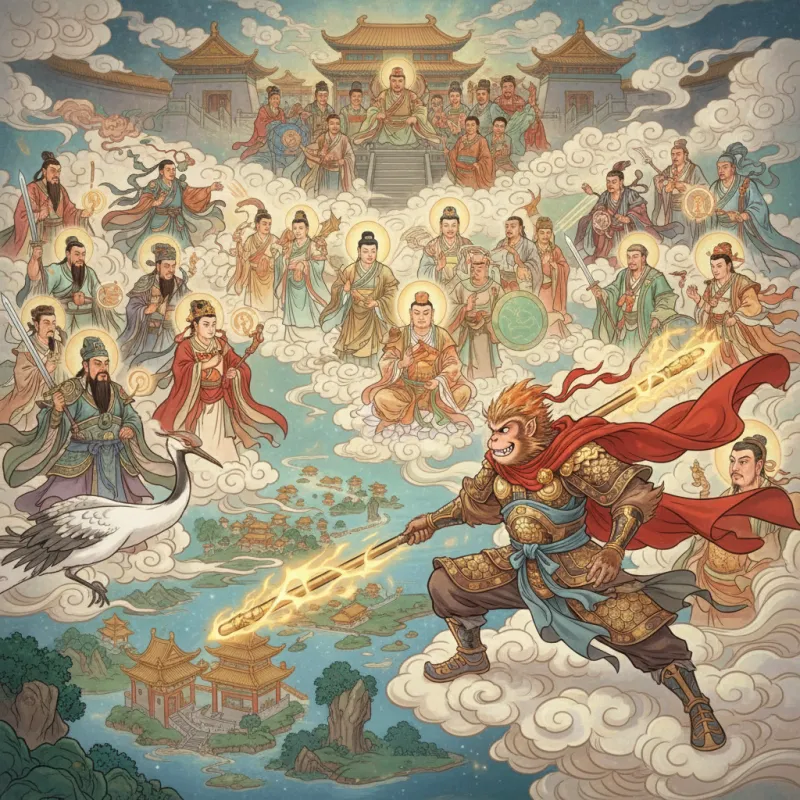
The Jade Emperor (玉皇大帝 Yùhuáng Dàdì) made a catastrophic miscalculation. He thought giving an upstart monkey a meaningless title would satisfy him. Instead, he handed Sun Wukong the match that would set Heaven ablaze.
Born From Stone, Bowing to No One
Sun Wukong (孙悟空 Sūn Wùkōng) was not born — he hatched. A stone egg on the summit of the Mountain of Flowers and Fruit (花果山 Huāguǒ Shān) absorbed cosmic energy for centuries until it cracked open, releasing a monkey who could already walk, talk, and cause trouble. Within days, he had claimed leadership of every monkey on the mountain. Within years, he would challenge the entire celestial order.
His story, immortalized in Wu Cheng'en's sixteenth-century masterpiece Journey to the West (西游记 Xīyóu Jì), is not merely an adventure tale. It is a profound meditation on power, pride, and the agonizing process of learning when to fight and when to submit. But before Sun Wukong became the reformed pilgrim escorting the monk Xuanzang to India, he was something far more dangerous: a being who genuinely believed he could overthrow Heaven itself.
The Education of a Rebel
Sun Wukong's first act of defiance was against death itself. Discovering that even the Monkey King must eventually die, he journeyed across oceans to find the Patriarch Subhuti (菩提祖师 Pútí Zǔshī), a Daoist-Buddhist sage who taught him the seventy-two transformations (七十二变 qīshí'èr biàn) and the cloud-somersault technique that let him travel 108,000 li in a single leap. When Subhuti expelled him for showing off, Sun Wukong returned home with powers that made him functionally immortal.
But immortality through cultivation wasn't enough. He stormed the underworld, found the Registry of Life and Death (生死簿 Shēngsǐ Bù), and scratched out his name along with those of every monkey on his mountain. When the Dragon Kings refused to give him a weapon worthy of his strength, he descended to the bottom of the Eastern Sea and claimed the Ruyi Jingu Bang (如意金箍棒 Rúyì Jīngū Bàng) — the pillar that once measured the depth of the cosmic ocean, weighing 17,550 pounds and capable of shrinking to the size of a needle.
The celestial bureaucracy had a problem. This monkey had assaulted the underworld, bullied the Dragon Kings, and possessed powers that rivaled many gods. The Jade Emperor's solution was classic bureaucratic thinking: give him a title with no real authority and hope he'd be satisfied.
Keeper of the Heavenly Horses — The Insult That Broke Heaven
They made him Bìmǎwēn (弼马温), Keeper of the Heavenly Horses. Sun Wukong accepted with pride, not realizing it was the lowest rank in the celestial hierarchy — essentially a stable boy. When he finally discovered the truth, his rage was apocalyptic. He smashed his way out of Heaven, declared himself the Great Sage Equal to Heaven (齐天大圣 Qítiān Dàshèng), and dared the Jade Emperor to do something about it.
This is where Sun Wukong's rebellion becomes fascinating from a shenxian (神仙) perspective. He wasn't fighting for justice or liberation. He was fighting for recognition, for status, for the acknowledgment that he was not beneath the gods simply because he was born from stone rather than appointed by cosmic decree. His rebellion was fundamentally about legitimacy — could power earned through cultivation and will match power granted by celestial bureaucracy?
The Jade Emperor, pressured by his court, sent the Pagoda-Bearing Heavenly King Li Jing (托塔李天王 Tuōtǎ Lǐ Tiānwáng) and Prince Nezha (哪吒 Nézhā) to subdue the monkey. They failed. Wave after wave of celestial warriors fell to Sun Wukong's staff. Finally, the Jade Emperor tried appeasement again — this time granting him the title he'd claimed for himself, Great Sage Equal to Heaven, along with a mansion in Heaven and a nominal position with no responsibilities.
The Peach Banquet — When Exclusion Became Revolution
For a while, it worked. Sun Wukong lounged in Heaven, satisfied with his title and his mansion. Then came the invitation list for the Peach Banquet (蟠桃会 Pántáo Huì), the grand celebration where immortals consumed the Peaches of Immortality (蟠桃 pántáo) that ripened once every several thousand years. Sun Wukong's name was not on the list.
The exclusion was deliberate. Despite his title, the celestial establishment never considered him a true equal. He was a mascot, a troublemaker given a fancy name to keep him quiet. When Sun Wukong discovered this, he didn't just crash the party — he consumed the peaches himself, drank the imperial wine, ate the pills of immortality from Laozi's (老子 Lǎozǐ) furnace, and achieved multiple layers of immortality that made him virtually indestructible.
This is the moment Sun Wukong transformed from a status-seeking upstart into an existential threat. He had stolen the very sources of celestial power, making himself immortal through at least five different methods. The Jade Emperor had no choice but to mobilize Heaven's full military might.
The Battle That Shook the Cosmos
One hundred thousand celestial soldiers descended on the Mountain of Flowers and Fruit. Sun Wukong fought them all. The battle raged for days, with the monkey transforming into countless forms, his staff multiplying into thousands of copies, his monkey subjects fighting alongside him with weapons he'd stolen from Heaven's armories.
Even Erlang Shen (二郎神 Èrláng Shén), the three-eyed god renowned as Heaven's greatest warrior, could only fight Sun Wukong to a standstill. It took Laozi dropping his Diamond Snare (金刚琢 Jīngāng Zhuó) on the monkey's head to finally capture him — and even then, only because Sun Wukong was distracted mid-battle.
They tried to execute him. The blade shattered. They tried to burn him in Laozi's Eight Trigrams Furnace (八卦炉 Bāguà Lú) for forty-nine days. He emerged with golden eyes that could see through any transformation and smoke-induced fury that made him even more dangerous. He fought his way to the Hall of Perfect Light (灵霄宝殿 Língxiāo Bǎodiàn), the Jade Emperor's throne room itself, and was about to claim the throne when the Buddha intervened.
The Buddha's Wager — Pride Meets Cosmic Truth
The Buddha's challenge was simple: if Sun Wukong could somersault beyond the Buddha's palm, he could have Heaven. Sun Wukong laughed and leaped, traveling billions of miles in an instant until he reached what he thought were the pillars at the edge of the universe. He urinated on one pillar to mark his territory and wrote "The Great Sage Equal to Heaven Was Here" on another.
When he returned, triumphant, the Buddha showed him the writing on his middle finger and the smell still lingering on his hand. Sun Wukong had never left the Buddha's palm. The entire cosmos he thought he'd traversed was contained within a single hand.
The Buddha imprisoned him under Five Elements Mountain (五行山 Wǔxíng Shān) for five hundred years. This wasn't just punishment — it was education. Sun Wukong needed to learn that power without wisdom is just destruction, that rebellion without purpose is just chaos, and that true freedom comes not from refusing all authority but from choosing which authority deserves your service.
The Rebel Becomes the Pilgrim
When the monk Xuanzang (玄奘 Xuánzàng) freed him five centuries later, Sun Wukong was given a choice: serve as the monk's protector on the journey to retrieve Buddhist scriptures from India, or remain imprisoned forever. He chose service, though the Guanyin placed a golden headband on him that would tighten painfully whenever he disobeyed.
This is where Sun Wukong's story becomes truly profound. The rebel who challenged Heaven became the loyal protector who fought demons, defeated false Buddhas, and ultimately achieved enlightenment not through power but through service. His rebellion wasn't erased — it was transformed. The same fierce independence that made him challenge the Jade Emperor now made him the perfect defender of a vulnerable monk traveling through demon-infested lands.
The Legacy of the Great Sage
Sun Wukong's rebellion failed, but his legend succeeded in ways the Jade Emperor never anticipated. He became the people's hero, the figure who proved that even the celestial bureaucracy could be challenged, that power earned through cultivation and will could match power granted by birth and position.
His story resonates because it captures a fundamental tension in Chinese spiritual thought: the relationship between individual cultivation and cosmic hierarchy. The Heavenly Court represents order, structure, and the proper arrangement of all things. Sun Wukong represents the chaos of individual will, the refusal to accept one's assigned place, the belief that merit should matter more than origin.
The genius of Journey to the West is that it doesn't fully resolve this tension. Sun Wukong achieves Buddhahood at the end, becoming the Victorious Fighting Buddha (斗战胜佛 Dòuzhàn Shèng Fó), but he never truly submits. He learns discipline, gains wisdom, and channels his rebellion toward worthy goals — but the fire that made him challenge Heaven never goes out. It just burns in a different direction.
That's why, fifteen hundred years after Wu Cheng'en wrote his story, Sun Wukong remains China's most beloved mythological figure. Not because he won his rebellion, but because he dared to rebel at all — and because even in defeat, even imprisoned under a mountain for five centuries, even wearing a headband that could torture him into submission, he never stopped being exactly who he was: the stone monkey who looked at Heaven and said, "I am your equal."
The Jade Emperor wanted to domesticate him. The Buddha wanted to enlighten him. But Sun Wukong, in the end, remained Sun Wukong — and that might be the greatest victory of all.
Related Reading
- The Heavenly Court: How Chinese Mythology Organized the Universe Like a Government Office
- The Jade Emperor: Supreme Ruler of the Chinese Heavens
- The Heavenly Court: How Chinese Heaven Is Organized
- Exploring the Rich Tapestry of Chinese Deities and Immortals in the Heavenly Court
- The Celestial Bureaucracy: How Chinese Heaven Is Organized
- Exploring the Rich Tapestry of Chinese Deities and Immortals
- A Practical Guide to Visiting Chinese Temples: What to Do and What Not to Do
- Guardians of the Night Sky: The Star Gods in Chinese Daoist and Buddhist Traditions