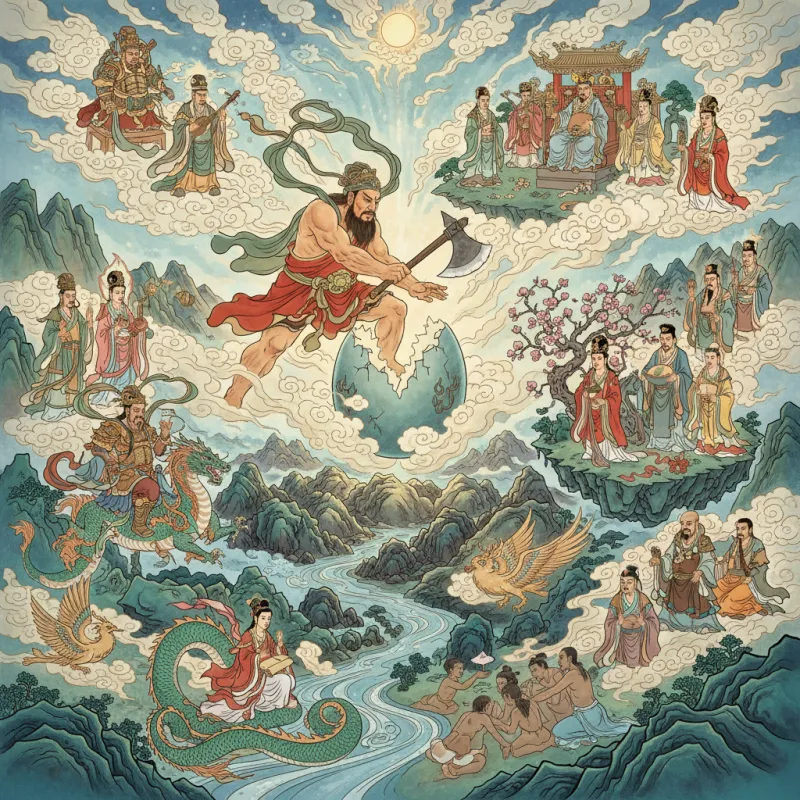
Before the world existed, there was only chaos—a cosmic egg floating in the void, containing everything and nothing at once. For 18,000 years, something slept inside that egg. When it finally woke up and stretched, the universe cracked open.
This is how Chinese mythology begins: not with a divine command or a carefully planned blueprint, but with a giant named Pangu (盘古, Pángǔ) who literally tore reality apart with his bare hands.
The Cosmic Egg and the First Sacrifice
Unlike the Abrahamic traditions where God speaks the world into existence, or Greek mythology where gods emerge from primordial deities to shape creation, Chinese cosmology starts with transformation and sacrifice. Pangu didn't design the world—he became it.
The myth goes that after Pangu separated the light yang (阳, yáng) elements from the heavy yin (阴, yīn) elements, creating heaven and earth respectively, he stood between them for another 18,000 years to keep them apart. Each day, heaven rose ten feet higher and earth grew ten feet thicker, and Pangu grew with them. When he finally died from exhaustion, his body underwent the ultimate metamorphosis: his breath became wind and clouds, his voice became thunder, his left eye became the sun and his right eye the moon, his blood formed rivers, his muscles became fertile soil, his hair became stars, his bones became minerals and precious stones, and the parasites on his body became humanity.
This is creation through dissolution of self. The world doesn't exist because a god willed it—it exists because Pangu gave everything he was to make it. This sacrificial model would echo through Chinese religious thought for millennia, influencing everything from ancestor worship practices to Buddhist concepts of self-negation.
Nüwa: The Mother of Humanity
But Pangu's story doesn't explain everything. If his parasites became humans, why do we have such elaborate myths about Nüwa (女娲, Nǚwā) creating humanity from yellow clay? This is where Chinese mythology reveals its fundamental difference from monotheistic traditions: it doesn't demand consistency. Multiple creation stories coexist, each explaining different aspects of existence.
Nüwa's creation myth is more intimate and deliberate than Pangu's cosmic transformation. According to texts like the Huainanzi (淮南子, Huáinánzǐ) from the 2nd century BCE, Nüwa felt lonely in the newly formed world and began sculpting humans from yellow river clay. The first humans she made carefully by hand became the nobility—each one unique and refined. But the work was tedious, so she dipped a rope in mud and swung it around, and the droplets that fell became the common people.
This isn't just a creation story—it's a social commentary embedded in mythology. The Chinese aristocracy literally claimed to be handcrafted while commoners were mass-produced. But Nüwa's story doesn't end with creation. When the pillars of heaven broke and the sky began to fall, flooding the earth, she smelted five-colored stones to repair the heavens and cut off the legs of a giant turtle to prop up the sky. She's both creator and maintainer, mother and engineer.
Fuxi and the Order of Civilization
Nüwa often appears alongside her brother-husband Fuxi (伏羲, Fúxī), and their relationship reveals another layer of Chinese creation mythology: the establishment of cosmic order and human civilization. While Pangu created the physical universe and Nüwa created humanity, Fuxi taught humans how to live within that universe.
Fuxi is credited with creating the Eight Trigrams (八卦, bāguà) that form the basis of the Yijing (易经, Yìjīng, Book of Changes), teaching humans to fish with nets, domesticate animals, and establish marriage customs. In some versions of the myth, Fuxi and Nüwa are the sole survivors of a great flood, and humanity descends from their union—a story that parallels flood myths across cultures but with distinctly Chinese characteristics.
The Han dynasty stone carvings from the Wu Liang shrine (2nd century CE) depict Fuxi and Nüwa with human heads and intertwined serpent bodies, holding a compass and a carpenter's square respectively—symbols of heaven's roundness and earth's squareness. They're not just creators but cosmic architects who established the fundamental patterns (理, lǐ) that govern reality.
The Jade Emperor and Bureaucratic Creation
Here's where Chinese mythology gets really interesting: the creation myths don't stop in the distant past. The Jade Emperor (玉皇大帝, Yùhuáng Dàdì), who became the supreme deity in popular Chinese religion by the Song dynasty (960-1279 CE), has his own creation narrative that's radically different from Pangu's physical transformation or Nüwa's artistic crafting.
According to Daoist texts, the Jade Emperor wasn't born into godhood—he earned it through 3,200 trials, each lasting 3 million years. His creation isn't of the physical world but of cosmic governance. He established the celestial bureaucracy that mirrors the Chinese imperial system, appointing gods to manage everything from weather to wealth, from longevity to literature. This is creation as administration, reflecting a uniquely Chinese understanding that the universe requires constant management, not just an initial act of making.
The Jade Emperor's role shows how Chinese deities function more like officials than omnipotent beings, subject to promotion, demotion, and even impeachment by higher cosmic authorities.
The Three Pure Ones and Primordial Qi
Daoist philosophy adds yet another layer to creation mythology through the concept of the Three Pure Ones (三清, Sānqīng)—the highest deities in the Daoist pantheon who represent different aspects of the Dao itself. The Celestial Worthy of Primordial Beginning (元始天尊, Yuánshǐ Tiānzūn) embodies the Dao before creation, existing in the state of wuji (无极, wújí)—the limitless void.
This philosophical approach to creation doesn't contradict the Pangu myth; it operates on a different level entirely. While Pangu explains the physical mechanics of creation, the Three Pure Ones explain the metaphysical source. The universe emerges from primordial qi (气, qì)—the fundamental energy-substance that predates matter and spirit. The Three Pure Ones don't create through action but through emanation, like light radiating from a source.
The Daozang (道藏, Dàozàng), the Daoist canon compiled over centuries, contains numerous creation texts that describe how the Dao spontaneously generates the One, the One generates the Two (yin and yang), the Two generate the Three (heaven, earth, and humanity), and the Three generate the ten thousand things. This isn't creation by a personal god but creation as a natural process of differentiation from unity to multiplicity.
Why Multiple Creators Matter
The multiplicity of Chinese creation myths isn't a bug—it's a feature. It reflects a worldview that sees truth as multifaceted rather than singular. Pangu's physical sacrifice, Nüwa's artistic creation, Fuxi's cultural ordering, the Jade Emperor's administrative governance, and the Three Pure Ones' metaphysical emanation aren't competing stories demanding you choose one. They're complementary perspectives on the mystery of existence.
This approach allowed Chinese religion to absorb Buddhist creation concepts when Buddhism arrived from India around the 1st century CE, adding yet another layer without displacing existing myths. The Buddhist concept of countless world-systems arising and dissolving through cosmic cycles coexisted peacefully with indigenous Chinese creation stories.
What emerges is a creation mythology that's less concerned with establishing a single authoritative account and more interested in exploring different dimensions of the question: How did we get here? The answer, Chinese mythology suggests, is too complex for any single story to capture. You need the cosmic sacrifice, the maternal crafting, the cultural teaching, the bureaucratic ordering, and the metaphysical emanation. You need all of it, because creation itself is multidimensional.
The Living Legacy
These creation myths aren't just ancient stories—they continue to shape Chinese religious practice and philosophical thought. The Pangu myth influences feng shui principles about the relationship between landscape and cosmic energy. Nüwa appears in contemporary Chinese media as a symbol of feminine creative power and environmental protection. The Jade Emperor receives offerings during Chinese New Year as the ultimate cosmic administrator who can influence one's fate in the coming year.
Understanding Chinese creation mythology means accepting that the universe is too vast, too complex, and too mysterious for a single narrative. It requires multiple creators because it has multiple dimensions—physical, social, cultural, administrative, and metaphysical. Each deity or cosmic principle addresses a different aspect of the fundamental question that haunts all human cultures: Why is there something rather than nothing?
The Chinese answer: Because Pangu sacrificed himself, because Nüwa felt lonely, because Fuxi brought order, because the Jade Emperor governs, and because the Dao spontaneously generates. All of these are true, and none of them are complete. That's not a contradiction—it's wisdom.
Related Reading
- Nüwa Repairs the Sky: The Goddess Who Saved the World
- Fuxi: The God-Emperor Who Gave Humanity Civilization
- Pangu Opens Heaven and Earth: The Chinese Creation Story
- Pangu and the Cosmic Egg: How the Chinese Universe Began
- Exploring Chinese Deities and Immortals in Daoist and Buddhist Creation Myths
- Ancient Chinese Underworld Deities: Guardians of Death and Afterlife Realms
- The Eight Immortals: China's Most Beloved Supernatural Team
- The Dragon Kings: Rulers of Rain and Sea