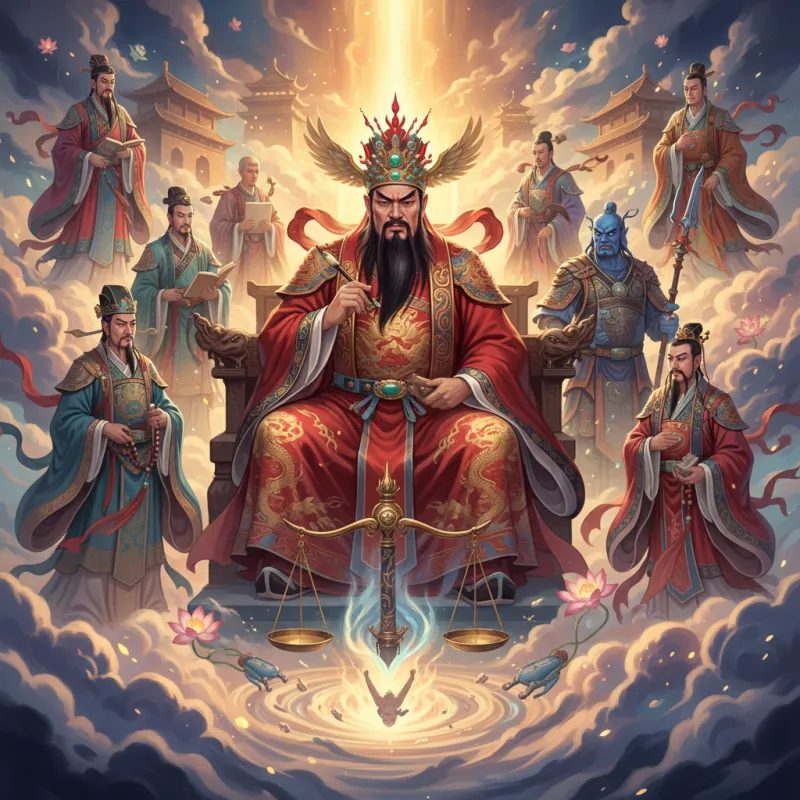
Picture this: you've just died. Your soul floats free from your body, disoriented, confused. Before you can process what's happening, two figures appear — one with the head of an ox, the other with the head of a horse. They don't ask questions. They don't explain. They simply grab you by the arms and drag you down, down, down into the earth itself, through layers of rock and darkness, until you arrive at a massive gate. Beyond it sits a figure in imperial robes, his face stern and unmovable, a ledger the size of a house open before him. This is Yanluo Wang (阎罗王, Yánluó Wáng), and he's been waiting for you.
The Judge Who Cannot Be Bribed
Yanluo Wang is not a demon. He's not Satan. He doesn't torture souls for fun or rule over a kingdom of chaos. He's a bureaucrat — the ultimate bureaucrat — and his domain is order, not suffering. His job is simple: review every soul that enters his court, consult the records of their life, and assign them to their next destination. Heaven, hell, reincarnation as a human, reincarnation as an animal, or one of the many specialized torture chambers reserved for specific crimes.
What makes him terrifying is not cruelty but fairness. Absolute, inflexible, incorruptible fairness. You cannot charm him. You cannot bribe him. You cannot argue that your good deeds outweigh your bad when the ledger clearly shows otherwise. The Book of Life and Death (生死簿, Shēngsǐ Bù) records everything — every lie, every kindness, every moment of cowardice or courage. Yanluo Wang reads it all, and then he decides.
This is why Chinese folk religion treats death with such seriousness. You're not facing oblivion. You're facing an audit.
From Indian King to Chinese Bureaucrat
Yanluo Wang didn't start out Chinese. His origins trace back to Yama, the Hindu and Buddhist god of death, who entered China along with Buddhist texts during the Han Dynasty (206 BCE – 220 CE). In Indian mythology, Yama was the first mortal to die, and thus became the ruler of the dead — a king who understood mortality because he'd experienced it himself.
But when Yama crossed into China, something fascinating happened. He got absorbed into the existing Chinese cosmology, which was already deeply bureaucratic. The Chinese saw the universe as a vast administrative system, with the Jade Emperor (玉皇大帝, Yùhuáng Dàdì) at the top and countless officials managing everything from weather to harvests to human lifespans. Death was just another department.
So Yama became Yanluo Wang, and instead of ruling alone, he became one of Ten Kings of Hell (十殿阎王, Shí Diàn Yánwáng), each presiding over a different court in the underworld. Yanluo Wang specifically rules the Fifth Court, though in popular imagination he's often treated as the supreme authority. The bureaucratization was complete — even hell had middle management.
The Ten Courts and the Journey of the Soul
When you die in Chinese cosmology, you don't go straight to judgment. You go on a journey. First, you cross the Yellow Springs (黄泉, Huángquán), the river that separates the living world from the dead. Then you're brought before the First Court, ruled by King Qinguang (秦广王, Qínguǎng Wáng), who conducts the initial review. If you lived a reasonably good life, you might pass through quickly. If not, you're sent deeper.
Each subsequent court handles specific types of sins. The Second Court punishes corrupt officials. The Third Court deals with those who showed disrespect to elders. The Fourth Court handles tax evaders and fraudsters. By the time you reach Yanluo Wang's Fifth Court, you're facing judgment for the most serious offenses — murder, blasphemy, causing others to commit suicide.
The punishments are creative and specific. Liars have their tongues pulled out. Adulterers are thrown into a pool of blood. Those who wasted food are forced to eat excrement. The Chinese underworld doesn't do generic suffering — it does poetic justice, tailored precisely to the crime. After punishment, souls move through the remaining courts until they reach the Tenth Court, where they drink the Tea of Forgetfulness (孟婆汤, Mèngpó Tāng) and are reincarnated, their memories wiped clean.
This system appears in vivid detail in the Journey to the West (西游记, Xīyóu Jì), written during the Ming Dynasty (1368-1644). When Sun Wukong storms the underworld, he doesn't fight Yanluo Wang directly — he breaks into the records office and erases his name from the Book of Life and Death, making himself immortal through bureaucratic manipulation. It's the most Chinese solution imaginable.
The Iconography of Authority
Walk into any traditional Chinese temple with an underworld section, and you'll recognize Yanluo Wang immediately. He sits on a throne, dressed in imperial robes and a judge's hat, his face severe and unsmiling. Often he's depicted with a long beard, symbolizing wisdom and age. In his hands he holds either a brush (for writing judgments) or a tablet (for recording verdicts).
Flanking him are his assistants: Ox-Head and Horse-Face, the enforcers who drag souls to judgment, and the Black and White Impermanence (黑白无常, Hēibái Wúcháng), who collect souls at the moment of death. Behind him, clerks work at desks piled high with scrolls, because even in the afterlife, paperwork never ends.
The visual language is deliberately borrowed from imperial courts. Yanluo Wang looks like an emperor because he functions like one — he has absolute authority within his domain, but he's also part of a larger cosmic hierarchy. He reports to higher powers, follows established laws, and maintains order according to principles that predate him.
This imagery became standardized during the Song Dynasty (960-1279), when Buddhist temples began commissioning elaborate paintings and sculptures of the underworld courts. These weren't meant to be abstract or symbolic — they were meant to be literal, educational, terrifying. Look at what awaits you if you sin. Look at the judge who will weigh your soul.
The Loopholes and the Rebels
Here's where Chinese mythology gets interesting: the system has loopholes. Yanluo Wang is powerful, but he's not omnipotent. Immortals, through cultivation and spiritual practice, can escape his jurisdiction entirely. This is the whole point of Daoist immortality practices — if you achieve immortality, your name gets erased from the Book of Life and Death, and Yanluo Wang has no claim on you.
Sun Wukong exploits this in Journey to the West. The Monkey King achieves immortality through multiple methods — eating the Peaches of Immortality, drinking the Wine of Heaven, consuming the Pills of Immortality — and then, just to be sure, he breaks into the underworld and physically erases his name and the names of all his monkey subjects from the death records. When Yanluo Wang protests, Sun Wukong beats up the guards and leaves. The bureaucracy has been hacked.
This reflects a deep tension in Chinese religious thought. On one hand, there's the orderly, moral universe where everyone gets what they deserve. On the other hand, there's the possibility of transcendence — of becoming so powerful or so enlightened that the rules no longer apply to you. Yanluo Wang represents the former, but Chinese mythology is full of characters who achieve the latter.
Even ordinary humans can sometimes negotiate. In folk tales, filial children occasionally bargain with Yanluo Wang to extend a parent's life, or virtuous souls are released early from punishment due to good deeds performed by their descendants. The system is rigid, but it's not completely inflexible. Merit matters, both your own and that of your family.
Yanluo Wang in Modern Culture
Yanluo Wang never really left Chinese popular consciousness. He appears in contemporary films, television dramas, video games, and novels, usually as a stern but ultimately fair authority figure. In the 2017 film The Monkey King 3, he's portrayed as a bureaucratic obstacle. In various Chinese RPGs and mobile games, he's a boss character or a quest-giver, maintaining his role as judge even in digital afterlives.
What's fascinating is how his character has softened slightly in modern retellings. Contemporary versions sometimes show him as weary, burdened by the endless stream of souls, occasionally sympathetic to human weakness. He's still the judge, but he's also tired — a civil servant who's been doing the same job for millennia and has seen every excuse, every plea, every attempt at manipulation.
This humanization reflects changing attitudes toward authority and judgment in Chinese culture. The absolute, terrifying judge of medieval Buddhism has become something more complex — still powerful, still fair, but also recognizably exhausted by the weight of his responsibilities.
Yet the core concept remains: death is not an ending but a transition, and that transition involves accountability. You will be judged. Your deeds will be weighed. And Yanluo Wang will be waiting with his ledger open, ready to assign you to exactly the afterlife you've earned.
The Cosmic Accountant
In the end, Yanluo Wang embodies a particularly Chinese vision of cosmic justice. Not the wrathful god of fire and brimstone, not the abstract principle of karma, but a judge sitting at a desk, reviewing files, making decisions based on documented evidence. He's terrifying precisely because he's reasonable. There's no appealing to mercy when the facts are clear. There's no escaping consequences when everything has been recorded.
This is why offerings to Yanluo Wang in temples are often practical — incense, fruit, sometimes paper money to ensure smooth processing in the afterlife bureaucracy. People don't pray to him for favors. They pray that when their time comes, the review will be fair and the records accurate. They pray that their good deeds have been properly documented, that their sins aren't worse than they remember.
And somewhere in the Fifth Court of Hell, Yanluo Wang sits on his throne, the Book of Life and Death open before him, waiting for the next soul to arrive. The line never ends. The work never stops. Justice, in the Chinese underworld, is eternal, meticulous, and absolutely unavoidable.
Related Reading
- Black and White Impermanence: The Soul Collectors
- The Underworld Gods: Who Runs Chinese Hell
- The Ten Yama Kings: Judges of the Chinese Underworld
- The Heavenly Court: How Chinese Heaven Is Organized
- The Daoist Pantheon: A Bureaucracy of Gods
- Exploring the Rich Tapestry of Chinese Deities and Immortals