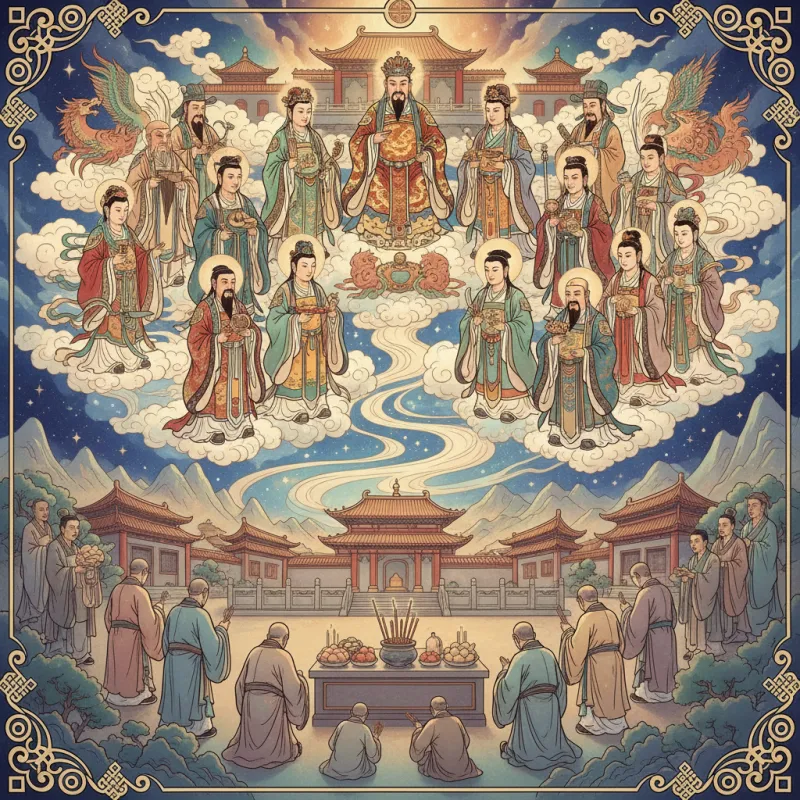
The smoke from the incense curls upward, carrying your whispered report to the dead. Your grandmother has been gone for three years, but you still tell her about your promotion, your daughter's first day of school, the argument you had with your brother. You're not praying to her — you're updating her. Because in Chinese tradition, death doesn't end family membership. It just changes the communication method.
This is ancestor worship (祖先崇拜 zǔxiān chóngbài), and if you think it's about superstition or blind tradition, you've misunderstood it entirely. It's a practical system for maintaining family continuity across generations, a calendar of obligations that keeps the dead present in the lives of the living. And unlike the vague "thoughts and prayers" of modern memorial culture, Chinese ancestor worship is specific, scheduled, and shockingly concrete.
The Three Pillars of the Ancestral Calendar
Chinese families don't just remember their dead — they maintain relationships with them through three major annual observances, each with its own character and purpose.
Qingming Festival (清明节 Qīngmíng Jié) arrives in early April, usually between the 4th and 6th. This is grave-sweeping day, when families travel to ancestral burial sites for what amounts to spring cleaning for the dead. You're not just standing there looking solemn. You're pulling weeds, scrubbing headstones, trimming overgrown grass. You burn joss paper (纸钱 zhǐqián) — those gold and silver sheets that represent money in the afterlife — and leave offerings of food and wine. The practice dates back over 2,500 years to the Zhou Dynasty, but it became standardized during the Tang Dynasty (618-907 CE) when the government made it an official holiday.
What makes Qingming different from Western memorial days is the specificity. You're not honoring "the dead" as an abstract category. You're visiting your grandfather, your great-aunt, your father's cousin who died young. You know their names. You know where they're buried. And you tell them what's happened since last year — births, marriages, business successes, family conflicts. The dead are treated as interested parties in ongoing family affairs.
Ghost Month (鬼月 Guǐyuè) occupies the entire seventh lunar month, usually falling in August or September. This is when the gates of the underworld open and all spirits — not just your ancestors, but hungry ghosts (饿鬼 èguǐ) with no living descendants to feed them — roam the mortal world. Families make daily offerings throughout the month, but the 15th day, known as Ghost Festival (中元节 Zhōngyuán Jié), is the peak. This is when you set out elaborate feasts, burn spirit money, and perform rituals to ensure your ancestors are well-fed and the hungry ghosts don't cause trouble.
Ghost Month has a darker edge than Qingming. People avoid swimming (ghosts might pull you under), don't get married (inauspicious), and are careful about nighttime activities. Businesses suffer because no one wants to sign contracts or make major purchases when the spirit world is this active. It's not fear exactly — it's caution, the same way you'd be careful walking through a neighborhood you don't know well.
Winter Solstice (冬至 Dōngzhì) and Chinese New Year (春节 Chūnjié) round out the calendar. Winter Solstice, usually December 21-22, is when families gather to make offerings at home altars and share meals that symbolically include the ancestors. Chinese New Year, the most important holiday in the Chinese calendar, begins with offerings to ancestors before any other celebration. You're essentially asking for their blessing on the coming year and reporting on the previous one.
The Home Altar: Your Ancestors' Permanent Address
If the festivals are scheduled visits, the home altar (神龛 shénkān) is where your ancestors live year-round. This isn't metaphorical. The altar, typically placed in the main room of the house facing the entrance, contains ancestral tablets (牌位 páiwèi) — wooden plaques inscribed with the names and dates of deceased family members. These tablets are treated as the actual presence of the ancestors, not just memorials to them.
The setup follows strict rules. The altar should be elevated, never on the floor. It should face south if possible, the direction of yang energy and imperial authority. Fresh offerings of fruit, tea, and incense are replaced regularly — daily in traditional households, weekly in modern ones. On the first and fifteenth of each lunar month, more elaborate offerings appear: cooked dishes, rice wine, fresh flowers.
What you're doing is maintaining a household that includes both living and dead members. When something significant happens — a child is born, someone gets married, a business deal succeeds — you report it at the altar. When you need guidance, you might burn incense and sit quietly, waiting for insight. This isn't prayer in the Western sense. It's more like consulting with senior family members who happen to be dead.
The practice connects to the Confucian concept of filial piety (孝 xiào), which doesn't end at death. You served your parents when they were alive; you continue serving them after they die. The altar is where that service happens daily, not just on special occasions. For more on how these practices intersect with broader Chinese spiritual traditions, see Daoist Funeral Rites and the Journey to the Afterlife.
The Offerings: Currency of the Afterlife
Chinese ancestor worship operates on a surprisingly materialistic theology. The dead need things — money, food, clothing, housing, transportation. And the living provide these things through offerings that are burned, transforming them from physical objects in this world to usable goods in the next.
Joss paper comes in many forms. The traditional gold and silver sheets represent basic currency. But modern offerings have evolved dramatically. You can now buy paper versions of credit cards, smartphones, luxury cars, houses, even mistresses (yes, really — it's controversial, but some shops sell them). These elaborate paper goods are burned during festivals, especially during Ghost Month and Qingming.
The logic is straightforward: burning transforms the object from yang (living world) to yin (spirit world). The smoke carries it across the boundary. Your ancestors receive it and can use it in their afterlife. It's a literal economy of the dead, complete with inflation — the denominations on spirit money have increased dramatically over the decades, from thousands to millions to billions of yuan.
Food offerings follow different rules. They're not burned but placed on the altar or at the grave, left for a period (usually until the incense burns out), then removed and eaten by the living family members. The idea is that the ancestors consume the spiritual essence (气 qì) of the food, leaving the physical substance for the living. It's a meal shared across the boundary of death, with everyone getting their appropriate portion.
Incense (香 xiāng) is the constant. It's burned at every interaction with ancestors, serving as both offering and communication medium. The smoke rises, carrying prayers and reports upward. Different types of incense suit different occasions — sandalwood for regular daily offerings, more expensive varieties for festivals. The number of sticks matters too: three for ancestors, one for deities, though practices vary by region.
The Theology: Where Are They, Exactly?
Chinese ancestor worship operates on a complex cosmology that doesn't quite match Western concepts of heaven and hell. The afterlife has multiple levels and locations, and your ancestors might be in different places depending on their karma, the rituals performed for them, and how long they've been dead.
The immediate destination after death is the Yellow Springs (黄泉 Huángquán), a shadowy underworld where spirits await judgment. Then comes the Ten Courts of Hell (十殿阎罗 Shí Diàn Yánluó), where the dead are judged and punished for earthly sins before being released to reincarnation or, for the virtuous, to a better afterlife realm. But ancestor worship assumes your family members aren't stuck in hell — the rituals you perform help them advance through these stages.
Well-maintained ancestors might ascend to become household gods (家神 jiāshén), protective spirits who watch over the family. Exceptionally virtuous ancestors might even achieve a form of immortality, joining the ranks of minor deities. This is why ancestor worship and deity worship often blur together — the line between a powerful ancestor and a minor god is fuzzy.
The practical implication: your rituals matter. They're not just symbolic gestures. They provide actual assistance to your ancestors in navigating the afterlife bureaucracy. Neglected ancestors become hungry ghosts, wandering spirits who cause trouble for the living. Well-fed, well-honored ancestors become protective forces. The relationship is transactional but not cynical — it's mutual obligation extending beyond death.
This cosmology intersects with both Buddhist and Daoist beliefs, creating a syncretic system that most Chinese families practice without worrying too much about theological consistency. For more on how Buddhist concepts shaped these practices, see The Hungry Ghost Festival: Feeding the Forgotten Dead.
Modern Adaptations: Ancestor Worship in the 21st Century
Chinese families living in modern apartments don't always have space for traditional altars. Overseas Chinese communities can't easily visit ancestral graves in China. And younger generations raised in secular environments sometimes struggle with practices that seem superstitious.
But ancestor worship adapts. Digital altars now exist — websites and apps where you can light virtual incense, leave virtual offerings, and maintain virtual ancestral tablets. Some families use these exclusively; others use them as supplements to physical altars. The practice feels strange until you realize that the medium was always symbolic anyway. Whether you burn paper money or transfer digital currency to an ancestor's virtual account, you're performing the same symbolic act.
Grave-sweeping has gone high-tech too. Services in China now offer proxy grave-sweeping — you pay someone to visit your ancestor's grave, clean it, and make offerings on your behalf, with photo documentation sent to you. It's controversial (is it still filial piety if you outsource it?), but it solves a real problem for families scattered across continents.
Some families have simplified the calendar, focusing on Qingming and Chinese New Year while skipping the more elaborate Ghost Month rituals. Others maintain full traditional practice, seeing it as a way to preserve cultural identity in diaspora communities. The diversity of modern practice suggests that ancestor worship is flexible enough to survive modernization, even if the forms change.
The core remains constant: maintaining connection with the dead, treating them as ongoing members of the family, and fulfilling obligations that don't end at the grave. Whether you do this with traditional paper offerings or digital avatars, the principle is the same.
Getting Started: A Practical Guide for Beginners
If you want to begin practicing ancestor worship but don't come from a family that maintained these traditions, start simple. You don't need elaborate equipment or deep theological knowledge. You need a space, some basic supplies, and a willingness to treat your dead relatives as if they're still part of your life.
Set up a small altar space — a shelf, a table, even a windowsill. Place photos of deceased family members there, or write their names on paper if you don't have photos. Add a small incense holder and some incense sticks (available at Asian grocery stores or online). That's your basic setup.
On the first and fifteenth of each lunar month, light incense and spend a few minutes at the altar. Tell your ancestors what's happening in your life. Report on family news. Ask for guidance if you need it. Leave a small offering — fruit, tea, a cup of rice wine. Remove it after the incense burns out.
Mark the major festivals on your calendar. For Qingming, visit graves if possible, or make special offerings at your home altar if not. For Ghost Month, increase your offerings and be more careful about spiritual matters. For Chinese New Year, make offerings before any other celebration.
The practice will feel awkward at first, especially if you're not used to talking to the dead. That's normal. You're learning a new form of relationship, one that crosses the boundary most modern people treat as absolute. Give it time. The awkwardness fades as the practice becomes routine, and routine is exactly what ancestor worship is supposed to be — not dramatic spiritual experiences, but regular, ongoing maintenance of family bonds that death doesn't break.
For those interested in how these practices connect to broader Chinese spiritual traditions, explore Chinese Death Rituals: From Funeral to Afterlife for a comprehensive overview of the entire process from death through ongoing ancestor veneration.
Related Reading
- Chinese Rituals and Ceremonies: The Sacred Practices That Connect Heaven and Earth
- Burning Ghost Money: The Complete Guide to Afterlife Offerings
- Chinese Funeral Traditions: A Guide to Death Customs
- Exploring Chinese Deities and Immortals: Rituals in Daoist and Buddhist Traditions
- How to Offer Incense: A Practical Guide to Chinese Temple Worship
- Unveiling the Rich Tapestry of Chinese Deities and Immortals
- Unveiling the Mystique of Chinese Animal Spirits in Daoist and Buddhist Beliefs
- Meet the Eight Immortals: Profiles of China's Favorite Supernatural Squad