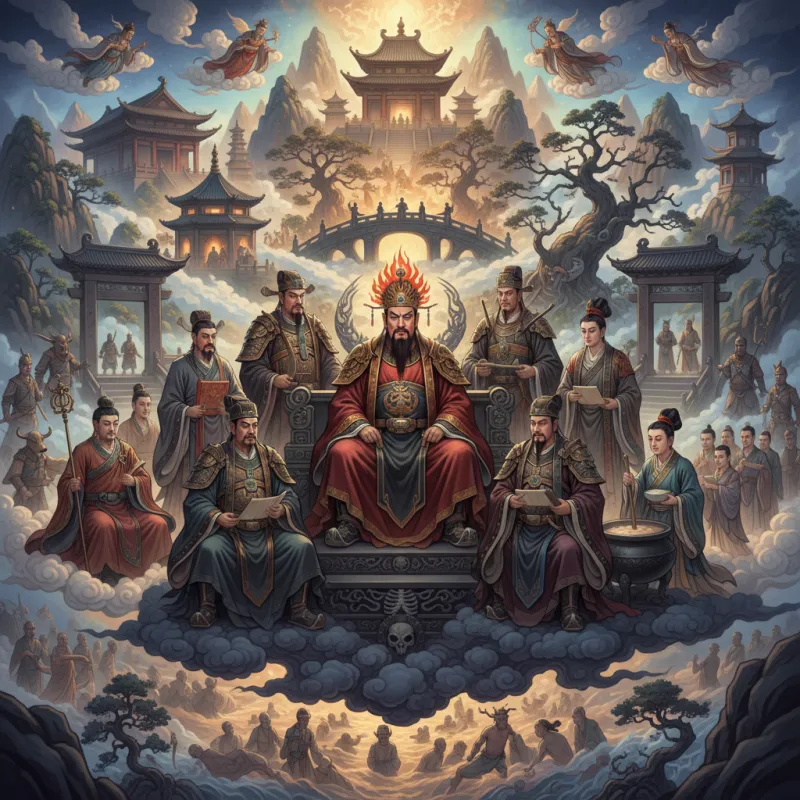
Picture this: you die, and instead of meeting St. Peter at pearly gates, you're handed a docket number and told to wait in line. Welcome to Chinese hell — where the afterlife runs like a cosmic DMV, complete with bureaucrats, paperwork, and a ten-court appeals process.
This isn't the fire-and-brimstone eternity you learned about in Sunday school. Chinese hell (地狱, dìyù) is temporary, procedural, and weirdly fair. It's a place where your grandmother who gossiped too much gets a different sentence than a serial killer, where punishments fit crimes with almost mathematical precision, and where everyone — yes, everyone — eventually gets paroled into their next life.
The Bureaucracy of the Dead
The Chinese underworld operates on a principle that would make any civil servant proud: meticulous record-keeping and proper channels. When you die, you don't face a single judge making a binary heaven-or-hell decision. Instead, you enter a system of ten courts, each specializing in different categories of sin, each presided over by a king who's essentially a divine magistrate.
This structure emerged during the Tang Dynasty (618-907 CE), though its roots stretch back to earlier Buddhist and Daoist concepts. The Jade Record (玉历, Yùlì), a Ming Dynasty text that became wildly popular, codified the system that most Chinese people recognize today. Think of it as the employee handbook for the afterlife — detailed, specific, and occasionally terrifying.
The genius of this system is its proportionality. You're not damned forever for stealing a loaf of bread, but you're also not getting off easy for murder just because you said sorry. Each court handles specific transgressions, and your sentence is calibrated to match. It's cosmic justice with a calculator.
The Ten Kings: A Judicial Lineup
First Court — King Qinguang (秦广王, Qínguǎng Wáng) serves as intake and triage. He reviews your life record — yes, there's a record, kept by underworld clerks who've been tracking your every move — and determines which subsequent courts you need to visit. Die a relatively good person? You might skip straight to reincarnation. Die with blood on your hands? Buckle up for the full tour.
Second Court — King Chujiang (楚江王, Chǔjiāng Wáng) handles dishonesty and corruption. Bribed officials, con artists, and anyone who made a living through deception answer to him. The punishments here involve freezing cold — a nice metaphor for the cold-heartedness of fraud.
Third Court — King Songdi (宋帝王, Sòngdì Wáng) deals with ingratitude and disrespect, particularly toward parents and elders. In a culture where filial piety (孝, xiào) is paramount, this court stays busy. Ungrateful children face punishments that often involve their hearts being literally weighed.
Fourth Court — King Wuguan (五官王, Wǔguān Wáng) judges tax evaders, hoarders, and those who wasted resources. Economic crimes get their own court because, well, the Chinese have always taken commerce seriously — even in death.
Fifth Court — King Yanluo (阎罗王, Yánluó Wáng) is the celebrity of the underworld. Derived from the Indian deity Yama, he's the one most people think of when they imagine Chinese hell. He presides over the Court of Screaming, where murderers and violent criminals face their reckoning. This is also where the famous "mirror of retribution" (孽镜台, nièjìng tái) stands — a supernatural screen that replays your worst deeds in vivid detail, forcing you to witness the consequences of your actions.
Sixth Court — King Biancheng (卞城王, Biànchéng Wáng) handles blasphemy and crimes against religion. Desecrated temples? Disrespected monks? This is your stop. The punishments here often involve being crushed or ground down — a fitting metaphor for grinding down the sacred.
Seventh Court — King Taishan (泰山王, Tàishān Wáng) judges those who violated graves, sold or ate human flesh, or engaged in particularly grotesque crimes. Named after Mount Tai, one of China's most sacred mountains, this court deals with violations of the body's sanctity.
Eighth Court — King Dushi (都市王, Dūshì Wáng) punishes filial impiety specifically — children who harmed their parents, abandoned their families, or caused their elders suffering. The punishments here are among the most severe because family betrayal cuts deepest in Chinese ethics.
Ninth Court — King Pingdeng (平等王, Píngděng Wáng) — whose name literally means "King of Equality" — handles crimes related to fire, arson, and abortion. This court also processes those who died by accident or suicide, determining whether their deaths warrant additional punishment or mercy.
Tenth Court — King Zhuanlun (转轮王, Zhuǎnlún Wáng) is the exit interview. After you've been processed, punished, and presumably learned your lesson, you arrive here to be assigned your next reincarnation. Will you come back as a human? An animal? A hungry ghost? King Zhuanlun decides based on your karmic balance sheet. Before you leave, you drink Mengpo's soup (孟婆汤, Mèngpó tāng) — a broth that erases all memory of your previous life and your time in hell. You're born fresh, with a clean slate, ready to accumulate new karma.
The Punishments: Poetic Justice Taken Literally
The tortures of Chinese hell aren't random sadism — they're thematically linked to specific sins. Liars get their tongues pulled out. Adulterers are thrown into pools of blood. Those who wasted food are force-fed molten metal. It's poetic justice taken to its logical, horrifying extreme.
The Journey to the West (西游记, Xīyóu Jì) includes a memorable sequence where the monk Xuanzang tours the underworld and witnesses these punishments firsthand. The descriptions are vivid enough to have inspired centuries of temple murals and folk art depicting hell's torments. These weren't meant to be metaphorical — they were warnings, visual aids for a largely illiterate population.
What makes these punishments particularly interesting is their temporary nature. You're not suffering forever — you're serving a sentence. Once your time is up, you move on. This reflects a fundamentally different worldview from Abrahamic religions: sin isn't an eternal stain but a debt that can be paid.
The Underworld's Supporting Cast
The Ten Kings don't work alone. They're supported by an entire bureaucracy of underworld officials, clerks, and enforcers. The Ox-Head and Horse-Face guards are the most famous — demonic bailiffs who escort souls through the courts and carry out punishments. They're the underworld's muscle, and they appear in countless folk tales as terrifying but ultimately lawful enforcers.
Then there's Mengpo (孟婆), the old woman who runs the amnesia soup stand at the exit. She's not a judge or a punisher — she's more like the underworld's HR department, ensuring smooth transitions between lives. Some versions of the myth say she was a virtuous woman who volunteered for the job; others claim she's been there since the beginning of time. Either way, she's essential to the system's function.
The underworld also employs countless clerks and record-keepers, tracking every soul's journey through the courts. This reflects the Chinese cultural obsession with documentation and proper procedure — even death requires paperwork.
Hell in Popular Culture
The ten courts of hell have inspired everything from temple architecture to video games. Buddhist temples across China, Taiwan, and Southeast Asia feature elaborate dioramas of the underworld, complete with painted figures suffering various torments. These "hell museums" were educational tools, teaching moral lessons through shock and awe.
In modern media, the underworld appears in films like Saving General Yang and The Monkey King series, in video games like Black Myth: Wukong, and in countless TV dramas. The bureaucratic nature of Chinese hell lends itself well to both horror and comedy — there's something inherently absurd about filling out forms in the afterlife.
The concept has also influenced how Chinese people approach death and ancestor worship. The practice of burning paper money and goods for the deceased stems partly from the belief that the dead need resources to navigate the underworld bureaucracy — bribes for officials, money for fines, supplies for the journey. It's practical spirituality: if hell is a government office, your ancestors need operating capital.
Why This Matters
The Chinese underworld reveals something profound about cultural values. A hell that's temporary, proportional, and bureaucratic reflects a society that believes in rehabilitation over eternal punishment, in cosmic fairness over divine caprice, and in the power of proper administration even in the spiritual realm.
It's also remarkably humane in its way. Everyone gets judged by the same standards. Everyone serves their time. Everyone gets another chance. There's no concept of being irredeemably evil — just varying degrees of karmic debt that must be paid.
This system has shaped Chinese attitudes toward death, justice, and morality for over a millennium. It's why ancestor veneration remains so important — your deceased relatives are navigating this system, and your prayers and offerings can help them. It's why moral behavior matters — not because a god is watching, but because cosmic accountants are taking notes.
The underworld gods aren't demons or angels. They're civil servants doing a job that someone has to do, maintaining order in the cosmos one soul at a time. And somehow, that's more terrifying — and more comforting — than any lake of fire could ever be.
Related Reading
- Black and White Impermanence: The Soul Collectors
- The Ten Yama Kings: Judges of the Chinese Underworld
- Yanluo Wang: The Chinese King of Hell
- Lü Dongbin: The Most Beloved Immortal in Chinese Culture
- Ancient Chinese Underworld Deities: Guardians of Death and Afterlife Realms
- Discovering Nature Spirits in Chinese Mythology: Guardians of the Earth and Sky