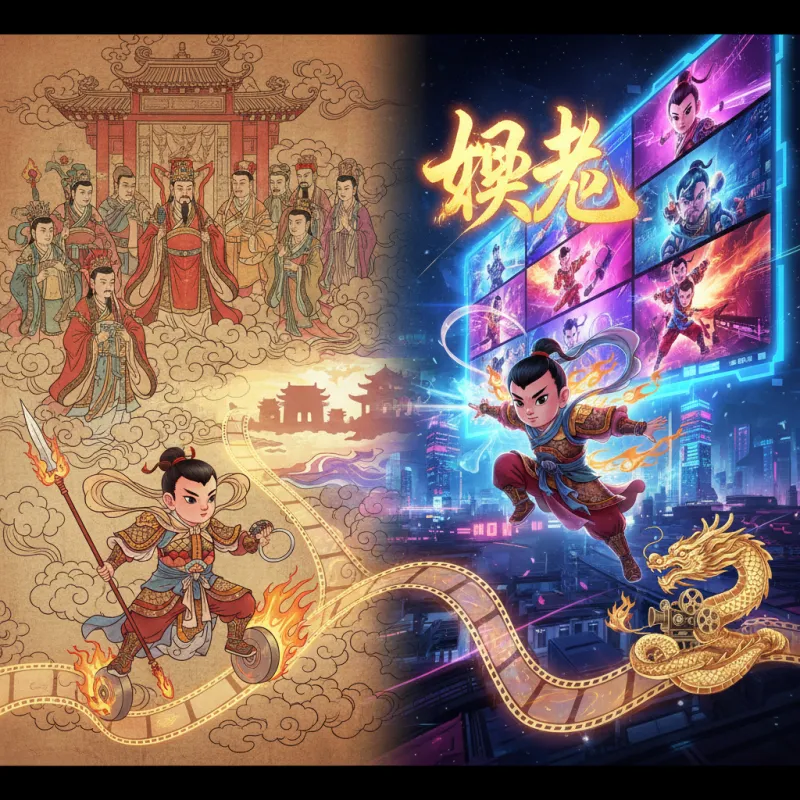
A child tears his own flesh from his bones, returns it to his parents, and declares himself free of filial obligation. Then he's reborn from a lotus flower, builds himself a new body, and goes on a revenge spree with a flaming spear and magic wheels. This isn't some edgy Netflix reboot—this is the original Nezha (哪吒, Nézhā), a deity who's been disturbing and delighting Chinese audiences for over a thousand years.
When Nezha: Birth of the Demon Child (哪吒之魔童降世, Nézhā Zhī Mó Tóng Jiàng Shì) raked in $726 million in 2019, Western media acted surprised. But anyone familiar with Chinese mythology knew Nezha had always been box office material. The real question wasn't whether he could carry a blockbuster—it was how long it would take for someone to figure that out.
The Deity Who Defied Heaven and Parents
Nezha's earliest appearances trace back to Tang Dynasty Buddhist texts, where he shows up as a guardian deity with distinctly foreign origins—likely imported from Hindu and Persian traditions. But by the time he landed in the Ming Dynasty novel Fengshen Yanyi (封神演义, Fēngshén Yǎnyì, Investiture of the Gods), he'd been thoroughly sinicized and given one of the most metal origin stories in world mythology.
Born after a three-year pregnancy, Nezha emerged as a ball of flesh that his father, the military commander Li Jing (李靖, Lǐ Jìng), immediately tried to slash open with his sword. The baby popped out fully formed, already wearing golden bracelets and a red silk sash—the Universe Ring (乾坤圈, Qiánkūn Quān) and the Red Armillary Sash (混天绫, Hùntiān Líng), two of his signature weapons. Within days, he was picking fights with dragon kings and accidentally killing their sons.
The conflict with Ao Bing (敖丙, Áo Bǐng), the Dragon King's third son, is where Nezha's story gets psychologically complex. After killing Ao Bing and skinning him for his tendons—yes, really—Nezha faced retaliation from the Dragon Kings, who threatened to flood his hometown. Rather than let his family suffer, Nezha performed an act that still shocks readers: he carved the flesh from his bones and returned it to his parents, severing the debt of birth and freeing them from responsibility for his actions.
This wasn't suicide. This was the ultimate rejection of filial piety (孝, xiào), the cornerstone of Confucian ethics. Nezha essentially said, "You gave me this body, here it is back, we're even, I owe you nothing." For a culture that built its entire social structure on parent-child obligation, this was revolutionary—and terrifying.
Lotus Rebirth and the Weaponized Child
The story doesn't end with Nezha's self-sacrifice. His teacher, the immortal Taiyi Zhenren (太乙真人, Tàiyǐ Zhēnrén), reconstructed him using lotus roots and leaves, giving him a new body free from parental debt. This lotus-born Nezha was even more powerful, wielding the Fire-Tipped Spear (火尖枪, Huǒjiān Qiāng) and riding the Wind Fire Wheels (风火轮, Fēnghuǒ Lún)—flaming wheels that let him fly at supersonic speeds.
But the new body didn't come with a new personality. Nezha immediately went after his father, Li Jing, seeking revenge for perceived slights and attempting to kill him multiple times. Only the intervention of the Buddha and the gift of a golden pagoda—which Li Jing could use to trap and control Nezha—prevented patricide. Even then, their relationship remained toxic, defined by resentment and supernatural restraint rather than love.
This father-son dynamic is what makes Nezha endlessly fascinating. He's not a dutiful deity like Erlang Shen, who served heaven despite personal cost. He's not a reformed demon like Sun Wukong, who eventually accepted Buddhist discipline. Nezha is perpetually angry, perpetually young, and perpetually at war with authority—especially parental authority.
From Religious Icon to Popular Culture Fixture
After Fengshen Yanyi cemented Nezha's narrative in the 16th century, he became a fixture in Chinese opera, folk religion, and popular culture. Temples dedicated to Nezha (哪吒庙, Nézhā Miào) appeared across China and Taiwan, where he's venerated as a protector deity, particularly popular among children and teenagers. His birthday, celebrated on the ninth day of the ninth lunar month, features processions with young boys dressed as the deity, complete with toy spears and wheels.
The 20th century brought Nezha to new media. The 1979 animated film Nezha Conquers the Dragon King (哪吒闹海, Nézhā Nào Hǎi) by Shanghai Animation Film Studio became a defining work of Chinese animation, presenting a more sympathetic Nezha whose suicide was framed as tragic heroism rather than rebellious rejection. This version influenced decades of adaptations, softening Nezha's edges while keeping his core defiance.
Television series, comic books, and video games followed, each iteration tweaking Nezha's character to fit contemporary values. Some versions emphasized his loyalty to heaven, making him a proper celestial warrior. Others leaned into his rebellious nature, positioning him as a misunderstood outsider. But none achieved the cultural penetration of the 2019 film.
The 2019 Phenomenon: Nezha Reimagined
Director Yang Yu (饺子, Jiǎozi) made a crucial decision with Nezha: Birth of the Demon Child: he'd make Nezha ugly. Not cute-ugly, but genuinely off-putting—dark circles under his eyes, crooked teeth, a perpetual sneer. This Nezha looked like a kid who'd been told his entire life that he was a demon, and he'd decided to act like it.
The film's genius was reframing Nezha's story through the lens of prejudice and self-determination. Born as a "demon pill" rather than a "spirit pill" due to a cosmic mix-up, this Nezha faced a village that feared and hated him from birth. His destructive behavior wasn't inherent evil—it was a traumatized response to constant rejection. The film's tagline, "My fate is mine to decide, not heaven's" (我命由我不由天, Wǒ Mìng Yóu Wǒ Bù Yóu Tiān), became a rallying cry for Chinese youth facing academic pressure and limited social mobility.
Yang Yu also did something radical with the Nezha-Ao Bing relationship: he made them friends. Instead of enemies, they became two sides of the same coin—Nezha the demon-born who wanted to be good, Ao Bing the spirit-born who felt pressured to be perfect. Their final confrontation wasn't about revenge but about two kids trapped by destiny trying to save each other. Chinese audiences, particularly those familiar with the intense pressure of the gaokao (高考, gāokǎo) college entrance exam, saw themselves in both characters.
The film's success—$726 million, beating Zootopia to become China's highest-grossing animated film—proved that Chinese mythology didn't need to be sanitized or westernized to succeed. It needed to be emotionally honest and visually spectacular, which Yang Yu's team delivered with stunning animation that mixed traditional Chinese aesthetics with modern CGI techniques.
Why Nezha Resonates Now
Nezha's enduring appeal lies in his refusal to accept the role assigned to him. In a culture that traditionally emphasized conformity, hierarchy, and filial duty, Nezha is the deity who said "no" to all of it. He rejected his parents, defied heaven, and literally rebuilt himself on his own terms. That's a powerful fantasy for anyone who's felt trapped by expectations.
The 2019 film tapped into something specific to contemporary China: a generation of only children (thanks to the one-child policy) who grew up under immense pressure to succeed, to honor their parents' sacrifices, to be perfect. Nezha's declaration that his fate was his own to decide resonated because it articulated a desire many felt but couldn't express—the desire to define yourself outside of family expectations and social roles.
But Nezha's appeal isn't limited to Chinese audiences. The themes of prejudice, self-determination, and found family (his relationship with Ao Bing) are universal. The film's international success, while modest compared to its Chinese box office, showed that mythology-based animation could travel across cultures when the emotional core was strong enough.
The Mythology-to-Media Pipeline
Nezha's box office success has implications beyond one film. It demonstrated that Chinese mythology contains dozens of characters with blockbuster potential, each with centuries of narrative development and cultural resonance. Studios are now mining Journey to the West, Fengshen Yanyi, and other classical texts for adaptable material, creating a mythology-to-media pipeline similar to Marvel's comic-to-film strategy.
The difference is that these aren't just stories—they're active religious and cultural touchstones. Nezha isn't a fictional character to millions of Chinese people; he's a deity they've prayed to, a figure in temple processions, a name invoked for protection. Adapting these figures requires balancing creative freedom with cultural respect, entertainment value with religious sensitivity.
Yang Yu navigated this by keeping Nezha's core traits—his defiance, his power, his complicated relationship with authority—while updating the context and motivations. He didn't make Nezha a different character; he made him a character for a different era. That's the key to successful mythological adaptation: evolution, not revolution.
Beyond the Box Office
Since 2019, Nezha has appeared in multiple films, series, and games, each building on the character's renewed popularity. A sequel, Nezha 2, is in production, promising to expand the mythology while maintaining the emotional depth that made the first film resonate. Other studios have launched their own mythological universes, hoping to replicate the success.
But Nezha's real legacy might be cultural rather than commercial. The film reminded Chinese audiences—especially younger ones—that their mythology is as rich, complex, and emotionally resonant as any Western franchise. It proved that stories rooted in Chinese culture could achieve both domestic success and international recognition without compromising their identity.
For a deity who's been around for over a millennium, Nezha's journey from Buddhist guardian to box office champion is just the latest chapter. He's survived dynastic changes, religious transformations, and cultural revolutions. He'll survive the streaming era too, probably while riding flaming wheels and picking fights with dragons. That's what Nezha does—he endures, he rebels, and he refuses to be anything other than himself. In 2019, that made him a hero. A thousand years ago, it made him a god. The difference, it turns out, isn't as big as you'd think.
Related Reading
- Journey to the West: From Novel to Netflix — Every Major Adaptation
- Chinese Gods in Anime and Manga: Eastern Mythology Goes Global
- Nezha: From Rebellious Child God to China's Biggest Animated Film
- Chinese Gods in Marvel and DC Comics
- Buddhist Deities in Chinese Culture: How India's Gods Became Chinese
- Exploring Chinese Deities and Immortals: Rituals in Daoist and Buddhist Traditions
- Gods of Chinese New Year: The Deities Behind the Festival