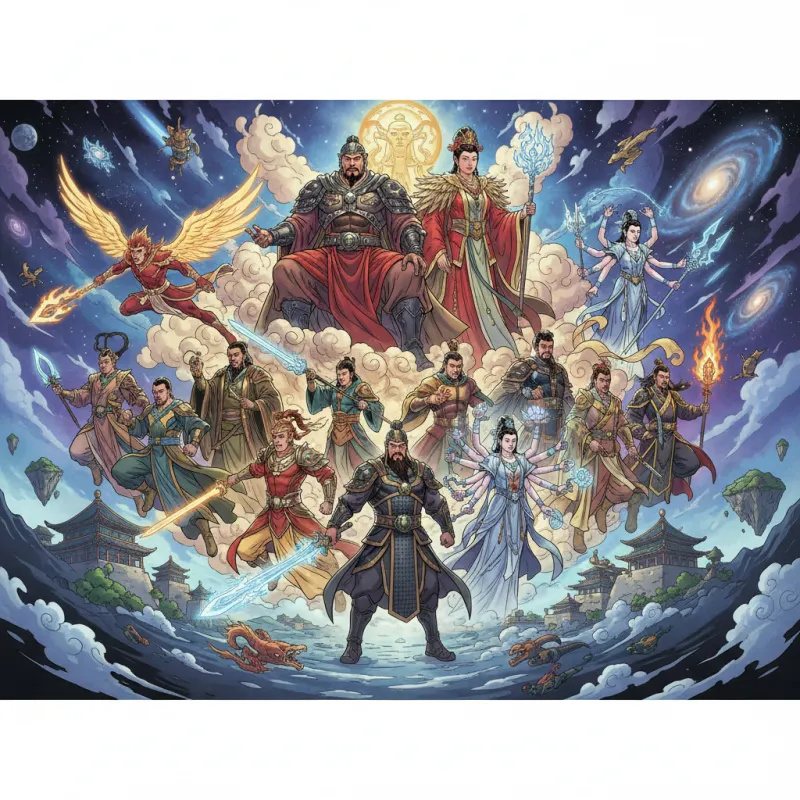
The Jade Emperor showed up in a 1970s Marvel comic looking like Zeus ate a fortune cookie. Muscular, toga-clad, perched on a cloud with a Fu Manchu mustache that would make any self-respecting celestial bureaucrat resign in protest. The Yù Huáng Dàdì (玉皇大帝), supreme ruler of heaven's administrative apparatus, reduced to a bodybuilder with questionable facial hair choices. Yet that absurd panel represents something significant: Western comics discovered Chinese mythology existed, and they've been trying to figure out what to do with it ever since.
The Early Days: When Marvel Thought All Asian Gods Looked the Same
Marvel's first attempts at incorporating Chinese deities into their universe were, to put it charitably, experimental. The 1970s and 80s saw characters like the Jade Emperor, Sun Wukong, and various immortals appear in titles like Master of Kung Fu and Thor, often drawn by artists who'd clearly never seen a Ming dynasty painting or read Journey to the West. The visual language defaulted to a mishmash of "exotic Asian" stereotypes—lots of dragons, clouds, and robes that looked more like bathrobes than imperial regalia.
The problem wasn't malice; it was ignorance combined with the comic industry's breakneck production schedule. Artists had maybe one afternoon to research an entire pantheon before pencils hit paper. Reference materials were scarce in pre-internet America. The result? Chinese gods who looked like they'd wandered off the set of a kung fu movie, not descended from the celestial bureaucracy that inspired Chinese imperial governance.
Sun Wukong (孫悟空), the Monkey King, fared slightly better because his visual design is inherently dynamic—a monkey in armor with a staff is hard to mess up completely. But even he got flattened into a generic "trickster" archetype, stripped of the Buddhist redemption arc that makes Journey to the West more than just a adventure story. Marvel's version appeared in Deadly Hands of Kung Fu looking appropriately simian but acting like every other wise-cracking sidekick in their roster.
DC's Slightly More Respectful Approach
DC Comics, perhaps because they came to Chinese mythology later, managed to avoid some of Marvel's more egregious missteps. Their incorporation of Chinese deities into the broader DC Universe showed more restraint and, occasionally, actual research. The Great Ten, a Chinese superhero team introduced in 2006, included members inspired by Chinese mythology and folklore, though they were modern interpretations rather than direct depictions of gods.
Where DC deserves credit is in their New Super-Man series (2016-2018), which featured Kong Kenan gaining powers from Chinese deities including the Monkey King. Writer Gene Luen Yang, himself Chinese-American and author of the acclaimed American Born Chinese graphic novel, brought cultural authenticity that previous attempts lacked. The series depicted Guānyīn (觀音), the Bodhisattva of Compassion, with appropriate reverence and visual accuracy. No togas. No Fu Manchu mustaches. Just a deity who actually looked like she'd stepped out of a Buddhist temple.
The series also engaged with Chinese philosophical concepts like the balance of yīn and yáng (陰陽) in ways that felt organic rather than tacked-on. When Kong Kenan channels the power of Qí (氣), the comic takes time to explain what that means within Chinese cosmology, not just treat it as generic "energy blasts." This is what happens when you have creators who understand the source material beyond Wikipedia summaries.
The Monkey King's American Adventures
Sun Wukong has become the most frequently adapted Chinese deity in Western comics, and for good reason—he's a perfect comic book character. Immortal, nearly invincible, armed with a size-changing staff, capable of transforming into anything, and possessing a personality that ranges from playful to wrathful. He's basically Wolverine, Deadpool, and Thor rolled into one monkey-shaped package.
Marvel has used him multiple times across different titles. He appeared in Journey into Mystery fighting alongside Thor, showed up in Agents of Atlas as a member of the team, and even got name-dropped in Shang-Chi comics. Each appearance tweaks his characterization slightly, but most maintain his core traits: arrogance, combat prowess, and a complicated relationship with authority.
DC's version, appearing in New Super-Man and other titles, leans more heavily into his Buddhist redemption arc. This Sun Wukong isn't just a powerful fighter; he's a being who achieved enlightenment through suffering and discipline. The staff, Rúyì Jīn Gū Bàng (如意金箍棒), isn't just a weapon but a symbol of his journey from rebel to protector. When written well, this version captures something essential about the original character that pure action-focused adaptations miss.
The challenge with Sun Wukong in comics is that he's almost too powerful. In Journey to the West, it takes Buddha himself to stop the Monkey King's rebellion. How do you write compelling stories about a character who can defeat nearly anyone? Marvel's solution has been to either depower him or place him in situations where raw strength isn't enough. DC's approach in New Super-Man was smarter: make him a mentor figure whose power is established but whose role is to guide rather than dominate.
The Jade Emperor's Bureaucratic Problem
The Yù Huáng Dàdì presents a unique challenge for Western comics: he's fundamentally boring by superhero standards. He doesn't fight. He doesn't have dramatic powers. He sits on a throne, receives reports, and makes administrative decisions about the cosmos. He's the ultimate middle manager, elevated to cosmic scale. This makes him terrible for action-packed comic books but fascinating for anyone who understands Chinese cosmology.
Marvel has mostly used him as a background figure, the authority that other characters report to or rebel against. He appears in Thor comics as part of the broader pantheon of gods that exist in the Marvel Universe, usually sitting in judgment or making pronouncements. The visual design has improved dramatically since the 1970s—modern depictions show him in proper imperial regalia, seated on a throne in a celestial palace, looking appropriately dignified.
What comics struggle to convey is the Jade Emperor's significance within Chinese religious thought. He's not just a powerful god; he's the embodiment of celestial order, the cosmic equivalent of the emperor on earth. His power comes from his position within the bureaucratic hierarchy of heaven, not from personal combat ability. This is a fundamentally different conception of divine authority than the Zeus-style "strongest god rules" model that Western audiences expect.
The few times comics have engaged with this bureaucratic aspect, the results have been surprisingly effective. A storyline in Agents of Atlas featured the Jade Emperor's court as a complex political entity with factions, rivalries, and administrative procedures. Characters had to navigate celestial bureaucracy to achieve their goals, which is much closer to how Chinese mythology actually works. More of this, please.
Guanyin, Nezha, and the Supporting Cast
Beyond the Jade Emperor and Sun Wukong, other Chinese deities have made sporadic appearances in Western comics, with varying degrees of accuracy. Guānyīn (觀音), the Bodhisattva of Compassion, appears in DC's New Super-Man as a wise, powerful figure who guides the protagonist. The depiction is respectful and visually accurate, showing her in traditional flowing robes with the characteristic serene expression. Marvel has been more hesitant with Guanyin, perhaps recognizing that a Buddhist figure of compassion doesn't fit easily into their punch-first universe.
Nézhā (哪吒), the child deity who fought the Dragon King, has appeared in both Marvel and DC comics, though usually in minor roles. His visual design—a young warrior with a spear, fire wheels, and a sash—translates well to comics, and his rebellious nature fits superhero narratives. Marvel's version appeared in Deadly Hands of Kung Fu and later titles, while DC included him in stories involving Chinese mythology. Neither publisher has given him a starring role, which is a missed opportunity. Nezha's story of defying corrupt authority and sacrificing himself for justice is tailor-made for modern superhero comics.
The Eight Immortals (八仙, Bā Xiān) have appeared occasionally, usually as a group rather than individuals. Marvel featured them in Master of Kung Fu and other titles, while DC included them in mystical storylines. The challenge with the Eight Immortals is that they're not warriors in the traditional sense—they're enlightened beings who happen to have magical abilities. Comics tend to reduce them to their powers (fan that controls wind, flute that charms animals, etc.) without exploring their personalities or the philosophical traditions they represent.
When Comics Get It Right (And Why It Matters)
The best comic book depictions of Chinese deities share common elements: cultural consultants, creators with personal connections to the material, and willingness to let Chinese mythology be Chinese rather than forcing it into Western narrative templates. Gene Luen Yang's New Super-Man succeeded because Yang understood that Chinese superhero stories don't have to follow the same beats as American ones. The series incorporated concepts like filial piety and ancestor veneration as sources of power, not just obstacles to overcome.
Marvel's Shang-Chi comics have improved dramatically in recent years, particularly after the character's MCU debut prompted renewed attention. Recent storylines have featured Chinese deities and mythological elements with more nuance and accuracy than earlier attempts. The visual designs draw from actual Chinese art rather than generic "Asian mysticism" aesthetics. Characters speak about Chinese philosophy in ways that suggest the writers have read more than fortune cookies.
What still needs work: the tendency to treat Chinese mythology as exotic flavor rather than a complete cosmological system. Western comics default to Greek/Norse mythology as the "standard" pantheon, with Chinese deities as interesting additions rather than equally valid alternatives. The Marvel and DC universes both have elaborate hierarchies of gods, but Chinese deities rarely occupy positions of real importance in those hierarchies. They're guests in someone else's universe, not full participants.
The Future: Beyond Stereotypes and Tokenism
The next evolution in depicting Chinese deities in Western comics requires moving beyond representation for its own sake. It's not enough to include a Chinese god in a lineup of international heroes or have Sun Wukong make a cameo. The question is: what stories can only be told through Chinese mythology? What narrative possibilities exist in Daoist cosmology, Buddhist philosophy, or Chinese folk religion that don't exist in Western traditions?
Imagine a comic series centered on the celestial bureaucracy, where conflicts are resolved through administrative procedures, political maneuvering, and philosophical debates rather than punching. Or a story exploring the relationship between gods and ancestors, where deceased family members have as much influence as deities. Or a narrative that takes seriously the idea that immortality is achieved through cultivation and discipline, not granted by cosmic accidents.
The tools exist now that didn't in the 1970s. Artists can reference thousands of images of Chinese religious art online. Writers can consult with cultural experts and read translations of primary texts. Publishers can hire creators with direct connections to Chinese culture. The question is whether the industry will invest in doing Chinese mythology justice, or continue treating it as exotic window dressing for stories that could be told with any pantheon.
The Jade Emperor still shows up in comics occasionally, and he no longer wears a toga. That's progress. But he's still usually a background figure, a name dropped to add mystical weight to a scene. When he becomes a fully realized character—bureaucrat, administrator, embodiment of cosmic order—then we'll know Western comics have finally figured out what to do with Chinese mythology. Until then, we're still in the early stages of a long journey west.
Related Reading
- Nezha: From Ancient Deity to Box Office Hit
- Nezha: From Rebellious Child God to China's Biggest Animated Film
- Chinese Gods in Anime and Manga: Eastern Mythology Goes Global
- Journey to the West: From Novel to Netflix — Every Major Adaptation
- Unveiling Chinese Deities and Immortals in Daoist and Buddhist Traditions
- The Lantern Festival: When Gods Walk Among Mortals
- Exploring the Rich Tapestry of Chinese Deities and Immortals