Picture this: you're lying in bed, fever burning through you, when the room suddenly grows cold. Two figures materialize at the foot of your bed. One towers over you, impossibly tall, dressed in flowing white robes with a long red tongue lolling from his grinning face. His hat reads "You're Coming With Me" (一见生财). Beside him stands his opposite — short, dark, scowling in black robes, his hat bearing the words "Exactly As Ordered" (天下太平). They've come to collect your soul, and there's no negotiating with Black and White Impermanence (黑白无常 Hēi Bái Wúcháng).
These aren't minor demons or random psychopomps. They're the most recognizable figures in Chinese death mythology, appearing in everything from Ming dynasty novels to modern horror films. Their name alone — wúcháng (无常), meaning "impermanence" — cuts to the heart of Buddhist philosophy. They are the walking, grinning, scowling reminder that nothing lasts. Not your wealth, not your status, not your carefully constructed life. When they show up, your time is done.
Two Friends, One Tragic Mistake
The origin story of Black and White Impermanence reads like a tragedy that got promoted to cosmic bureaucracy. According to the most widespread version, they were once two mortal friends named Xie Bi'an (谢必安) and Fan Wujiu (范无救) who lived during the Song dynasty. The details vary by region, but the core narrative remains consistent.
One day, the two friends were walking together when Xie Bi'an needed to return home for something. Fan Wujiu, being the loyal friend, promised to wait for him under a bridge. But the weather turned. Rain came down in sheets. The river began to rise. Fan Wujiu, bound by his promise, refused to leave his post. When Xie Bi'an finally returned, he found his friend drowned, still waiting faithfully beneath the bridge.
Overcome with guilt and grief, Xie Bi'an hanged himself on the spot. His body was discovered with his tongue hanging out — which explains White Impermanence's signature long red tongue in iconography.
When Yanluo Wang, the King of Hell, heard this story, he was moved by their loyalty and righteousness. He appointed them as soul collectors, forever bound together in death as they were in life. Xie Bi'an became White Impermanence (Bai Wuchang), and Fan Wujiu became Black Impermanence (Hei Wuchang). Their friendship became their eternal job description.
The Odd Couple of Death
What makes Black and White Impermanence so memorable isn't just their appearance — it's their dynamic. They're the original odd couple, cosmic partners with completely opposite personalities and approaches to soul collection.
White Impermanence (Xie Bi'an) is tall, sometimes depicted as over seven feet, with a pale face and that distinctive long red tongue. He wears white robes and a tall white hat inscribed with characters that roughly translate to "You're Coming With Me" or "At First Sight, Wealth Arrives" (一见生财 yī jiàn shēng cái) — a darkly ironic pun, since seeing him means your wealth days are over. His personality is cheerful, almost playful. He smiles constantly, sometimes laughs. He's the "good cop" of the underworld, the one who might chat with you on the way to judgment.
Black Impermanence (Fan Wujiu) is his opposite in every way. Short, dark-skinned, dressed in black robes with a perpetual scowl. His hat reads "Exactly As Ordered" (天下太平 tiān xià tài píng, literally "Peace Under Heaven" — another ironic touch). He's serious, stern, no-nonsense. He doesn't smile. He doesn't joke. He's there to do a job, and that job is dragging your soul to the underworld for judgment. He's the "bad cop," though calling him bad isn't quite right — he's just uncompromising.
Together, they represent the dual nature of death itself. White Impermanence embodies the release, the end of suffering, the Buddhist concept that death is simply transition. Black Impermanence represents the fear, the finality, the judgment that awaits. You can't have one without the other.
Their Role in the Underworld Bureaucracy
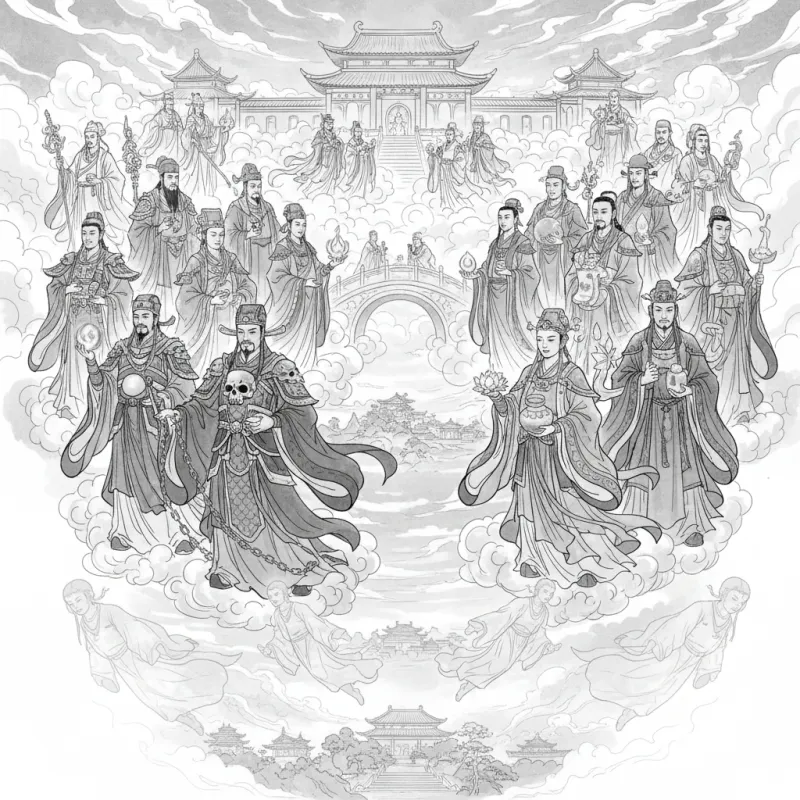
In the complex hierarchy of Chinese underworld mythology, Black and White Impermanence serve as field agents for Yanluo Wang and the Ten Courts of Hell. They're not decision-makers — they're executors of orders. When someone's time is up according to the Book of Life and Death (生死簿 shēng sǐ bù), these two show up to collect.
But they're not mindless reapers. According to various folk tales and religious texts, they have some discretion. White Impermanance, being more lenient, might give someone a few extra moments to say goodbye or finish urgent business. Black Impermanence, being strict, ensures the cosmic schedule stays on track. This creates a natural balance — mercy tempered by justice, compassion checked by duty.
They work alongside other underworld officials like the Ox-Head and Horse-Face guards (牛头马面 Niú Tóu Mǎ Miàn), but Black and White Impermanence are specifically tasked with collecting souls at the moment of death. The Ox-Head and Horse-Face are more like prison guards; Black and White Impermanence are the arresting officers.
Their jurisdiction is universal. Rich or poor, virtuous or wicked, emperor or beggar — everyone gets the same treatment. This democratic approach to death made them popular figures in folk religion. They proved that even in death, there was a kind of equality. Your wealth and status meant nothing to them.
Cultural Impact and Modern Appearances
Walk through any traditional Chinese funeral procession or temple festival, and you'll likely see performers dressed as Black and White Impermanence. They've become staple figures in Chinese opera, particularly in performances related to the underworld or ghost stories. Their distinctive appearance makes them instantly recognizable — no explanation needed.
In literature, they appear throughout Chinese ghost story collections and supernatural fiction. The Strange Tales from a Chinese Studio (聊斋志异 Liáo Zhāi Zhì Yì) by Pu Songling references them. They show up in Journey to the West (西游记 Xī Yóu Jì) adaptations. Modern horror films and TV dramas regularly feature them as antagonists or, interestingly, as sympathetic figures just doing their jobs.
The 2020s have seen a resurgence of interest in traditional Chinese mythology, and Black and White Impermanence have benefited. They appear in video games, anime-style adaptations, and even as popular tattoo designs. Young Chinese people who might not know the full mythology still recognize the tall figure in white and the short figure in black.
What's fascinating is how their image has evolved while maintaining core elements. Modern depictions sometimes make them more attractive, less frightening — bishōnen versions for contemporary audiences. But the essential dynamic remains: one tall and pale, one short and dark; one smiling, one scowling; partners in the business of death.
The Philosophy Behind the Figures
Strip away the mythology and folk tales, and Black and White Impermanence represent something profound: the Buddhist concept of impermanence (无常 wúcháng) made visible and personal. Buddhism teaches that all conditioned things are impermanent — everything that arises will cease. This isn't meant to be depressing; it's meant to be liberating. If you truly understand impermanence, you stop clinging to things that can't last.
But humans struggle with abstract philosophy. We need stories, images, characters. Black and White Impermanence give impermanence a face — two faces, actually. They make the abstract concrete. When you see them in a temple procession or a folk opera, you're not just seeing scary death figures. You're seeing a reminder: this life is temporary, so live accordingly.
Their contrasting appearances reinforce this teaching. White Impermanence's smile suggests that death isn't necessarily terrible — it's natural, even peaceful. Black Impermanence's scowl reminds us that death is also serious, final, and demands we face judgment for how we lived. Together, they present a complete picture: death is both release and reckoning.
The fact that they were once human friends adds another layer. They understand mortality because they experienced it. They're not distant gods or abstract forces — they're former humans who died tragically and were elevated to cosmic positions. This makes them more relatable, more sympathetic. They're not punishing you; they're just doing the job they were assigned after their own deaths.
Meeting Them: What the Folk Traditions Say
According to Chinese folk belief, there are signs that Black and White Impermanence are near. Sudden cold spots in warm rooms. The smell of incense when none is burning. Shadows that move wrong. Dogs barking at nothing. These aren't just superstitions — they're part of a rich tradition of death omens that helped people prepare psychologically for mortality.
Some traditions hold that virtuous people see White Impermanence first, while wicked people see Black Impermanence. Others say everyone sees both, but your perception of them depends on your karma. If you've lived well, White Impermanence's smile seems welcoming; if you've lived poorly, Black Impermanance's scowl seems terrifying.
There are folk rituals meant to delay their arrival — offerings, prayers, merit-making activities. But the underlying message is always the same: they're coming eventually. The best preparation isn't trying to avoid them but living in a way that makes their arrival less frightening.
Modern Chinese people might not literally believe in Black and White Impermanence, but the cultural impact remains. The phrase "Black and White Impermanence are coming" (黑白无常来了) is still used colloquially to mean someone's time is up, or that consequences are arriving. They've transcended their mythological origins to become cultural shorthand for mortality itself.
Why They Still Matter
In an age of scientific materialism, why do Black and White Impermanence persist in Chinese culture? Because they solve a problem that science can't: how to think about death in a way that's both honest and bearable.
They don't sugarcoat death. They don't promise easy immortality or comfortable afterlives. They show up, they collect your soul, they take you to judgment. It's bureaucratic, impersonal, inevitable. But there's something comforting in that inevitability. If death comes for everyone, if even emperors face the same two collectors, then death is at least fair.
Their partnership also matters. Death doesn't come as a single terrifying figure but as two contrasting personalities. One smiles, one scowls. One is tall, one is short. One represents mercy, one represents justice. This duality makes death more complex, more nuanced, more human. It suggests that death itself contains multitudes — it's not just one thing.
And ultimately, they remind us of the friendship that created them. Two men who valued loyalty so much that they died for it, then were rewarded with eternal partnership. In a mythology full of demons, tortures, and cosmic punishments, Black and White Impermanence stand out as figures born from love and loyalty. They're frightening, yes, but they're also strangely reassuring. When your time comes, at least you won't face it alone. You'll have two guides, two friends, two former humans who understand exactly what you're going through.
They're coming for all of us eventually. But knowing their story makes the wait a little less frightening.
Related Reading
- The Ten Yama Kings: Judges of the Chinese Underworld
- The Underworld Gods: Who Runs Chinese Hell
- Ox-Head and Horse-Face: The Underworld's Enforcers
- The Peaches of Immortality: Xi Wangmu Garden
- Exploring Chinese Deities and Immortals: Rituals in Daoist and Buddhist Traditions
- Xuanwu: The Turtle-Snake God of the North