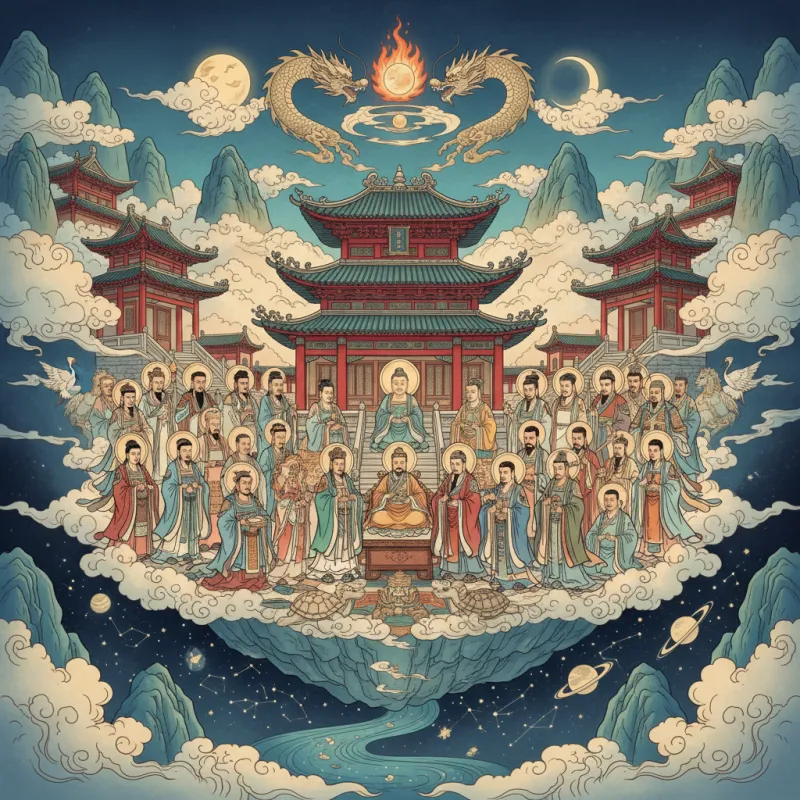
Stand at the entrance of any Chinese temple and look up. That sweeping roof isn't just beautiful — it's a weapon. Those upturned eaves? They're designed to fling demons back into the sky, because evil spirits, according to centuries of architectural wisdom, can only travel in straight lines. The moment you understand this, every temple transforms from a pretty building into a three-dimensional spell, a structure that doesn't just house the divine but actively fights for it.
The Roof: A Battlefield in Ceramic and Wood
The roof of a Chinese temple is where theology meets physics. That distinctive curve — called 飞檐 (fēi yán, "flying eaves") — emerged during the Tang Dynasty and became increasingly dramatic through the Song and Ming periods. But it's not the curve alone that matters. It's what lives on that curve.
Walk around any major temple and count the figures marching along the roof ridge. These aren't decorations. They're guardians, ranked by importance. The lead figure is always a man riding a phoenix — this is Qí Mǐn Dàwáng (齐闵大王), a prince who, according to legend, escaped assassination by riding a phoenix across a river. Behind him march a procession of mythical beasts: dragons, phoenixes, lions, seahorses, each one a specific defense against a specific threat.
The number of these figures tells you the building's importance. The Hall of Supreme Harmony in Beijing's Forbidden City has eleven — the maximum. Most temples have five, seven, or nine (always odd numbers, which are yang and therefore protective). The Jade Emperor's halls typically get nine. Lesser deities make do with five. This isn't arbitrary. It's a precise hierarchy written in glazed ceramic.
The dragon finials at each end of the main ridge beam — called 鸱吻 (chīwěn, "owl kiss") — are specifically anti-fire talismans. They're often shown swallowing the ridge beam itself, symbolically drinking in any flames that might threaten the wooden structure. During the Ming Dynasty, these became so elaborate that some temples had to reinforce their roof structures just to support the weight of their own protective symbolism.
Doors: The Threshold Between Worlds
Temple doors are never just doors. They're portals, and portals require guardians. This is why you'll find door gods — 门神 (ménshén) — painted or carved on nearly every temple entrance. The most common pair are Qin Shubao and Yuchi Gong, two Tang Dynasty generals who, according to legend, stood guard outside Emperor Taizong's bedroom to protect him from demons. They were so effective that the emperor had their portraits painted on doors instead, giving them a permanent night off.
But look closer at the doors themselves. Count the studs — those brass or iron knobs arranged in a grid. Imperial buildings have nine rows of nine studs (81 total). Temples dedicated to major deities might have seven rows of seven (49 total). Lesser temples get five by five. This isn't decoration. It's a mathematical declaration of cosmic rank.
The threshold itself — that raised wooden beam you step over — is called 门槛 (ménkǎn), and you never, ever step on it. It's not just rude; it's spiritually dangerous. The threshold is where the boundary between sacred and profane is thinnest. Stepping on it is like stepping on the neck of the temple itself. Watch any Chinese person entering a temple, and you'll see them lift their feet deliberately over this barrier, maintaining the separation between worlds.
Pillars: The Axis of Heaven and Earth
The red pillars that support every temple hall are more than structural elements. They're cosmic axes, connecting the underworld (foundation), the human realm (the hall itself), and heaven (the roof). This is why they're almost always red — the color of yang energy, life force, and divine fire.
But the real magic is in what's written on them. Temple pillars are covered in couplets — 对联 (duìlián) — parallel verses that frame the deity's nature and powers. These aren't random poetry. They're carefully composed to balance yin and yang, to match tone and meaning across both pillars, creating a linguistic harmony that mirrors the cosmic balance the temple represents.
At the Chenghuang Temple in Shanghai, the pillars flanking the City God's throne read: "Observe the good and evil of this world" on one side, and "Judge the right and wrong of human hearts" on the other. This isn't just description — it's a warning. The pillars themselves are watching you.
The number of pillars also matters. Major halls typically have six or eight pillars in the front row (even numbers, representing earth and stability). The most important halls might have twelve, representing the twelve earthly branches and the complete cycle of time. When you see a hall with an unusual number of pillars, you're looking at a specific cosmological statement.
The Altar: Geography of the Divine
Temple altars follow a strict spatial hierarchy that mirrors the celestial bureaucracy. The highest position — the center of the back wall — belongs to the primary deity. This isn't negotiable. In a Guanyin temple, the Goddess of Mercy sits center. In a City God temple, the Chenghuang takes that spot.
But look at who flanks them. These attendant positions reveal theological relationships. Guanyin is often flanked by her two attendants, Longnü (Dragon Girl) and Shancai (Good Fortune Boy). The Jade Emperor typically has the Celestial Masters of the Four Directions. These aren't random groupings — they're organizational charts of the divine bureaucracy.
The altar itself has levels, and each level has meaning. The highest tier is for the primary deity. The second tier is for major attendants or related deities. The third tier is for offerings. This vertical hierarchy mirrors the horizontal one: center is highest rank, left side (from the deity's perspective) is second rank, right side is third rank.
Incense burners are positioned according to this same logic. The largest burner sits directly in front of the main deity. Smaller burners serve the attendants. The massive outdoor incense burner in the temple courtyard — often a bronze ding (鼎) vessel — is for general prayers and offerings to all the temple's residents at once.
Decorative Panels: The Illustrated Sutras
Every carved panel, every painted beam, every ceramic tile tells a story. These aren't abstract designs — they're narrative theology. The most common motifs form a visual vocabulary that any temple-goer would once have been able to read fluently.
Bats (蝠, fú) are everywhere because the word sounds identical to "fortune" (福, fú). Five bats together represent the Five Blessings: longevity, wealth, health, virtue, and a peaceful death. When you see five bats circling a central character for longevity (寿, shòu), you're looking at a complete prayer rendered in wood or stone.
Peonies represent wealth and honor, but also female beauty and reproductive power. They're common in temples dedicated to goddesses or in halls where women pray for children. Lotus flowers are Buddhist symbols of purity — they grow from mud but bloom unstained, just as enlightenment emerges from the suffering of samsara.
Dragons and phoenixes together represent the emperor and empress, yang and yin, cosmic balance. But count the dragon's claws. Five-clawed dragons were reserved for imperial use. Temple dragons typically have four claws. If you see a five-clawed dragon in a temple, you're either in a former imperial temple or looking at a building that's making a very bold claim about its importance.
The Eight Immortals appear frequently, each with their distinctive attributes: Lü Dongbin with his sword, He Xiangu with her lotus, Lan Caihe with their flower basket. Their presence marks a temple with Daoist affiliations. Similarly, the Eighteen Arhats signal Buddhist identity — these are the Buddha's original disciples, each frozen in a moment of spiritual realization.
Courtyards: The Architecture of Spiritual Progress
Chinese temples are rarely single buildings. They're compounds, organized as a series of courtyards that you move through in sequence. This isn't random layout — it's a physical manifestation of spiritual progression.
You enter through the mountain gate (山门, shānmén), even if there's no mountain nearby. This is the boundary marker, the point where you leave the mundane world. The first courtyard often contains the Hall of Heavenly Kings, where four massive guardian figures face the cardinal directions, protecting the sacred space from external threats.
The second courtyard brings you to the main hall — the 大雄宝殿 (dàxióng bǎodiàn, "Great Hero's Precious Hall") in Buddhist temples, or the primary deity's hall in Daoist temples. This is the heart of the complex, the point of maximum sacred intensity.
Behind this, in larger temples, you'll find additional courtyards and halls, each dedicated to specific deities or functions. This progression from outer to inner, from public to private, from accessible to restricted, mirrors the spiritual journey from ordinary consciousness to enlightenment, from the human realm to the divine.
The courtyards themselves are never empty space. They're carefully designed to control your experience. The placement of incense burners, the positioning of ancient trees, the location of stone tablets — all of this guides your movement and your attention. You're not just walking through a temple. You're being choreographed through a spiritual experience.
The Living Text
Once you learn to read temple architecture, you realize that these buildings are doing something remarkable: they're making abstract theology concrete. The hierarchy of heaven becomes the hierarchy of roof ornaments. The journey to enlightenment becomes a walk through courtyards. The cosmic battle between order and chaos becomes the curve of a roof.
This is why temple architecture remained so consistent across centuries and across China's vast geography. It wasn't just tradition or aesthetic preference. It was a functional system for encoding and transmitting religious knowledge in a society where most people couldn't read texts but could absolutely read buildings.
The next time you visit a Chinese temple, don't just look at it. Read it. Count the roof guardians. Check the door studs. Notice which deities flank the main altar. Every detail is a word in a language that's been speaking for over a thousand years, and once you learn to listen, these buildings never stop talking.
Related Reading
- The Most Sacred Temples in China You Can Visit
- 10 Most Sacred Daoist Temples in China You Can Visit
- Exploring the Rich Tapestry of Chinese Deities and Immortals in Temples
- Daoist Temples: Where to Go, What to Expect, and How Not to Embarrass Yourself
- Sacred Mountain Pilgrimage: The Chinese Tradition of Climbing to Heaven
- Sun Wukong: The Great Sage Who Challenged Heaven — Shenxian Perspective
- Unveiling the Rich Tapestry of Chinese Deities and Immortals
- Exploring the Enigmatic World of Chinese Immortals and Deities