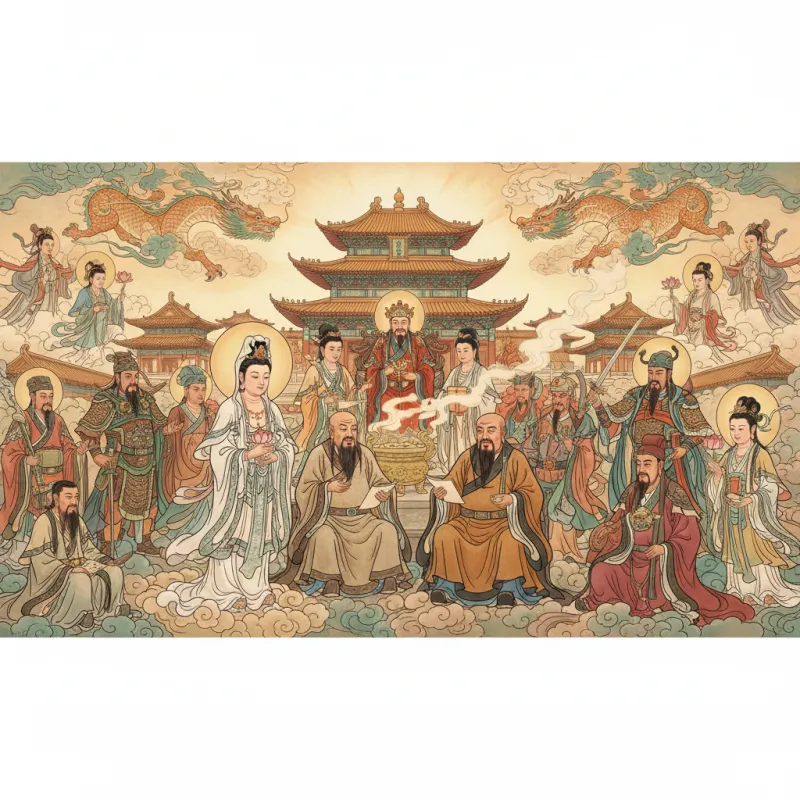
Step into any Chinese temple at dawn, and you'll witness something extraordinary: elderly devotees lighting incense before a bewildering array of divine figures—some serene, others fierce, a few downright peculiar. That three-eyed warrior? The Jade Emperor's nephew. The lady holding a lotus? Could be Guanyin, or maybe one of seven other goddesses. The bearded gentleman riding a tiger? Well, that depends on which temple you're in. This isn't confusion—it's the magnificent, sprawling universe of Chinese deities and immortals, where the divine bureaucracy mirrors earthly government, and the path to immortality is as varied as the people who seek it.
The Divine Bureaucracy: How Heaven Actually Works
Western visitors often find Chinese temple worship baffling because they're expecting something like a church. Instead, they've walked into the celestial equivalent of a government office building. The Chinese pantheon operates on a bureaucratic model that would make any civil servant nod in recognition. At the top sits the Jade Emperor (玉皇大帝, Yùhuáng Dàdì), who manages the cosmos like an imperial administrator manages provinces. Below him sprawl departments for everything from weather control to underworld justice, each staffed by specialized deities who file reports, get promotions, and occasionally face demotion for incompetence.
This isn't metaphor—it's theology. When you burn paper money at a temple, you're literally bribing celestial officials. When you petition a deity, you're filing a formal request. The City God (城隍, Chénghuáng) in each locality functions exactly like a mayor, maintaining order and reporting to higher authorities. This system emerged during the Tang Dynasty (618-907 CE) when Daoist theologians essentially mapped heaven onto the imperial bureaucracy, creating a divine structure that felt immediately familiar to Chinese worshippers. It's why you'll often see temples with multiple halls—you're moving through different departments, each handling specific concerns.
Immortals vs. Deities: The Crucial Distinction
Here's where it gets interesting: not every divine figure in a Chinese temple is actually a deity. Many are immortals (仙, xiān), and the difference matters. Deities are born divine or appointed to celestial office—they're management. Immortals are humans who achieved transcendence through cultivation practices, alchemy, meditation, or sheer virtue—they're self-made success stories. Think of deities as hereditary nobility and immortals as meritocratic achievers.
The Eight Immortals (八仙, Bāxiān) perfectly illustrate this distinction. These aren't gods—they're humans who cracked the code of immortality through various means. Lü Dongbin (吕洞宾) achieved it through Daoist internal alchemy. He Xiangu (何仙姑), the only woman among them, ate a magical peach. Iron-Crutch Li (铁拐李) mastered spirit projection so thoroughly that his soul could leave his body for days. Their temples don't demand the same formal reverence as deity temples; instead, they offer inspiration. The message is clear: you too could potentially join their ranks, given sufficient dedication and perhaps a lucky encounter with a magical fruit.
This distinction shapes temple architecture and worship practices. Deity halls tend toward formality—strict ritual protocols, elaborate offerings, hierarchical seating arrangements. Immortal shrines feel more approachable, often decorated with scenes from their earthly adventures. Visit the Wong Tai Sin Temple in Hong Kong, dedicated to the immortal Wong Tai Sin (黄大仙, Huáng Dàxiān), and you'll notice the atmosphere differs markedly from the grand formality of temples dedicated to the Jade Emperor.
The Daoist-Buddhist Fusion: When Pantheons Collide
Walk into most Chinese temples, and you'll encounter a theological puzzle that would give monotheists headaches: Daoist immortals sharing altar space with Buddhist bodhisattvas, all overseen by deities from folk religion. This isn't syncretism gone wrong—it's syncretism working exactly as intended. Chinese religious practice has always been pragmatic rather than doctrinaire. If a deity delivers results, who cares which tradition claims them?
The most striking example is Guanyin (观音, Guānyīn), the Goddess of Mercy. She started as the Buddhist bodhisattva Avalokiteśvara—originally male in Indian Buddhism—but transformed in China into a feminine figure who absorbed characteristics from the Daoist Queen Mother of the West (西王母, Xīwángmǔ) and various local goddesses. By the Song Dynasty (960-1279 CE), she'd become so thoroughly Chinese that most worshippers didn't know her Buddhist origins. Her temples blend Buddhist sutras with Daoist talismans, and nobody finds this contradictory.
This fusion intensified during the Ming Dynasty (1368-1644 CE) when the novel "Journey to the West" (西游记, Xīyóujì) popularized a cosmology where Buddhist and Daoist figures coexisted in the same narrative universe. The novel's author, Wu Cheng'en, had the Jade Emperor consulting with Buddha, Daoist immortals attending Buddhist ceremonies, and everyone generally getting along. This fictional integration reflected and reinforced actual temple practices, where practical efficacy trumped theological purity.
Regional Variations: The Local Gods Matter Most
Here's what guidebooks often miss: the most important deities in any Chinese temple are usually the local ones you've never heard of. Every region, city, and sometimes individual neighborhood has its own protective deities, often historical figures who were deified after death for their service to the community. These local gods (地方神, dìfāng shén) command more daily devotion than the famous names in the pantheon.
Take Mazu (妈祖, Māzǔ), the sea goddess. In coastal Fujian and Taiwan, she's everywhere—massive temples, household shrines, fishing boat altars. But travel inland to Shanxi province, and you'll barely find her mentioned. Instead, you'll encounter Guandi (关帝, Guāndì), the deified general Guan Yu from the Three Kingdoms period (220-280 CE), who dominates northern temples. He's the patron of martial artists, police officers, and oddly enough, accountants—his reputation for integrity made him the god of business honesty.
The City God temples (城隍庙, Chénghuáng Miào) showcase this localism perfectly. Every major city has one, but each City God is different—usually a historical official who governed that specific city with exceptional virtue. Shanghai's City God was Qin Yubo, a Ming Dynasty magistrate. Beijing's was a Yuan Dynasty general. These aren't interchangeable franchise deities; they're deeply rooted in local history and identity. Understanding temple architecture and regional variations helps decode these local preferences.
The Immortality Seekers: Paths to Transcendence
The quest for immortality (长生不老, chángshēng bùlǎo) drives much of Chinese temple culture, and the methods are fascinatingly diverse. Daoist temples particularly emphasize this pursuit, offering multiple paths to transcendence. Physical immortality through alchemical elixirs was popular during the Tang Dynasty—until too many emperors died from mercury poisoning. The focus then shifted to internal alchemy (内丹, nèidān), transforming the body's energies through meditation and breathing exercises.
But immortality isn't always about living forever. Some immortals achieved "release from the corpse" (尸解, shījiě), where they appeared to die but actually shed their physical form like a snake shedding skin. Others became "earth immortals" (地仙, dìxiān), living for centuries in remote mountains. The hierarchy of immortality has five levels, from ghost immortals (鬼仙, guǐxiān)—barely better than being dead—to celestial immortals (天仙, tiānxiān) who dwell in heaven itself.
Temples dedicated to immortals often contain clues about their cultivation methods. Lü Dongbin's temples feature imagery of internal alchemy—diagrams of energy channels, symbolic representations of the "golden elixir." Temples to the immortal Zhongli Quan (钟离权) emphasize breathing techniques. These aren't just decorative; they're instructional, offering worshippers a roadmap to their own potential transcendence. The message embedded in these temples is radically democratic: divinity isn't reserved for the chosen few but available to anyone willing to undertake the necessary cultivation.
Temple Rituals: Communicating with the Divine
The rituals performed in Chinese temples reveal the transactional nature of divine-human relationships. This isn't the unconditional love of monotheistic traditions; it's a reciprocal exchange. You offer incense, food, and respect; the deity offers protection, prosperity, or problem-solving. The relationship requires maintenance—neglect your offerings, and don't expect divine intervention when you need it.
The most common ritual involves the three incense sticks (上香, shàngxiāng), but the details matter. The first stick honors heaven, the second earth, the third humanity—or alternatively, Buddha, Dharma, and Sangha in Buddhist temples. You bow three times, holding the incense at forehead level, then plant the sticks in the burner. Get the sequence wrong, and you've committed a social faux pas in front of the divine bureaucracy.
More complex rituals involve divination blocks (筊杯, jiǎobēi)—two crescent-shaped wooden pieces thrown to receive yes/no answers from deities. One flat side up and one rounded side up means "yes." Both flat means "no." Both rounded means the deity is laughing at your question—ask something less stupid. This system appears simplistic until you watch an elderly devotee engage in a lengthy conversation with a deity, asking follow-up questions, seeking clarification, negotiating terms. It's prayer as dialogue, not monologue.
The Modern Temple: Ancient Gods in Contemporary China
Chinese temples today navigate a fascinating tension between ancient tradition and modern reality. The Communist Party officially promotes atheism, yet temples thrive—some as tourist attractions, others as genuine centers of worship, many as both simultaneously. The government has learned that temples serve social functions beyond religion: they're community centers, cultural preservation sites, and increasingly, economic engines through religious tourism.
Young Chinese urbanites approach temples differently than their grandparents. They might not know the elaborate mythology, but they'll still visit during exam season to petition Wenchang (文昌, Wénchāng), the god of literature and examinations. They'll photograph themselves with temple cats believed to bring good luck, post offerings on social media, and blend ancient practices with contemporary life. Some temples have adapted, offering QR codes for digital donations and online prayer services.
Yet the core remains unchanged. Whether you're a devout Daoist, a casual Buddhist, or an atheist hedging your bets, Chinese temples offer the same thing they've offered for millennia: a structured way to engage with forces beyond human control, a community of fellow seekers, and the tantalizing possibility that transcendence—however you define it—might actually be achievable. The deities and immortals wait in their halls, as they have for centuries, ready to receive petitions, grant blessings, and occasionally, if the stories are true, guide a dedicated seeker toward immortality itself.
Related Reading
- Chinese Temple Architecture: What Every Symbol Means
- Daoist Temples: Where to Go, What to Expect, and How Not to Embarrass Yourself
- Sacred Mountain Pilgrimage: The Chinese Tradition of Climbing to Heaven
- The Most Sacred Temples in China You Can Visit
- 10 Most Sacred Daoist Temples in China You Can Visit
- Buddhist Deities in Chinese Culture: How India's Gods Became Chinese
- Xuanwu: The Turtle-Snake God of the North
- A Practical Guide to Visiting Chinese Temples: What to Do and What Not to Do