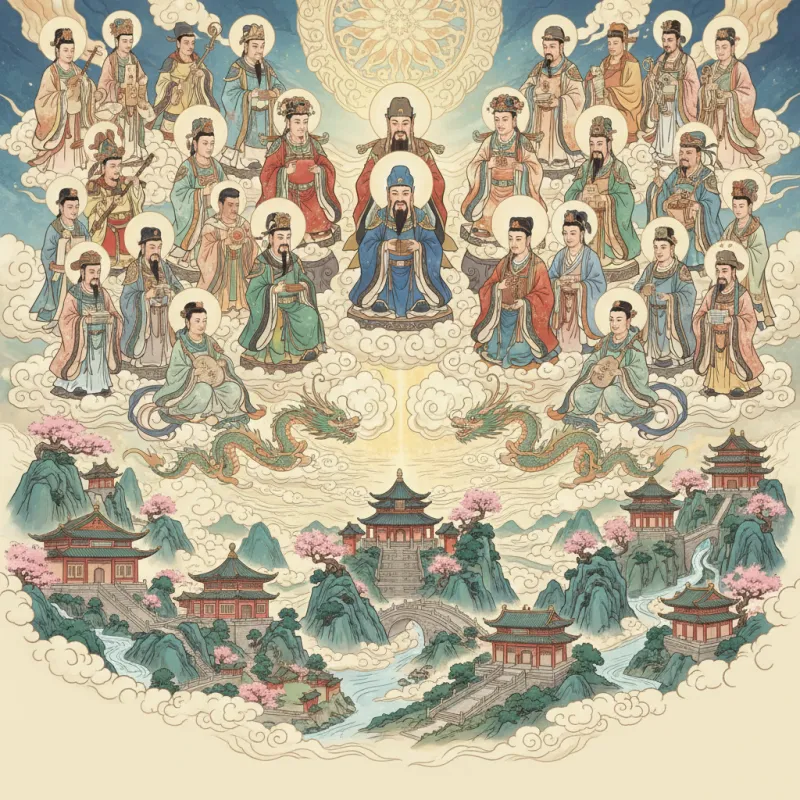
The bronze hall at Wudang's peak catches the first light of dawn and throws it back at the sky like a challenge. For a moment, the mountain has two suns. This is not metaphor — this is what 300,000 workers built in the 15th century when an emperor decided a god needed a proper address. China's sacred Daoist temples aren't museums. They're active power sites where the membrane between worlds grows thin, where incense smoke still carries prayers upward, and where you can walk the same stone steps that immortals allegedly climbed.
Wudang Mountain: Where Martial Arts Met the Divine
Wudang Mountain (武当山 Wǔdāng Shān) in Hubei Province isn't just famous — it's the template. This is where Xuanwu (玄武 Xuánwǔ), the Dark Warrior of the North, chose to manifest, and where Daoist martial arts were supposedly revealed to the monk Zhang Sanfeng in a dream about a snake and a crane fighting. The Golden Summit Temple (金顶 Jīndǐng) at 1,612 meters is entirely clad in bronze-gilt tiles that have survived six centuries of weather. The Ming Emperor Yongle didn't just build a temple here — he built seventy-two temples, thirty-six nunneries, and a network of paths that turn the entire mountain into a three-dimensional mandala.
The morning mist phenomenon is real and predictable. Cloud inversions happen roughly 200 days per year, creating the "sea of clouds" (云海 yúnhǎi) that makes the Golden Summit appear to float. Pilgrims still climb the ancient stone stairs — all 1,400 of them — though a cable car now offers an alternative for the less devoted.
White Cloud Temple: Beijing's Daoist Vatican
Baiyun Guan (白云观 Báiyún Guān) in Beijing serves as the headquarters of the Quanzhen (全真 Quánzhēn) school of Daoism, making it functionally the administrative center of organized Daoism in China. Founded in 739 CE during the Tang Dynasty, it was rebuilt in the Ming Dynasty after Genghis Khan's armies destroyed the original. The temple complex houses the China Daoist Association, which means real ecclesiastical business happens here alongside tourism.
The temple's most famous feature is the "Bridge of Luck" where visitors throw coins at a bell hanging beneath the arch. Hit the bell and your wish is granted — miss and you've just donated to temple maintenance. During Chinese New Year, Baiyun Guan hosts the largest temple fair in Beijing, drawing crowds that would make any deity feel properly appreciated. The temple also maintains one of the most complete collections of Daoist scriptures in China, though these are not generally accessible to casual visitors.
Mount Qingcheng: Daoism's Birthplace
Qingcheng Mountain (青城山 Qīngchéng Shān) in Sichuan Province claims to be where Zhang Daoling (张道陵 Zhāng Dàolíng) founded organized Daoism in 142 CE, establishing the Way of the Celestial Masters (天师道 Tiānshī Dào). This makes it arguably the oldest continuously operating Daoist site in existence. The mountain's name means "Green City Mountain" — a reference to the dense forest coverage that makes the peaks look like green fortifications.
The Shangqing Palace (上清宫 Shàngqīng Gōng) sits at the summit, rebuilt multiple times but maintaining its position as the mountain's spiritual apex. What makes Qingcheng special is its integration with the landscape — temples emerge from the forest rather than dominating it. The architecture follows the principle of "borrowing scenery" (借景 jièjǐng), where buildings frame natural views rather than competing with them. The mountain is also a UNESCO World Heritage site, paired with the nearby Dujiangyan irrigation system, because apparently ancient Chinese engineers were also concerned with harmonizing human works with natural forces.
Mount Longhu: Where Talismans Have Power
Longhu Mountain (龙虎山 Lónghǔ Shān) in Jiangxi Province is the ancestral home of the Celestial Masters lineage, where Zhang Daoling's descendants maintained an unbroken succession for sixty-three generations until 1949. The Celestial Master's Mansion (天师府 Tiānshī Fǔ) was essentially a hereditary theocracy, with each Celestial Master serving as both spiritual leader and temporal ruler of the mountain.
The mountain's name — "Dragon Tiger Mountain" — comes from the legend that Zhang Daoling refined elixirs here and when he succeeded, a dragon and tiger appeared to guard the site. The Hanging Coffin Cliffs (悬棺 xuánguan) add an eerie dimension: ancient coffins placed in cliff-face caves hundreds of meters above the river, their placement method still debated by archaeologists. The temple complex specializes in talismanic magic (符箓 fúlù), and you can still watch Daoist priests create protective talismans using techniques allegedly unchanged since the Han Dynasty. Whether they work is between you and the spirits.
Mount Hua: The Deadliest Pilgrimage
Huashan (华山 Huàshān) in Shaanxi Province has a reputation: it's the most dangerous of China's sacred mountains. The plank walk (长空栈道 chángkōng zhàndào) involves traversing wooden planks bolted to a vertical cliff face with only a chain for safety. People die here. Not often, but regularly enough that the mountain maintains its fearsome reputation.
The five peaks of Huashan correspond to the five directions (north, south, east, west, and center), with temples on each summit. The West Peak Temple (西峰 Xīfēng) is associated with the goddess Xiwangmu, the Queen Mother of the West, though her primary cult center is elsewhere. What makes Huashan spiritually significant is the ordeal of reaching it — the difficulty is the point. Daoism values mountains precisely because they're hard to climb, because the effort purifies intention. The South Peak (南峰 Nánfēng) at 2,154 meters is the highest, and the sunrise from its summit is considered one of China's essential experiences, assuming you survive the night climb.
Maoshan: The Exorcist's Academy
Maoshan (茅山 Máoshān) in Jiangsu Province is the headquarters of the Shangqing (上清 Shàngqīng) school of Daoism, which specializes in exorcism, spirit communication, and ritual magic. This is where Daoist priests learn to deal with ghosts, demons, and other inconvenient supernatural entities. The mountain is named after the Mao brothers — Mao Ying, Mao Gu, and Mao Zhong — who achieved immortality here during the Han Dynasty.
The Yuanfu Wanning Palace (元符万宁宫 Yuánfú Wànníng Gōng) serves as the main temple, rebuilt in 2005 after the original was destroyed during the Cultural Revolution. Maoshan's reputation for magical efficacy means it attracts a different kind of pilgrim — people with problems that require supernatural solutions. The temple maintains a school for Daoist priests, teaching the traditional arts of ritual, meditation, and the creation of protective talismans. If you need a proper exorcism in China, Maoshan-trained priests are considered the gold standard.
Mount Lao: Where the Sea Meets the Sky
Laoshan (崂山 Láoshān) in Shandong Province is unique among China's sacred mountains because it rises directly from the Yellow Sea. The Taiqing Palace (太清宫 Tàiqīng Gōng) sits at the mountain's base, its courtyards filled with ancient trees and the sound of waves. The mountain's proximity to the ocean gives it a different energy — less austere than the inland peaks, more fluid and changeable.
Laoshan is famous for its mineral springs, which produce water considered ideal for brewing tea. The mountain's Daoist temples have maintained tea cultivation for centuries, and Laoshan green tea remains one of China's premium varieties. The mountain also appears in Pu Songling's "Strange Tales from a Chinese Studio" (聊斋志异 Liáozhāi Zhìyì), where a Daoist priest teaches a student to walk through walls — a skill that proves less useful than expected. The temples here emphasize the gentler aspects of Daoist practice: tea cultivation, calligraphy, and the appreciation of natural beauty.
Qingyang Palace: Chengdu's Urban Temple
Qingyang Gong (青羊宫 Qīngyáng Gōng) in Chengdu, Sichuan, proves that sacred sites don't require mountain isolation. This urban temple, founded in the Zhou Dynasty, sits in the middle of a modern city and maintains its spiritual authority through sheer historical weight. The temple's name means "Black Goat Temple," referring to Laozi's mount, and the bronze goat statues in the courtyard are rubbed smooth by pilgrims seeking healing — touch the part of the goat corresponding to your ailment and the goat absorbs the illness.
The temple houses the only complete copy of the Daoist canon (道藏 Dàozàng) in Southwest China, making it a research center as well as a worship site. The Eight Trigrams Pavilion (八卦亭 Bāguà Tíng) is an architectural marvel, its structure embodying the principles of the Yijing (易经 Yìjīng). Qingyang Palace also maintains a traditional Chinese medicine clinic, because Daoism never separated spiritual health from physical health. The temple's urban location means it serves a daily community of worshippers rather than occasional pilgrims, giving it a lived-in quality that mountain temples sometimes lack.
Yongle Palace: Where Walls Speak
Yongle Gong (永乐宫 Yǒnglè Gōng) in Shanxi Province is technically a temple, but it's really an art gallery that happens to be sacred. The temple's walls are covered with Yuan Dynasty murals depicting the entire Daoist pantheon — over 400 square meters of paintings showing gods, immortals, and celestial bureaucrats in exquisite detail. These are among the finest surviving examples of Chinese religious art, comparable to the Sistine Chapel in cultural significance.
The temple was originally built at the birthplace of Lü Dongbin (吕洞宾 Lǚ Dòngbīn), one of the Eight Immortals, but was moved brick by brick in the 1950s when the original site was flooded by a reservoir project. Chinese archaeologists disassembled the entire complex, numbered every piece, and reconstructed it on higher ground — a feat of preservation that saved the murals from destruction. The main hall's mural of the "Procession of Immortals" shows the celestial hierarchy in full regalia, a visual encyclopedia of Daoist cosmology.
Louguantai: The First Temple
Louguantai (楼观台 Lóuguān Tái) in Shaanxi Province claims to be the oldest Daoist temple in China, built at the spot where Laozi supposedly wrote the Daodejing (道德经 Dàodéjīng) before departing westward on his water buffalo. The "Tower for Observing" was where the border guard Yin Xi watched for Laozi's arrival, recognized him as a sage, and convinced him to write down his teachings before leaving civilization forever.
The temple complex includes the Shuojing Platform (说经台 Shuōjīng Tái), the exact spot where Laozi allegedly composed the 5,000 characters of the Daodejing. Whether this is historically accurate is less important than what it represents — this is where Daoism's foundational text entered the world. The temple maintains a scholarly atmosphere, with research facilities dedicated to studying early Daoist texts and practices. The surrounding area is also home to several hermitages where modern practitioners continue the tradition of solitary cultivation, proving that some people still take the path of the sage seriously.
These ten temples represent different aspects of Daoist practice — martial arts, ritual magic, scholarly study, artistic expression, and simple devotion. They're not museum pieces. Incense still burns, priests still chant, and pilgrims still climb. The gods, apparently, are still receiving visitors at these addresses.
Related Reading
- Chinese Temple Architecture: What Every Symbol Means
- The Most Sacred Temples in China You Can Visit
- Sacred Mountain Pilgrimage: The Chinese Tradition of Climbing to Heaven
- Exploring the Rich Tapestry of Chinese Deities and Immortals in Temples
- Daoist Temples: Where to Go, What to Expect, and How Not to Embarrass Yourself
- The Chinese Religious Calendar: When to Worship What
- Guanyin: The Goddess of Mercy Who Hears Every Cry
- Chinese Funeral Traditions: A Guide to Death Customs