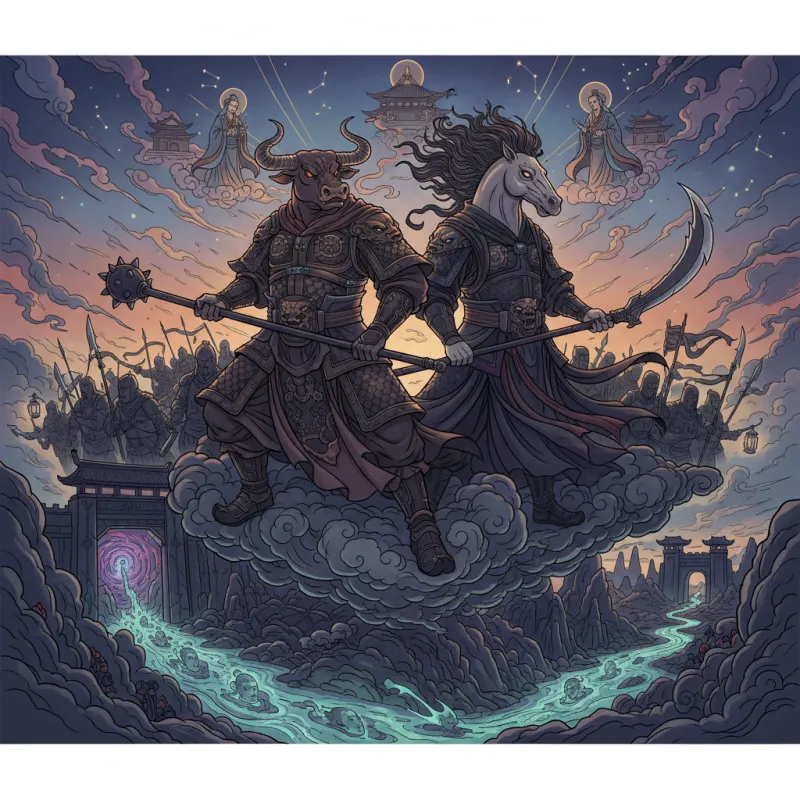
Picture this: you're lying in bed, fever burning through you, when the door splinters open. Two figures step through—one with the massive head of an ox, nostrils flaring, the other with the elongated skull of a horse, teeth bared in what might be a grin. They're not here to check your temperature. They're here because your name just appeared on a list in the underworld's bureaucracy, and Ox-Head and Horse-Face (牛头马面 Niútóu Mǎmiàn) don't do house calls for fun. They do arrests.
The Underworld's Muscle
In the sprawling bureaucracy of Chinese hell, someone has to do the dirty work. While the Ten Yama Kings sit in judgment and City God manages the paperwork, Ox-Head and Horse-Face are the ones who actually drag souls across the threshold between life and death. They're bailiffs, bounty hunters, and enforcers rolled into two terrifying packages.
Ox-Head (牛头 Niútóu) stands taller, broader, with the massive head of a water buffalo mounted on shoulders that look like they could carry a mountain. He typically wields a trident or heavy chains, and artists throughout the dynasties have depicted him with eyes that glow like coals. Horse-Face (马面 Mǎmiàn) is leaner but no less intimidating—his elongated equine skull gives him an almost skeletal appearance, and he's usually shown carrying an iron staff or rope to bind the souls he captures.
The pairing isn't random. In Chinese cosmology, the ox and horse represent tireless labor and unstoppable momentum. Oxen plow fields from dawn to dusk without complaint. Horses carry riders across impossible distances. These aren't gentle farm animals in the underworld's service—they're the embodiment of relentless, mechanical enforcement. When they come for you, they don't stop, don't negotiate, and certainly don't care about your unfinished business in the mortal world.
Origins in Buddhist Hell
The earliest mentions of Ox-Head and Horse-Face appear in Buddhist sutras that made their way to China during the Han and Tang dynasties. The Sutra on Questions about Hell (問地獄經 Wèn Dìyù Jīng) describes various underworld servants, and while it doesn't name them explicitly, it references ox-headed and horse-headed guards (牛頭獄卒 niútóu yùzú and 馬頭獄卒 mǎtóu yùzú) who patrol the levels of hell.
But here's where it gets interesting: these figures existed in Indian Buddhist texts as goṣīrṣa (ox-head) and aśvaśīrṣa (horse-head), minor demons who tortured the damned. When Buddhism merged with Chinese folk religion and Daoism during the Tang Dynasty (618-907 CE), these guards got promoted. They became the primary soul-collectors, the faces of death itself for ordinary Chinese people who might never read a sutra but would definitely see these figures in temple murals and hear about them in storytelling performances.
The Chinese transformation made them more bureaucratic. Indian Buddhist hells were places of pure torment. Chinese hells became government offices with filing systems, and Ox-Head and Horse-Face became civil servants—albeit terrifying ones with arrest warrants signed by the Yama Kings.
What They Actually Do
Their job description is brutally simple: retrieve souls whose time has expired and deliver them to the underworld for processing. But the details reveal a system that's both methodical and merciless.
When someone's death date arrives—and yes, in Chinese cosmology, there's a predetermined date written in the registers of fate—Ox-Head and Horse-Face receive the assignment. They manifest in the mortal world, visible only to the dying person and sometimes to those with spiritual sight. They don't wait for the soul to separate naturally from the body. They yank it out.
The Journey to the West (西遊記 Xīyóu Jì), written by Wu Cheng'en in the 16th century, includes a famous scene where these two show up to collect the Tang Emperor's soul. The emperor, terrified, tries to bargain for more time. Ox-Head and Horse-Face are unmoved. They have a quota, a schedule, and a bureaucratic system that doesn't accommodate imperial privilege. Only the intervention of Judge Cui, an underworld official who owes the emperor a favor, saves him—and even then, it's through paperwork, not mercy.
Once captured, souls are bound with chains or ropes (the iconography varies by region and period) and marched to the underworld. This isn't a gentle transition. Folk tales describe the journey as agonizing, with the soul fully conscious and aware of being dragged away from everything it knew. Some stories mention that Ox-Head and Horse-Face take the most direct route, which often means passing through walls, mountains, and rivers—disorienting and terrifying for the newly dead soul.
The Iconography of Fear
Walk into any traditional Chinese temple with an underworld section, and you'll find them. Ox-Head and Horse-Face are usually positioned at the entrance to the hell courts, flanking the doorway like nightmarish bouncers. Their statues are deliberately grotesque—bulging eyes, exposed teeth, exaggerated muscles, skin painted in unnatural colors (often green or blue for Ox-Head, red or black for Horse-Face).
This isn't accidental. These images served a social function. In a society where most people couldn't read, visual representations of hell's enforcers were moral education. Behave, or these two will come for you. The temples in places like Fengdu Ghost City (豐都鬼城 Fēngdū Guǐchéng) in Chongqing take this to an extreme, with life-sized or larger statues positioned in tableaux showing them dragging souls, beating prisoners, or standing guard over torture chambers.
Ming and Qing dynasty hell scrolls—long painted scrolls depicting the ten courts of hell—always include Ox-Head and Horse-Face. They appear repeatedly throughout the scroll, emphasizing their omnipresence. You can't escape them. They're in every court, at every level, always watching, always ready to enforce the Yama Kings' judgments.
Cultural Evolution and Modern Appearances
Something fascinating happened to Ox-Head and Horse-Face over the centuries: they became almost... familiar. Not friendly, exactly, but recognizable enough to become cultural shorthand. By the Qing Dynasty, they were appearing in popular novels, operas, and folk tales not just as terrifying enforcers but as characters with personalities.
In some stories, they're portrayed as somewhat dim-witted—strong and loyal but not particularly clever. This characterization probably reflects a common human coping mechanism: making the terrifying more manageable by adding humor. There are folk tales where clever souls trick them, at least temporarily, or where they make bureaucratic mistakes (grabbing the wrong soul, showing up at the wrong address).
Modern Chinese media has run with this. In contemporary films, TV shows, and novels dealing with Chinese mythology, Ox-Head and Horse-Face often appear as comic relief—bumbling supernatural cops who are good at their job but not exactly sophisticated. The 2017 film Journey to the West: The Demons Strike Back portrays them as bickering partners. Video games like Onmyoji and Honor of Kings feature them as playable characters with elaborate backstories.
This evolution is interesting because it shows how cultures domesticate their fears. The original Buddhist demons became Chinese bureaucrats, who then became familiar cultural figures, who finally became entertainment characters. Yet in traditional religious contexts—funerals, temple ceremonies, ancestral rites—they remain deadly serious. The duality persists.
The Bureaucratic Horror
What makes Ox-Head and Horse-Face particularly unsettling isn't just their appearance—it's what they represent. They're the face of a system that's both cosmic and bureaucratic, where death isn't a natural transition but an administrative process, and you're not a person but a case file.
In Western conceptions of death, you might face judgment from a divine being who weighs your soul, considers your circumstances, shows mercy or wrath. In the Chinese underworld system, you face clerks, judges, and enforcers who process you according to regulations. Ox-Head and Horse-Face don't care about your story. They have a name, a date, and an address. If it matches, you're coming with them.
This reflects something deep in Chinese cultural consciousness about the nature of power and justice. The system is vast, impersonal, and inescapable. You can't charm it, bribe it (well, you can try, but that's a different discussion about underworld currency), or fight it. The best you can hope for is that the paperwork is correct and you're treated according to the rules.
Why They Still Matter
In an age of modern medicine and secular worldviews, why do Ox-Head and Horse-Face persist in Chinese culture? Because they represent something that hasn't changed: the inevitability and impersonality of death. Medical technology might delay them, but it can't cancel the appointment.
They also serve as a reminder of accountability. In a moral universe where actions have consequences, someone has to enforce those consequences. The Black and White Impermanence might be the ones who track your deeds, but Ox-Head and Horse-Face are the ones who make sure you face judgment for them.
Visit any traditional Chinese funeral, and you'll still see paper offerings burned for the deceased—including paper money to potentially bribe underworld officials and paper goods to make the journey easier. The underlying assumption? That journey is real, those officials exist, and Ox-Head and Horse-Face are waiting at the end of it.
They've become cultural icons precisely because they embody a truth every culture must face: death comes for everyone, and when it does, you don't get to negotiate the terms. You can only hope you've lived well enough that what comes after isn't too terrible. And if you haven't? Well, Ox-Head and Horse-Face don't do mercy. They do their job.
Related Reading
- The Ten Yama Kings: Judges of the Chinese Underworld
- The Underworld Gods: Who Runs Chinese Hell
- Yanluo Wang: The Chinese King of Hell
- Sun Wukong as a Real Deity: Temples and Worship of the Monkey God
- Unveiling the Rich Tapestry of Chinese Deities and Immortals
- Discovering Nature Spirits in Chinese Mythology: Guardians of the Earth and Sky