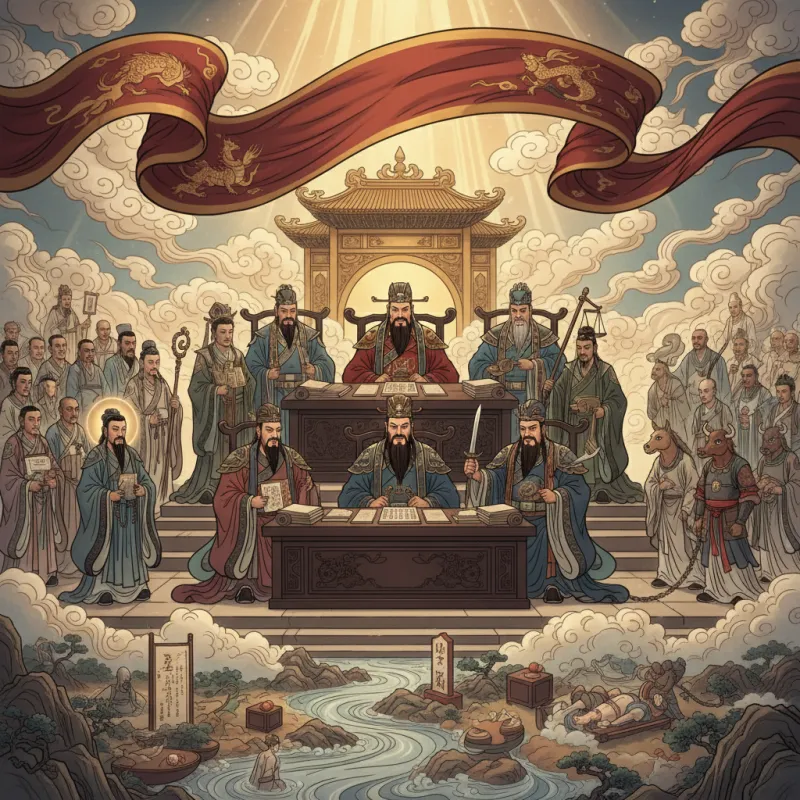
You die. Your body goes cold. But you—the part of you that thinks, remembers, regrets—you're just getting started. Because in Chinese cosmology, death isn't an ending. It's an arraignment. Within moments, psychopomps drag your soul before the first of ten courts, where King Qinguang sits with your life's ledger open on his desk. Every lie you told. Every kindness you showed. Every time you cut someone off in traffic. It's all there. And he's just the first judge.
The Bureaucracy of the Afterlife
The Ten Yama Kings (十殿阎罗 Shí Diàn Yánluó) run the Chinese underworld like a celestial DMV—except instead of renewing your license, they're deciding whether you reincarnate as a human, an animal, or something worse. This system appears in Buddhist texts that entered China during the Tang Dynasty (618-907 CE), but it really crystallized in the Ming Dynasty novel Journey to the West and the Jade Record (玉历 Yù Lì), a morality text that terrified generations of Chinese readers with its graphic descriptions of underworld punishments.
Each king presides over one of ten courts arranged in sequence. Your soul moves through them like a defendant shuttled between courtrooms, and each judge specializes in particular categories of wrongdoing. The system is exhaustive, methodical, and—here's the kicker—completely unavoidable. You can't lawyer your way out. You can't bribe the bailiff. The Ox-Head and Horse-Face guards make sure of that.
The Ten Courts and Their Verdicts
First Court — King Qinguang (秦广王 Qínguǎng Wáng). This is intake. King Qinguang sits at the entrance to the underworld with the Mirror of Retribution (孽镜台 Nièjìng Tái), which replays your entire life in unflinching detail. He's looking at your overall moral balance. If you were genuinely virtuous—rare, but it happens—he might send you directly to reincarnation as a human or even elevation to a heavenly realm. If you were neutral, you proceed to the other courts. If you were terrible, he marks your file and sends you deeper into the system. King Qinguang also handles souls who died unjustly or before their time, which makes his court a strange mix of judgment and triage.
Second Court — King Chujiang (楚江王 Chǔjiāng Wáng). Specializes in corruption, fraud, and medical malpractice. Yes, medical malpractice. Ancient Chinese texts are very specific about this: doctors who prescribed the wrong treatment, merchants who sold fake medicine, anyone who profited from others' suffering—they answer to King Chujiang. His punishments involve freezing hells and the Pool of Filth, where souls wade through excrement. The message is clear: if you made money by harming people, you're going to suffer.
Third Court — King Songdi (宋帝王 Sòngdì Wáng). Judges ingratitude, disrespect toward elders, and tax evasion. The Chinese moral universe takes filial piety seriously, and King Songdi enforces it. Souls who mistreated their parents get their hearts ripped out repeatedly. Those who cheated on taxes—which in traditional China meant cheating the emperor, a cosmic authority—face having their ribs crushed. The punishments here reflect Confucian values as much as Buddhist ones, showing how the Yama Kings absorbed multiple philosophical traditions.
Fourth Court — King Wuguan (五官王 Wǔguān Wáng). Handles tax evasion (again—apparently this was a big problem), miserliness, and blasphemy. If you hoarded wealth while others starved, or if you disrespected religious figures and sacred texts, King Wuguan has a special hell where you're ground between millstones. The repetition of tax evasion across multiple courts suggests that the Jade Record was partly a government propaganda tool, using religious fear to encourage civic compliance.
Fifth Court — King Yanluo (阎罗王 Yánluó Wáng). The big one. King Yanluo is the most famous of the ten, often treated as the supreme ruler of the underworld in popular culture. He judges murder, atheism, and complaints against heaven. This court is where the worst offenders end up, and the punishments are appropriately horrific: being sawed in half, having your tongue pulled out, being thrown into a mountain of knives. King Yanluo appears in countless Chinese operas, novels, and films, usually depicted with a fierce expression and elaborate robes. He's the judge you really don't want to face.
Sixth Court — King Biancheng (卞城王 Biànchéng Wáng). Focuses on sacrilege, including desecrating graves, wasting food, and—interestingly—complaining too much. The Chinese underworld apparently has no patience for chronic negativity. Souls judged here face the Hell of Wailing and Grinding, where they're crushed under boulders. The inclusion of food waste as a serious sin reflects the agricultural anxieties of a civilization that experienced frequent famines.
Seventh Court — King Taishan (泰山王 Tàishān Wáng). Named after Mount Tai, one of China's most sacred mountains. He judges those who violated graves, sold or ate human flesh (yes, this was apparently common enough to warrant its own category), and engaged in kidnapping. The punishments involve being steamed alive or having your intestines pulled out. King Taishan's association with Mount Tai connects the underworld to physical geography, suggesting that the mountain itself was seen as a gateway between worlds.
Eighth Court — King Dushi (都市王 Dūshì Wáng). Handles filial impiety—specifically, children who didn't care for their aging parents. In a society without social security, elder care was a family responsibility, and failing at it was considered one of the worst sins. King Dushi's hell involves being crushed by carts and having your bones broken repeatedly. The severity of these punishments shows how central filial piety was to Chinese social order.
Ninth Court — King Pingdeng (平等王 Píngděng Wáng). His name means "King of Equality," which is ironic because he judges prostitution, arson, abortion, and drug dealing. The "equality" refers to the idea that everyone, regardless of social status, faces the same judgment for these crimes. Souls here are thrown into pits of fire or frozen in ice. The inclusion of abortion and prostitution reflects Buddhist sexual ethics layered onto Confucian morality.
Tenth Court — King Zhuanlun (转轮王 Zhuànlún Wáng). The final court. King Zhuanlun doesn't judge—he assigns your next reincarnation based on the verdicts from the previous nine courts. His name means "Wheel-Turning King," referring to the Buddhist wheel of samsara. He determines whether you're reborn as a human, animal, hungry ghost, or hell being. If you've been punished enough and your karma is balanced, you might get another shot at human life. If not, well—enjoy being a dung beetle for the next few centuries.
The Wheel of Rebirth
After passing through all ten courts, souls arrive at the Terrace of Forgetfulness (忘川台 Wàngchuān Tái), where the goddess Meng Po (孟婆 Mèng Pó) serves them a tea that erases all memories of their previous life. Then they're reborn according to King Zhuanlun's verdict. The system is cyclical, inescapable, and—according to Buddhist philosophy—the only way out is to achieve enlightenment and escape the wheel entirely.
Why This System Matters
The Ten Yama Kings represent something fascinating: a fusion of Indian Buddhist concepts with Chinese bureaucratic thinking. The idea of multiple judges, specialized courts, and sequential processing mirrors the imperial Chinese government's administrative structure. It's cosmic civil service. This wasn't accidental—the Jade Record and similar texts were often promoted by local officials as tools for social control, using fear of afterlife punishment to encourage moral behavior.
But there's something else going on here. The specificity of the sins—medical malpractice, food waste, complaining—reveals what Chinese society actually worried about. These weren't abstract theological concepts. They were practical anxieties about social cohesion, resource scarcity, and family stability. The underworld courts functioned as a mirror, reflecting the values and fears of the living.
The Yama Kings also appear throughout Chinese popular culture, from the Journey to the West episode where Sun Wukong storms the underworld and erases his name from the death register, to modern films like Saving General Yang and the Painted Skin series. They've become shorthand for cosmic justice—the idea that even if you escape earthly consequences, you can't escape the final accounting.
The Modern Afterlife
Today, the Ten Yama Kings remain embedded in Chinese religious practice, especially in Daoist and folk Buddhist temples. During the Ghost Festival (中元节 Zhōngyuán Jié), families burn paper money and offerings to help deceased relatives pay off their karmic debts and improve their standing in the underworld courts. The system has adapted to modern concerns—some contemporary religious texts now include sins like environmental destruction and cyberbullying in the courts' jurisdictions.
The Yama Kings endure because they offer something powerful: the promise that justice exists beyond human institutions. That the corrupt official who escaped earthly punishment will face King Chujiang. That the abusive parent will answer to King Dushi. That the ledger always balances, even if it takes ten courts and a thousand lifetimes to do it. Whether you believe in them or not, the Ten Yama Kings represent a profound human need—the need to believe that someone, somewhere, is keeping score.
Related Reading
- The Underworld Gods: Who Runs Chinese Hell
- Black and White Impermanence: The Soul Collectors
- Yanluo Wang: The Chinese King of Hell
- Guardians of the Night Sky: The Star Gods in Chinese Daoist and Buddhist Traditions
- The Eight Immortals: Complete Guide to China's Most Beloved Gods
- Nezha: From Rebellious Child God to China's Biggest Animated Film