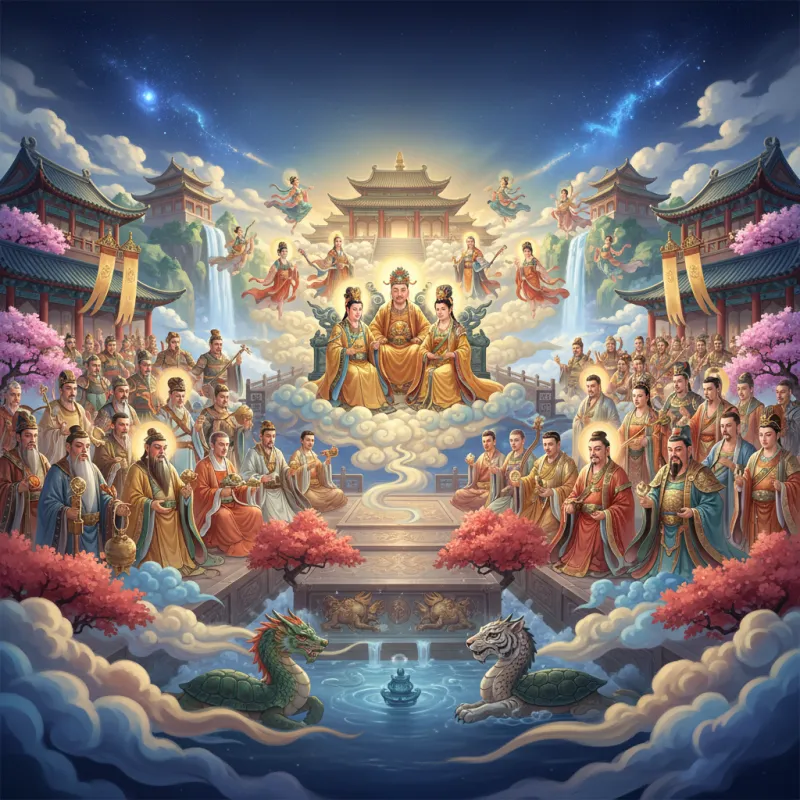
Picture this: a deity gets demoted for incompetence, stripped of his celestial rank, and reassigned to a lower department. Another god submits a formal complaint about jurisdictional overlap with a neighboring ministry. A third deity — let's call him the God of Thunder — must file paperwork in triplicate before he's authorized to strike anyone with lightning. This isn't satire. This is how Chinese heaven actually works according to centuries of religious tradition, popular novels, and folk belief. The Heavenly Court (天庭 tiāntíng) operates exactly like an imperial bureaucracy because that's precisely what it is: a cosmic civil service with all the hierarchy, red tape, and office politics you'd expect from any government institution.
The Jade Emperor's Cabinet: Heaven's Executive Branch
At the apex sits the Jade Emperor (玉皇大帝 Yùhuáng Dàdì), but don't mistake him for an omnipotent creator god. He's more like a celestial CEO who inherited the position after the previous administration. According to Daoist texts, he earned his throne through countless eons of cultivation and merit, but once installed, he governs through delegation, not divine fiat. The Jade Emperor doesn't personally manage every rainstorm or death — he has departments for that.
Directly beneath him operate the Four Heavenly Ministers (四御 Sìyù), a kind of inner cabinet handling the most critical portfolios. The Great Emperor of the North Star (紫微大帝 Zǐwēi Dàdì) manages celestial administration and cosmic order. The Great Emperor of Longevity (长生大帝 Chángshēng Dàdì) oversees life spans and natural cycles. These aren't symbolic titles — each minister commands entire departments with specialized staff. When the Jade Emperor needs something done, he doesn't wave his hand and make it happen. He issues an edict, which gets passed down through proper channels, where subordinate deities implement the policy. Heaven runs on memos.
The Ministry System: Specialized Departments for Everything
Chinese heaven divides its operations into ministries (部 bù) that mirror the Six Ministries of imperial China. There's a Ministry of Thunder (雷部 Léibù), headed by Lei Gong (雷公), which doesn't just randomly throw lightning bolts around. Thunder gods must receive authorization from higher authorities before executing divine punishment. The classic novel Journey to the West repeatedly shows celestial officials requesting permission, filing reports, and waiting for approval before taking action. When Sun Wukong wreaks havoc in heaven, the response isn't immediate divine wrath — it's a bureaucratic scramble to mobilize the right departments.
The Ministry of Wealth (财神部 Cáishén bù) manages economic fortune under various Gods of Wealth, most famously Zhao Gongming (赵公明). But wealth distribution isn't arbitrary — it follows karmic accounting. Deities in this ministry track merit, calculate debts from past lives, and allocate prosperity accordingly. They're essentially cosmic accountants. The Ministry of Epidemics (瘟部 Wēnbù), meanwhile, handles disease outbreaks. Yes, there are gods whose job is to spread plague, but they don't act capriciously. They operate under orders, targeting specific individuals or regions based on karmic justice or heavenly policy decisions. During the Ming and Qing dynasties, people would propitiate these plague gods not by begging for mercy, but by essentially lobbying them like you'd lobby any government official — with offerings, petitions, and appeals to proper procedure.
The Department of Exorcism (驱魔司 Qūmó sī) employs celestial warriors and demon-hunters who maintain order in the supernatural realm. These aren't freelance heroes — they're commissioned officers with ranks, territories, and chains of command. When a demon causes trouble, the local City God (城隍 Chénghuáng) files a report up the hierarchy, and the Department dispatches appropriate personnel. Everything is documented. For more on how these divine officials interact with the mortal realm, see City Gods: The Divine Mayors of Chinese Cities.
Ranks, Promotions, and Performance Reviews
Here's where it gets really interesting: gods can be promoted or demoted based on performance. This isn't metaphorical. Chinese folk religion genuinely treats deities as civil servants subject to evaluation. Local gods who fail to protect their communities — say, a River God who allows catastrophic flooding — can be ritually demoted or even "fired" by imperial decree. Historical records from the Tang and Song dynasties document emperors issuing edicts that stripped underperforming deities of their titles.
The god Guan Yu (关羽), originally a historical general from the Three Kingdoms period, received posthumous promotions over centuries until he reached the rank of "Emperor Guan" (关帝 Guān Dì). His celestial career advancement happened through a combination of popular devotion and imperial recognition — essentially, good performance reviews from both the masses and the government. By the Qing dynasty, he'd accumulated so many titles and honors that his full official designation took several minutes to recite.
Conversely, deities who abuse their authority face consequences. The Investiture of the Gods (封神演义 Fēngshén Yǎnyì), a Ming dynasty novel, depicts the establishment of the heavenly bureaucracy after a cosmic war. The victorious side literally assigns defeated warriors and fallen heroes to specific divine positions based on their abilities and karmic records. It's a mass hiring event. Some characters receive prestigious posts; others get stuck with minor positions. The novel treats this as completely normal — of course heaven needs an HR department to sort out personnel assignments.
The Reporting Structure: Who Reports to Whom
The organizational chart of Chinese heaven would make any corporate consultant weep with joy. Local Earth Gods (土地神 Tǔdì shén) report to City Gods, who report to provincial-level deities, who report to the Jade Emperor's court. Information flows upward through proper channels; orders flow downward the same way. When a human dies, the local Earth God escorts the soul to the City God, who reviews the person's life record and forwards the case to the underworld bureaucracy for final judgment. No deity acts unilaterally.
This hierarchy extends to the underworld as well. The Ten Kings of Hell (十殿阎王 Shí Diàn Yánwáng) technically operate under the Jade Emperor's ultimate authority, though they maintain considerable autonomy in their domain. They're like a separate branch of government — judicial rather than executive — but still part of the same cosmic civil service. Souls move through ten courts, each presided over by a different king who judges specific categories of sin. It's an assembly line of judgment, and yes, there's paperwork at every stage. The underworld keeps meticulous records of every soul's deeds, and these records can be audited, appealed, or corrected if errors are found.
Interdepartmental Conflicts and Jurisdictional Disputes
Because heaven operates as a bureaucracy, it suffers from bureaucratic problems. Deities squabble over jurisdiction. Departments compete for resources and prestige. Journey to the West is full of examples: when Sun Wukong steals the peaches of immortality, multiple departments point fingers at each other over who should have prevented the theft. The guards blame the administrators; the administrators blame the guards. The Jade Emperor has to sort out the mess like a manager dealing with interdepartmental conflict.
Different religious traditions further complicate matters. Buddhist deities, Daoist immortals, and folk gods all coexist in the Chinese pantheon, sometimes with overlapping responsibilities. Guanyin (观音), the Buddhist Bodhisattva of Compassion, operates within the heavenly system but maintains a degree of independence due to her Buddhist credentials. She's like a consultant brought in from outside the organization — respected and influential, but not technically part of the regular chain of command. This creates interesting dynamics when Buddhist and Daoist deities must cooperate on projects.
The Dragon Kings (龙王 Lóngwáng) who control rain and water present another jurisdictional puzzle. They govern their aquatic domains with considerable autonomy, but they're ultimately subordinate to heaven's authority. When humans need rain, they petition the local Dragon King, but if the Dragon King refuses or fails to deliver, the complaint goes up to the Ministry of Thunder, which can override the Dragon King's decision. It's a federal system with checks and balances.
Why Heaven Mirrors Earth: The Logic of Cosmic Bureaucracy
This isn't accidental or arbitrary. Chinese cosmology operates on the principle that heaven and earth mirror each other (天人合一 tiān rén hé yī). If the human world is governed by bureaucracy, then naturally the divine world must be too. This reflects a deeply pragmatic worldview: the universe runs on order, hierarchy, and proper procedure because those are the mechanisms that actually work for organizing complex systems.
Moreover, this bureaucratic heaven serves a psychological and social function. It makes the divine realm comprehensible and negotiable. You can't bargain with an incomprehensible cosmic force, but you can petition a deity who has a specific job title and operates within a system of rules. Chinese folk religion treats gods as powerful officials who can be lobbied, bribed (with offerings), and held accountable. When disaster strikes, it's not random divine wrath — it's a policy decision made by specific deities for specific reasons, and therefore potentially reversible through proper channels.
The system also provides social commentary. By depicting heaven as bureaucratic, Chinese culture implicitly critiques earthly bureaucracy. When Journey to the West shows celestial officials as petty, incompetent, or corrupt, it's satirizing the Ming dynasty government. The joke works because everyone understands that heaven and earth operate on the same principles — and suffer from the same problems.
The Modern Heavenly Court: Adapting to New Times
Interestingly, this bureaucratic heaven hasn't disappeared in modern times — it's adapted. Contemporary Chinese folk religion still treats deities as officials with specific portfolios, though the language has shifted slightly. Gods are now sometimes described using modern corporate terminology: "managers," "directors," "departments." Temples function like government offices where petitioners submit requests and make offerings that resemble both religious devotion and bureaucratic fees.
Some temples have even modernized their operations to match. You can find temples where devotees fill out printed forms specifying their requests, which priests then ritually submit to the appropriate deity. It's the ancient system updated for contemporary efficiency. The underlying logic remains unchanged: heaven is organized, hierarchical, and operates through proper channels. Whether you're in the Tang dynasty or the twenty-first century, if you want something from the gods, you need to file the right paperwork with the right department.
This bureaucratic model of heaven reveals something profound about Chinese civilization: a belief that order, hierarchy, and proper procedure aren't just human inventions but cosmic principles. The universe itself runs on administrative logic. And if that seems mundane or uninspiring compared to visions of heaven as eternal bliss, consider this: a bureaucratic heaven is one you can understand, navigate, and potentially influence. It's a heaven that makes sense. For a culture that spent millennia perfecting the art of government administration, what could be more divine than a well-organized office?
Related Reading
- The Celestial Bureaucracy: How Chinese Heaven Is Organized
- The Heavenly Court: How Chinese Mythology Organized the Universe Like a Government Office
- Exploring the Rich Tapestry of Chinese Deities and Immortals in the Heavenly Court
- Sun Wukong: The Great Sage Who Challenged Heaven — Shenxian Perspective
- The Jade Emperor: Supreme Ruler of the Chinese Heavens
- Exploring the Rich Tapestry of Chinese Deities and Immortals
- The Star Gods: Fu Lu Shou
- Unraveling the Mystique of Chinese War Gods in the Daoist and Buddhist Pantheon