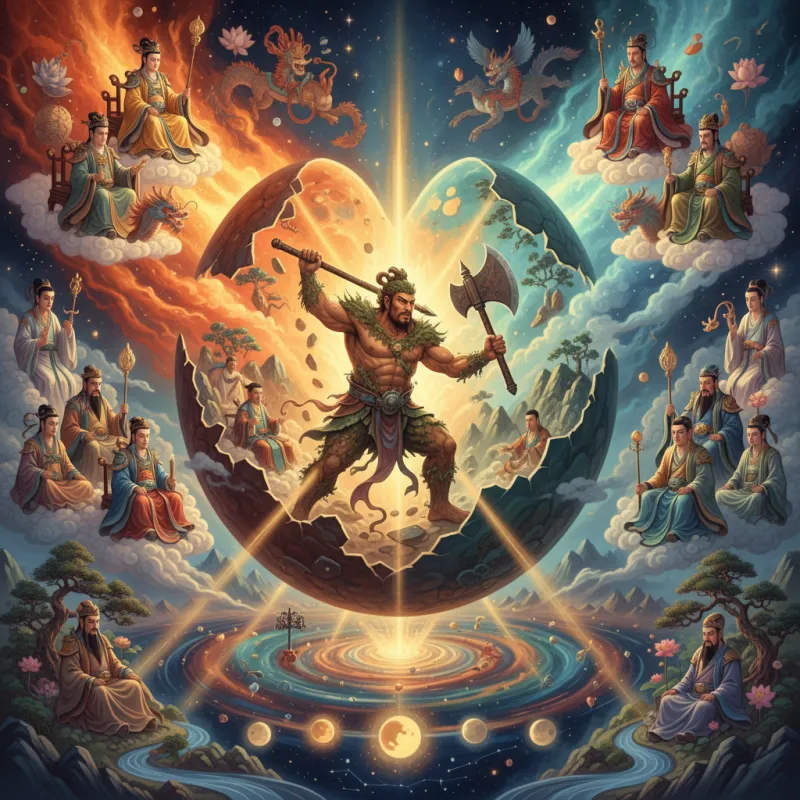
Before the first breath, before the first thought, before even the concept of "before"—there was an egg. Not the kind you crack for breakfast, but a cosmic egg floating in absolute nothingness, containing everything that would ever exist compressed into a single point. And inside that egg, a hairy giant named Pangu (盤古, Pángǔ) slept for eighteen thousand years, dreaming the universe into being.
This is how Chinese cosmology begins: not with a divine command or a cosmic explosion, but with sleep, an axe, and the most patient act of creation ever conceived.
The Axe That Split Reality
When Pangu finally woke—and the texts never explain what alarm clock could rouse someone after eighteen millennia—he found himself trapped in suffocating darkness. The chaos (混沌, húndùn) pressed in from all sides, undifferentiated and formless. His response was refreshingly direct: he grabbed an axe and swung.
Where did the axe come from? The myth doesn't say, and that's precisely what makes it brilliant. Pangu doesn't pray for tools or wait for divine intervention. The axe simply exists because the story needs it to exist, a narrative efficiency that would make modern screenwriters weep with envy.
The egg cracked. The light, pure yang (陽, yáng) energy rose upward, forming the heavens (天, tiān). The heavy, turbid yin (陰, yīn) energy sank downward, becoming the earth (地, dì). For the first time in existence, there was separation. There was up and down. There was space.
But Pangu wasn't finished. He stood between heaven and earth, one hand pushing up, one foot pressing down, and began to grow. Ten feet per day, every day, for another eighteen thousand years. Imagine the dedication—no weekends off, no vacation days, just thirty-six thousand years of literally holding the universe together through sheer stubbornness.
When Gods Die, Worlds Are Born
Here's where the Pangu myth transcends simple creation stories and becomes something genuinely profound: his death is not an ending but a transformation so complete it borders on the mystical.
After thirty-six thousand years of labor, Pangu died. But his body didn't decay—it became everything. His breath became the wind and clouds. His voice became thunder. His left eye became the sun, his right eye the moon. His four limbs and five extremities became the four cardinal directions and five sacred mountains. His blood flowed as rivers, his muscles formed the earth's soil, his hair became the stars.
Even his parasites—yes, the myth specifically mentions his parasites—transformed into humanity. We are, according to this version, the fleas and lice of a dead giant, which is either deeply humbling or darkly hilarious depending on your perspective.
This concept of transformation echoes through Chinese philosophy. Unlike creation myths where gods remain separate from their creations, Pangu becomes the universe. There's no distinction between creator and creation, no divine realm separate from the material world. Everything is Pangu, and Pangu is everything—a fundamentally Daoist idea wrapped in mythological clothing.
The Late Arrival of a Creation Story
Here's something most people don't realize: the Pangu myth is relatively young by Chinese standards. It first appears in the Sanwu Liji (三五歷紀, Sānwǔ Lìjì), a text from the Three Kingdoms period (220-280 CE), written by Xu Zheng. That's roughly two thousand years after the earliest Chinese written records.
For comparison, the Nüwa creation myth appears in much older texts. So why did China need Pangu when it already had perfectly good creation stories?
The answer might lie in cultural exchange. Some scholars note similarities between Pangu and creation myths from southern minority groups, particularly the Miao and Yao peoples. Others point to possible influences from Indian cosmology, which reached China via Buddhism during the Han and Three Kingdoms periods. The cosmic egg motif appears in Hindu mythology, and the idea of a primordial being whose body becomes the universe echoes the Rigveda's Purusha.
But whether borrowed or indigenous, the Pangu myth filled a gap in Chinese cosmology. It provided a clear, linear narrative of how something came from nothing—a question that earlier Chinese texts often sidestepped in favor of describing how existing forces like yin and yang interacted.
The Symbolism of Eighteen Thousand Years
Numbers in Chinese mythology are never arbitrary, and eighteen thousand appears twice in the Pangu story for good reason. Eighteen (十八, shíbā) carries significance in Chinese numerology, but more importantly, the doubling—eighteen thousand years asleep, eighteen thousand years awake—creates perfect symmetry.
This reflects the Chinese philosophical obsession with balance. Pangu's life divides into two equal halves: passive gestation and active creation, sleep and wakefulness, being and doing. Even in death, his body splits into complementary pairs: sun and moon, heaven and earth, yin and yang.
The number also emphasizes the incomprehensible scale of cosmic time. Thirty-six thousand years is long enough to make human lifespans seem like mayfly flickers, yet it's still countable, still graspable. The myth operates on a human scale blown up to cosmic proportions—we can imagine growing ten feet per day even if we can't imagine doing it for eighteen thousand years.
Pangu in Popular Culture and Worship
Unlike some Chinese deities who command elaborate temple complexes and annual festivals, Pangu occupies an odd position in religious practice. He's universally known but rarely worshipped. You won't find many Pangu temples, and he doesn't feature prominently in Daoist or Buddhist liturgy.
This makes sense when you consider his role. Pangu is a beginning, not an ongoing presence. He completed his task and ceased to exist as a conscious entity. There's no point praying to someone who became the mountains and rivers—you'd essentially be praying to geography.
However, Pangu does appear in popular culture with surprising frequency. The Journey to the West (西遊記, Xīyóu Jì) mentions him in passing, establishing the cosmic timeline. Modern Chinese fantasy novels and games regularly reference Pangu as the ultimate origin point, the zero hour before which nothing existed. He's become shorthand for "the beginning of everything," a narrative anchor point.
Some southern Chinese communities, particularly among the Yao people, do maintain Pangu worship traditions, suggesting the myth's possible origins in these cultures before it was absorbed into mainstream Han Chinese mythology.
The Philosophy Hidden in the Myth
Strip away the giant and the axe, and the Pangu myth encodes several core Chinese philosophical principles. First, the idea that order emerges from chaos through separation and differentiation—the fundamental process of yin and yang dividing from the primordial unity (太極, tàijí).
Second, the concept that creation requires sacrifice. Pangu doesn't create the world through divine fiat or magical words. He physically holds it apart for eighteen thousand years, then dies to complete the process. Creation is labor, and labor has costs.
Third, the ultimate unity of all things. Because everything comes from Pangu's body, everything is fundamentally connected. The mountains and rivers, the sun and moon, even humanity—we're all pieces of the same original being. This resonates with both Daoist ideas of universal interconnection and Buddhist concepts of dependent origination.
The myth also subtly addresses the problem of consciousness and matter. Pangu begins as a conscious being and ends as unconscious matter, suggesting that consciousness and materiality aren't separate categories but different states of the same underlying reality. When Pangu dies, his consciousness doesn't go to heaven or hell—it disperses into the wind and thunder, becoming the dynamic forces of nature.
Why This Myth Still Matters
In an age of Big Bang cosmology and quantum physics, why should anyone care about a giant with an axe? Because the Pangu myth isn't really about cosmology—it's about meaning.
The scientific creation story tells us the universe began with a singularity that expanded. True, but also profoundly alienating. We're accidents of chemistry on a random rock orbiting an average star. The Pangu myth offers something different: we're pieces of a being who sacrificed everything to create space for existence. The universe isn't random—it's the body of someone who cared enough to die for it.
This is why creation myths persist despite scientific alternatives. They provide narrative, purpose, and connection. When you look at a mountain and remember it's Pangu's limb, or watch a thunderstorm and hear his voice, the world becomes less empty, less mechanical. Everything has a story, and you're part of that story.
The Pangu myth also reminds us that creation is ongoing. Just as Pangu separated heaven and earth through constant effort, we maintain and recreate our world through daily labor. Every act of building, organizing, or making order from chaos echoes Pangu's original work. We're not just descended from the creator—we continue the creation.
And perhaps most importantly, the myth teaches that endings and beginnings are the same thing. Pangu's death is the world's birth. What looks like destruction from one angle is transformation from another. In a culture that would later develop sophisticated philosophies about change and impermanence, this is the foundational insight: nothing truly ends, it only becomes something else.
Related Reading
- Creation Myths in Chinese Religion: How Gods Made the World
- Fuxi: The God-Emperor Who Gave Humanity Civilization
- Nüwa Repairs the Sky: The Goddess Who Saved the World
- Exploring Chinese Deities and Immortals in Daoist and Buddhist Creation Myths
- Pangu Opens Heaven and Earth: The Chinese Creation Story
- Guardians of the Night Sky: The Star Gods in Chinese Daoist and Buddhist Traditions
- Sacred Mountain Pilgrimage: The Chinese Tradition of Climbing to Heaven
- The Underworld Gods: Who Runs Chinese Hell