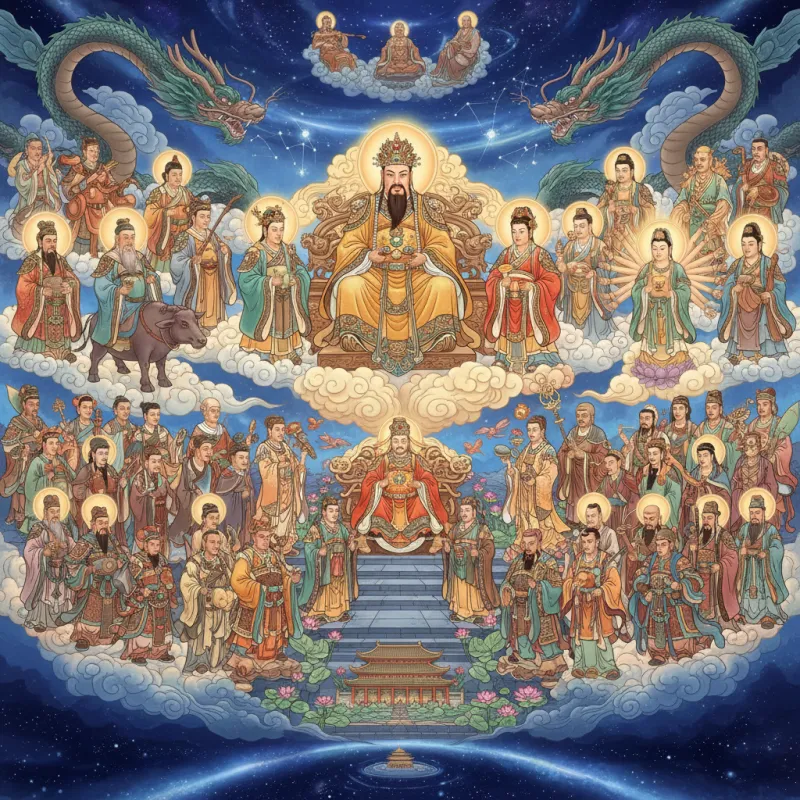
Picture this: You're standing in a Daoist temple in Sichuan, incense smoke curling toward the ceiling, and before you stretches an entire bureaucracy of gods. Not just a handful of deities lounging on clouds, but thousands of celestial officials, each with specific job titles, departmental responsibilities, and performance reviews. Welcome to the Daoist pantheon — where heaven runs like the world's most elaborate civil service.
Heaven's Corporate Structure
The Daoist pantheon isn't organized like the Greek gods' dysfunctional family reunion. It's modeled directly on imperial China's government bureaucracy, complete with ranks, departments, and chains of command. This makes perfect sense when you remember that Daoism developed alongside Chinese statecraft. The celestial hierarchy mirrors earthly power structures so precisely that when emperors reorganized their ministries, Daoist priests sometimes updated heaven's org chart to match.
At the apex sit abstract cosmic principles. Mid-level management includes specialized deities handling everything from weather to wealth. At the ground level, you'll find local spirits managing individual villages, neighborhoods, and even specific households. It's a divine pyramid scheme that actually works.
The Three Pure Ones: The C-Suite
The highest tier belongs to the Sanqing (三清, Sānqīng) — the Three Pure Ones. These aren't gods you pray to for parking spots. They're philosophical concepts given form, representing different aspects of the Dao itself.
Yuanshi Tianzun (元始天尊, Yuánshǐ Tiānzūn), the Celestial Worthy of Primordial Beginning, embodies the Dao before anything existed — pure potential, the cosmic equivalent of a blank page before the universe's first word. He's typically depicted holding a pearl, symbolizing the undifferentiated unity before creation.
Lingbao Tianzun (灵宝天尊, Língbǎo Tiānzūn), the Celestial Worthy of Numinous Treasure, represents the Dao in motion — that crucial moment when possibility crystallizes into reality. He holds a ruyi scepter, the symbol of wish fulfillment and cosmic authority.
Daode Tianzun (道德天尊, Dàodé Tiānzūn), the Celestial Worthy of the Way and Virtue, is actually Laozi deified. Yes, the same guy who supposedly wrote the Daodejing and then rode off on a water buffalo. By the Han Dynasty, he'd been promoted from philosopher to cosmic principle. He represents the Dao as it manifests in the world — practical wisdom rather than abstract theory.
These three rarely get involved in human affairs directly. They're too busy being metaphysical.
The Jade Emperor: Heaven's CEO
Below the Three Pure Ones sits Yuhuang Dadi (玉皇大帝, Yùhuáng Dàdì), the Jade Emperor, who actually runs the show. If the Three Pure Ones are the board of directors, the Jade Emperor is the CEO handling day-to-day operations. He's the deity most Chinese people actually interact with, the one who receives reports from all the other gods and makes executive decisions about human fate.
According to legend, the Jade Emperor earned his position through three million years of cultivation and 1,750 trials. That's commitment to career advancement. He presides over heaven's bureaucracy from his palace, reviewing performance reports from subordinate deities and occasionally demoting gods who slack off. The Kitchen God reports directly to him every New Year, delivering an annual review of each household's behavior.
The Jade Emperor's wife, Wangmu Niangniang (王母娘娘, Wángmǔ Niángniáng), the Queen Mother of the West, manages her own domain. She's not just a consort — she's an ancient deity in her own right, predating organized Daoism. Her peach garden produces the immortality peaches that ripen once every 3,000 years, and her birthday banquet is heaven's most exclusive social event. Remember the chaos in Journey to the West when Sun Wukong crashed that party? That was her event he ruined.
The Department Heads
Below the executive level, heaven's bureaucracy branches into specialized departments, each managed by powerful deities with specific portfolios.
Guanyin (观音, Guānyīn), the Goddess of Mercy, technically belongs to the Buddhist pantheon but has been thoroughly integrated into Chinese folk religion. She's the deity of compassion, the one you call when you need help and everyone else has failed. Her ability to appear in 33 different forms makes her heaven's most versatile operator.
Guan Yu (关羽, Guān Yǔ), the red-faced general from the Three Kingdoms period, was deified centuries after his death and now serves as the God of War and Righteousness. Police stations and triads both worship him, which tells you something about the flexibility of divine patronage. He's also the patron of business and wealth — because apparently, military strategy and accounting require similar skills.
Mazu (妈祖, Māzǔ), the Goddess of the Sea, protects sailors and fishermen. She started as a mortal woman named Lin Moniang in 10th-century Fujian, who supposedly saved her father and brothers from drowning using her spiritual powers. Now she's one of the most widely worshipped deities in coastal China and throughout the Chinese diaspora. Her temples dot every port from Guangdong to Taiwan.
The Eight Immortals (八仙, Bāxiān) form a kind of special task force — enlightened beings who've achieved immortality and now wander the world helping people and causing mischief. Each represents a different social class and life condition, making them relatable to everyone. They're the immortals you'd actually want to grab a drink with, assuming you can handle their supernatural party tricks.
The Middle Management
Below the celebrity deities sits an extensive middle management of specialized gods handling specific domains. There's a god for literally everything.
Caishen (财神, Cáishén), the God of Wealth, comes in multiple versions — military and civil — because apparently, making money requires different divine patrons depending on your industry. Businesses display his image prominently, hoping for his blessing on their quarterly earnings.
Wenchang Wang (文昌王, Wénchāng Wáng), the God of Literature and Examinations, was crucial during the imperial examination era. Students burned incense to him before tests, hoping for divine inspiration. He's still popular today, though now he helps with SATs and college entrance exams instead of the civil service examinations.
Tudi Gong (土地公, Tǔdì Gōng), the Earth God, manages local territories. Every neighborhood has its own Earth God shrine, usually a small red structure where locals leave offerings. He's the divine equivalent of a district manager, handling local issues and reporting up the chain to higher authorities.
The Ground-Level Operators
At the bottom of the hierarchy sit the household and personal deities who deal with daily life's minutiae.
The Kitchen God (灶君, Zàojūn) lives above your stove and monitors family behavior all year, then reports to the Jade Emperor during Chinese New Year. Families traditionally smear honey on his lips before he ascends, hoping to sweeten his report or stick his mouth shut. It's divine bribery, and everyone's in on the joke.
Door Gods (门神, Ménshén) guard entrances, their fierce painted faces warning evil spirits to stay out. The most famous pair are Qin Shubao and Yuchi Gong, two Tang Dynasty generals who supposedly protected Emperor Taizong from demons. Now they protect millions of doorways across China.
Even your bed has a deity — Chuang Gong (床公, Chuáng Gōng) and Chuang Po (床婆, Chuáng Pó), the Bed Duke and Bed Duchess, who oversee conception and childbirth. Privacy is not a concept in Chinese folk religion.
The Flexibility of Faith
What makes the Daoist pantheon fascinating is its flexibility. New deities get added regularly. Historical figures who demonstrated exceptional virtue or ability can be deified — it's like heaven's hall of fame, except you can pray to the inductees. Local spirits get promoted to regional gods if they prove effective. Ineffective deities get demoted or forgotten.
This isn't a closed system handed down from on high. It's a living, evolving pantheon that responds to human needs and historical changes. When new challenges arise — say, automobile accidents — new protective deities emerge or existing ones expand their portfolios. The pantheon grows organically, like a divine ecosystem adapting to its environment.
The result is a religious landscape where Buddhist bodhisattvas, Daoist immortals, Confucian sages, and deified historical figures all coexist in the same temples, receiving offerings from the same worshippers. It's theological multitasking at its finest, and it works because Chinese folk religion has never been particularly concerned with doctrinal purity. What matters is efficacy — does the deity deliver results?
This practical approach to divinity means you might pray to Guanyin for compassion, Guan Yu for business success, and the Kitchen God for family harmony, all in the same day. You're not being inconsistent; you're being strategic. Heaven's bureaucracy is vast, so you go to the right department for each need.
The Daoist pantheon isn't just a collection of gods — it's a mirror reflecting Chinese society's values, fears, and aspirations across millennia. It's a bureaucracy, yes, but one with room for rebels, tricksters, and reformed demons. It's a hierarchy that somehow remains accessible, with deities ranging from cosmic abstractions to the god living above your stove. And it's still growing, still adapting, still finding new ways to help humans navigate the chaos of existence.
Related Reading
- The Three Pure Ones: Supreme Deities of Taoism
- The Three Pure Ones: Supreme Deities of Daoism — Shenxian Perspective
- The Complete Guide to Chinese Gods and Immortals
- The Mountain Gods: Nature Deities in the Daoist Pantheon — Shenxian Perspective
- Celestial Masters and Heavenly Generals: Daoism's Divine Warriors — Shenxian Perspective
- Chinese Gods in Marvel and DC Comics
- Unveiling the Mystique of Chinese Animal Spirits in Daoist and Buddhist Beliefs
- Unraveling the Mystique of Chinese War Gods in the Daoist and Buddhist Pantheon