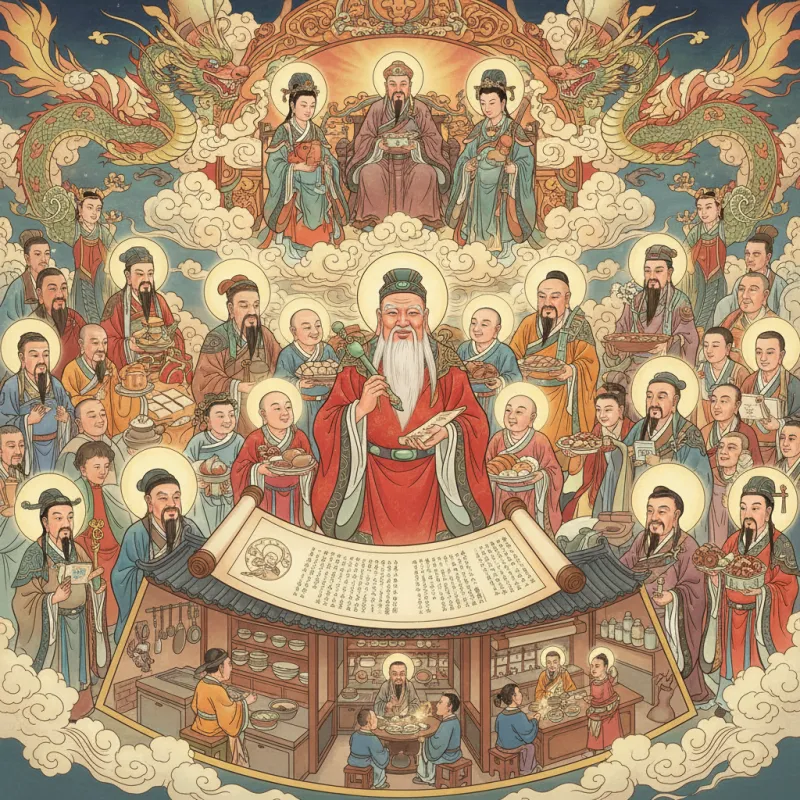
Every night, while you sleep, someone is watching. Not from the shadows or through a window—from right next to your stove. In millions of Chinese homes, a paper portrait hangs above the kitchen hearth, depicting a stern-faced official in traditional robes. This is Zaoshen (灶神), the Kitchen God, and he's been taking notes. For an entire year, he observes every family quarrel, every act of kindness, every bowl of rice wasted, every lie told over dinner. Then, on the 23rd day of the twelfth lunar month, he ascends to heaven to file his report with the Jade Emperor (玉皇大帝 Yùhuáng Dàdì). Your fate for the coming year—health, wealth, harmony—hangs on what he says. No wonder Chinese families have spent centuries trying to bribe him with sticky candy.
The Bureaucrat in Your Kitchen
Unlike the distant celestial powers or the fierce guardian deities, Zaoshen operates on an intimate scale. He doesn't command thunder or judge the dead. He's essentially a divine middle manager, a heavenly bureaucrat whose jurisdiction is your kitchen and whose performance review determines your family's fortune. The Chinese pantheon mirrors the imperial bureaucracy with remarkable precision, and Zaoshen represents the lowest—yet most invasive—level of supernatural surveillance.
His official title is Zao Jun (灶君), "Lord of the Stove," though he's also called Zao Wang (灶王), "King of the Stove," or Zao Wang Ye (灶王爷), "Grandfather King of the Stove." The proliferation of titles reflects both respect and familiarity—he's important enough to warrant honorifics, yet close enough to be addressed like family. After all, he lives in your house.
The Kitchen God's origins are murky, predating organized Daoism and Buddhism. Archaeological evidence suggests stove worship existed as early as the Han Dynasty (206 BCE–220 CE), though the deity's personality and mythology crystallized much later. By the Song Dynasty (960–1279), Zaoshen had evolved from a vague household spirit into a fully characterized deity with a backstory, a wife (sometimes), and a clearly defined bureaucratic function.
The Spy Who Came in from the Kitchen
What makes Zaoshen uniquely unsettling is his surveillance role. Most Chinese deities require you to seek them out—you visit their temple, make offerings, petition for help. Zaoshen is already there, embedded in your domestic space, observing without being summoned. He watches the family eat, listens to conversations, notes who treats the elderly with respect and who wastes food. He's the original home surveillance system, centuries before Ring doorbells.
The Jade Emperor, heaven's supreme administrator, relies on these reports to allocate fortune and misfortune. In the cosmic bureaucracy, Zaoshen functions like a local census taker or tax assessor, providing ground-level intelligence that informs heavenly policy decisions. This isn't abstract theology—it's practical governance extended into the supernatural realm.
Traditional texts specify what Zaoshen reports: acts of filial piety, charitable deeds, honest business practices, but also lies, cruelty, waste, and family discord. Some versions claim he tracks major sins, while others suggest he notes every minor transgression, maintaining a running tally throughout the year. The ambiguity itself serves a purpose—if you don't know exactly what he's recording, you'd better behave in all circumstances.
This surveillance theology had real social effects. The Kitchen God reinforced Confucian family values and social harmony through supernatural enforcement. Parents invoked Zaoshen when children misbehaved: "The Kitchen God is watching!" It was crowd control through cosmic accountability, and it worked because the kitchen was unavoidable—everyone had to eat.
The Great Ascension and the Sticky Candy Conspiracy
On the 23rd day of the twelfth lunar month (or the 24th in some regions), Zaoshen departs for heaven to deliver his annual report. This day, called Xiao Nian (小年, "Little New Year"), triggers one of Chinese folk religion's most pragmatic rituals: the systematic bribery of a deity.
Families offer tanggua (糖瓜), sticky malt candy, to Zaoshen before his departure. The official explanation is that the sweet offering expresses gratitude and respect. The actual folk logic is more cynical and delightful: the sticky candy will either seal his lips shut so he can't report your misdeeds, or make his words so sweet that he only says nice things about your family. Some families also offer him wine, hoping he'll be too drunk to remember the bad stuff. This is theology meets practical psychology—if you can't be good all year, at least you can try to influence the performance review.
The ritual involves burning Zaoshen's paper image, which releases his spirit for the heavenly journey. Some families also burn paper horses or sedan chairs to ensure he travels in comfort and arrives in a good mood. The kitchen is then cleaned thoroughly—partly as practical preparation for New Year, partly to erase evidence before the divine inspector returns.
Zaoshen remains in heaven until New Year's Eve, when families welcome him back with a new paper image and fresh offerings. The week of his absence is considered an auspicious time for household repairs, deep cleaning, and frank family discussions—after all, the spy is away. This practical theology acknowledges human nature: we need both surveillance and privacy, both accountability and freedom from judgment.
The Kitchen God's Backstory: From Mortal to Monitor
Unlike many deities whose origins are lost in prehistory, Zaoshen has several competing origin stories, each revealing different aspects of Chinese values and anxieties. The most popular version, recorded in various Ming and Qing Dynasty texts, tells of Zhang Lang (张郎), a man who divorced his virtuous wife to marry a younger woman. After squandering his fortune, he became a beggar. Years later, blind and destitute, he unknowingly begged at his ex-wife's door. She recognized him, took him in, and fed him. Overcome with shame when he realized who she was, Zhang Lang threw himself into the kitchen stove and died. The Jade Emperor, moved by his remorse and his ex-wife's forgiveness, appointed him Kitchen God—a position where he could observe and report on family virtue, having learned its value through his own failures.
This origin story is remarkably sophisticated. It transforms Zaoshen from an arbitrary authority into a reformed sinner, someone who understands human weakness because he embodied it. His surveillance isn't tyrannical—it's educational, conducted by someone who knows how badly people can mess up and how redemption works. The story also centers female virtue and forgiveness, making the Kitchen God's authority dependent on recognizing a woman's moral superiority.
Alternative versions exist. Some claim Zaoshen was originally a fire deity, gradually anthropomorphized into a household god. Others identify him with historical figures or legendary characters. The multiplicity of origin stories suggests Zaoshen's role mattered more than his identity—Chinese folk religion needed a kitchen deity, and various narratives competed to explain why he was there.
The Kitchen God's Wife (Sometimes)
In many households, Zaoshen doesn't work alone. His wife, Zaoshen Nainai (灶神奶奶) or Zaoshen Popo (灶神婆婆), appears in some paper images and receives offerings alongside her husband. Her role varies by region and tradition. Some versions portray her as a co-observer, equally responsible for reporting family behavior. Others cast her as a moderating influence, tempering her husband's reports with mercy and understanding.
The most cynical folk interpretation suggests that families offer extra sweets to Zaoshen's wife so she'll nag her husband into giving a favorable report—essentially weaponizing the stereotype of the nagging wife for divine lobbying purposes. This reflects both the pragmatic flexibility of Chinese folk religion and its willingness to project human relationship dynamics onto the divine realm.
Not all traditions include the wife, and her presence or absence reveals regional variations in how families conceptualize divine authority. A solo Kitchen God suggests a more austere, bureaucratic surveillance. A married Kitchen God implies negotiation, domestic politics, and the possibility of mercy—after all, if even the gods have to deal with spousal opinions, maybe there's room for human appeal.
Kitchen God in Modern China: Surveillance Theology Meets Surveillance State
The Kitchen God's worship declined dramatically during the Cultural Revolution (1966–1976), when religious practices were suppressed as feudal superstition. Burning paper images of a divine spy probably seemed especially problematic to a government implementing its own extensive surveillance systems. The irony is rich: the Communist Party objected to supernatural surveillance while building one of history's most comprehensive earthly monitoring apparatuses.
Since the 1980s, Zaoshen worship has experienced a modest revival, particularly in rural areas and among older generations. Urban apartments rarely have traditional kitchens with hearths, making the Kitchen God's physical placement awkward. Some families adapt by placing his image near the stove or refrigerator, while others abandon the practice entirely. The rise of delivery apps and eating out further diminishes the kitchen's centrality to family life—when you're not cooking at home, what's the Kitchen God observing?
Yet Zaoshen's conceptual legacy persists. The idea of constant observation shaping behavior, of annual performance reviews determining fortune, of trying to influence authority figures through strategic offerings—these patterns remain deeply embedded in Chinese social psychology. The Kitchen God may be fading from actual kitchens, but the surveillance theology he represents has found new expressions in social credit systems, workplace monitoring, and digital tracking. The divine bureaucrat has been replaced by algorithmic bureaucrats, but the underlying logic—that observation ensures compliance, that behavior is always being recorded and evaluated—remains remarkably consistent.
The God You Can't Escape
What distinguishes Zaoshen from deities like Caishen, the God of Wealth, or Guanyin, the Goddess of Mercy, is his inescapability. You can choose whether to worship the God of Wealth. You can decide whether to visit Guanyin's temple. But if you have a kitchen—and everyone needs to eat—you have the Kitchen God. He's not optional. He's not distant. He's right there, next to the rice cooker, taking notes.
This makes Zaoshen perhaps the most psychologically sophisticated deity in the Chinese pantheon. He doesn't promise cosmic rewards or threaten dramatic punishments. He simply watches, remembers, and reports. The threat isn't divine wrath—it's bureaucratic documentation. Your misdeeds won't trigger thunderbolts; they'll go into your permanent record. It's a very Chinese form of social control: not spectacular violence, but patient, meticulous record-keeping that determines your future prospects.
The Kitchen God represents the domestication of the divine, the infiltration of cosmic authority into everyday life. He transforms the kitchen from a purely functional space into a moral arena where every action carries supernatural weight. Wasting food isn't just economically foolish—it's a mark against your family's heavenly file. Treating your mother-in-law well isn't just social obligation—it's improving your annual performance review with the Jade Emperor.
In the end, Zaoshen embodies a profound truth about Chinese religious psychology: the gods aren't distant cosmic forces but intimate participants in daily life, and the most powerful divine authority isn't the one who commands armies or controls nature, but the one who watches you eat dinner and remembers what you said. The Kitchen God doesn't need to be powerful. He just needs to be there, observing, until it's time to file his report. Sweet candy optional, but recommended.
Related Reading
- Exploring Chinese Deities and Immortals: Insights into Daoist and Buddhist Folk Gods
- The Kitchen God: Spy of Heaven
- The City God System: Local Government of the Spirit World
- Folk Gods of China: The Deities Your Grandmother Prays To
- Unveiling the Rich Tapestry of Chinese Deities and Immortals in Folk Religion
- The Underworld Gods: Who Runs Chinese Hell
- Nezha: From Ancient Deity to Box Office Hit
- Exploring Chinese Deities and Immortals: Rituals in Daoist and Buddhist Traditions