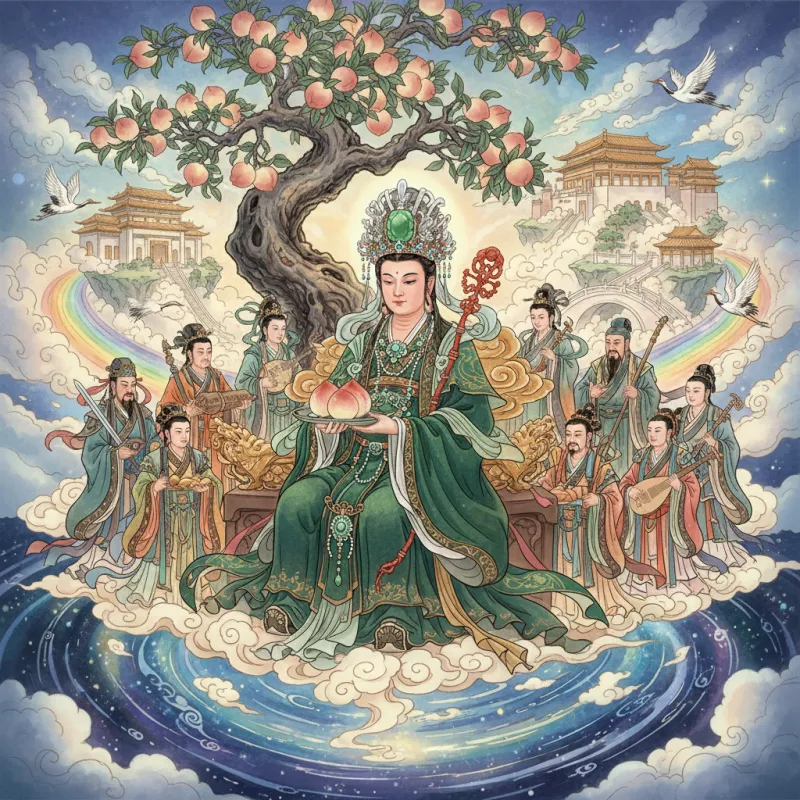
A peach tree blooms once every three thousand years in the gardens of Kunlun Mountain, and when its fruit finally ripens after another three millennia, the Queen Mother of the West hosts a banquet that determines who among mortals and immortals will taste eternity. This is no mere myth—Xiwangmu (西王母), the Queen Mother of the West, has presided over the boundary between life and death for over two thousand years of Chinese religious imagination, transforming from a wild-haired, tiger-toothed mountain demon into the most powerful goddess in the Daoist pantheon.
From Monster to Matriarch
The earliest textual appearance of Xiwangmu comes from the "Shanhaijing" (山海經, Classic of Mountains and Seas), compiled sometime between the 4th and 1st centuries BCE. Here she's barely recognizable as the elegant goddess of later tradition. The text describes her as having a human face, tiger's teeth, a leopard's tail, and disheveled hair topped with a ceremonial headdress. She dwells in a cave on Jade Mountain, commanding the spirits of plague and pestilence. This is no benevolent immortal—she's a shamanic figure of raw, untamed power.
By the Han Dynasty (206 BCE - 220 CE), something remarkable happened. Xiwangmu underwent one of the most dramatic makeovers in mythological history. The "Shiji" (史記, Records of the Grand Historian) by Sima Qian mentions her in connection with Emperor Wu of Han's obsession with immortality, but it's the "Han Wudi Neizhuan" (漢武帝內傳, Inner Biography of Emperor Wu of Han) that gives us the transformed goddess. Now she appears as a beautiful woman of about thirty, arriving at the emperor's palace in a chariot pulled by phoenixes, attended by jade maidens, bringing with her seven peaches of immortality. The monster has become a queen.
The Peaches of Immortality
Those peaches—pantao (蟠桃)—are Xiwangmu's signature gift and the source of her enduring appeal. According to the "Dongfang Shuo Zhuan" (東方朔傳, Biography of Dongfang Shuo), the peach trees in her western paradise grow in three varieties: those that ripen every three thousand years grant immortality to mortals; those that ripen every six thousand years allow one to ascend to heaven; and the rarest, ripening every nine thousand years, make one equal to heaven and earth themselves.
The Peach Banquet (Pantao Hui, 蟠桃會) became a central motif in Chinese religious art and literature. Every year—or every three thousand years, depending on the source—Xiwangmu invites the worthy immortals to feast on these fruits. The "Journey to the West" (西遊記) famously features Sun Wukong, the Monkey King, crashing this exclusive party, devouring the peaches, and causing celestial chaos. The novel's 16th-century author Wu Cheng'en understood that Xiwangmu's peaches weren't just magical fruit—they were the ultimate symbol of access to power and eternal life.
Palace in the Kunlun Mountains
Xiwangmu's residence on Mount Kunlun (崑崙山) places her at the mythological axis mundi of Chinese cosmology. Kunlun isn't just any mountain—it's the pillar connecting earth to heaven, located in the far west where the sun sets and the boundary between the living world and the realm of immortals grows thin. The "Huainanzi" (淮南子), compiled around 139 BCE, describes her palace as surrounded by weak water (ruoshui, 弱水) that cannot support even a feather, making it impossible for mortals to reach without divine assistance.
Her gardens contain not only the peach trees but also the jade pond (Yaochi, 瑤池) where she bathes and holds court. This pond became so associated with her that Yaochi became one of her alternative names. The Tang Dynasty poet Li Shangyin wrote of "the jade pond's frozen waves" in his poem about Xiwangmu, capturing the crystalline, otherworldly quality of her domain. Later Daoist texts describe her palace as having nine-story jade towers, pearl pavilions, and gardens where every plant grants some form of supernatural power or longevity.
Consort, Counterpart, or Independent Power?
The question of Xiwangmu's relationship to male deities reveals much about changing Chinese attitudes toward gender and power. Early texts present her as an independent sovereign, ruling the western paradise without reference to any male counterpart. However, by the Han Dynasty, some sources began pairing her with Dongwanggong (東王公, King Father of the East), creating a cosmic yin-yang balance.
This pairing never quite stuck. Unlike other divine couples in Chinese mythology, Dongwanggong remains a shadowy figure while Xiwangmu's cult flourished. By the Tang Dynasty (618-907 CE), she was more commonly associated with the Jade Emperor, though their relationship varies by text—sometimes she's his wife, sometimes his mother, sometimes an independent power who predates him. The ambiguity itself is telling. Xiwangmu's power doesn't derive from her relationship to male deities; she holds it in her own right.
The Cult of Xiwangmu
In 3 BCE, something extraordinary happened. A popular religious movement swept through China, with thousands of people claiming Xiwangmu had descended to earth and was distributing talismans of immortality. People danced in the streets, passed around mysterious tokens, and traveled westward hoping to meet the goddess. The Han court, alarmed by this spontaneous mass movement, tried to suppress it, but the incident reveals how deeply Xiwangmu had penetrated popular religious consciousness.
Archaeological evidence confirms her widespread worship. Han Dynasty tomb murals frequently depict Xiwangmu, often paired with Fuxi and Nüwa, the creator deities. She appears on bronze mirrors, jade carvings, and stone reliefs. One particularly striking example from a 2nd-century CE tomb in Sichuan shows her seated on a throne, flanked by attendants, with the sun and moon above her—a composition that emphasizes her cosmic authority.
Daoist temples dedicated to Xiwangmu can be found throughout China, with major centers on Mount Hua in Shaanxi and Mount Tai in Shandong. The Eight Immortals are said to have received their powers after attending her peach banquet, linking her directly to some of Daoism's most popular figures. Women particularly venerated her, seeing in her a model of female power and autonomy rare in traditional Chinese religion.
Xiwangmu in Literature and Popular Culture
Beyond religious texts, Xiwangmu appears throughout Chinese literature as a symbol of unattainable immortality and divine feminine power. The Tang poet Li Bai wrote of her in "Ballad of Mount Lushan," imagining her palace as a place of transcendent beauty. The Ming Dynasty novel "Investiture of the Gods" (封神演義) features her as a major character who intervenes in the cosmic war between the Shang and Zhou dynasties.
In modern times, Xiwangmu has experienced a revival. She appears in contemporary Chinese fantasy novels, video games, and films, often portrayed as a powerful but enigmatic figure who guards the secrets of immortality. The 2015 film "Mojin: The Lost Legend" features her tomb as a central plot element, while numerous Chinese RPGs include her peach garden as a high-level location. This enduring presence in popular culture demonstrates how Xiwangmu continues to capture the imagination as a symbol of eternal life and feminine power.
The Goddess Who Transcends Time
What makes Xiwangmu's mythology so enduring? Perhaps it's the fundamental human desire she represents—the wish to transcend mortality, to taste the fruit that grants eternal life. Unlike many immortality myths that end in tragedy (think of Gilgamesh or Tithonus), Xiwangmu offers the possibility that immortality can be achieved, that somewhere in the western mountains, peaches are ripening that could make us equal to heaven itself.
Her transformation from demon to goddess also speaks to something profound about Chinese religious thought. Rather than being destroyed or defeated, she was transformed and elevated, her wild power channeled into benevolent sovereignty. She embodies the Daoist principle that apparent opposites—life and death, mortal and immortal, wild and civilized—are not contradictions but points on a continuum that the wise can navigate.
Today, when you see images of peaches in Chinese art, or hear references to the "Peach Banquet," you're encountering echoes of Xiwangmu's mythology. She remains what she has always been: the keeper of the boundary between mortality and eternal life, the goddess who decides who will taste the peaches of immortality and who will remain forever outside the gates of her western paradise.
Related Reading
- The Three Pure Ones: Supreme Deities of Daoism — Shenxian Perspective
- Celestial Masters and Heavenly Generals: Daoism's Divine Warriors — Shenxian Perspective
- The Complete Guide to Chinese Gods and Immortals
- The Three Pure Ones: Supreme Deities of Taoism
- The Jade Emperor: Ruler of Heaven
- The Eight Immortals: China's Most Beloved Supernatural Team
- The Kitchen God: Spy of Heaven
- Exploring the Rich Pantheon of Chinese Deities and Immortals in Daoism and Buddhism