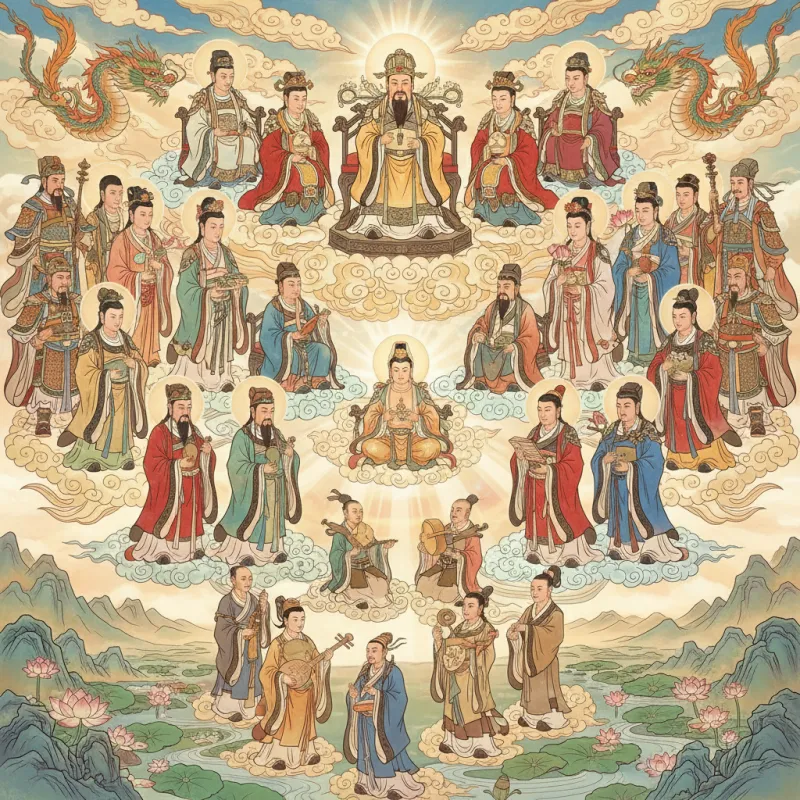
When a person dies in China, their family doesn't just grieve — they become administrators. Within hours, relatives transform into logistics coordinators, ritual specialists, and spiritual accountants, managing a complex bureaucracy that spans both worlds. The deceased isn't simply "gone." They've been transferred to a new department, and if the paperwork isn't filed correctly, if the proper offerings aren't made, if the rituals are performed out of sequence, the consequences ripple through both the living and the dead.
White, Not Black: The Color System of Chinese Mourning
Walk into a Chinese funeral and you'll be struck by the sea of white. White cloth headbands, white robes, white banners — the color that Western cultures associate with weddings and purity is, in China, the color of death. This isn't a recent development. White (白 bái) has marked mourning in China for over three thousand years, rooted in the ancient belief that white represents the raw, unadorned state of grief and the transition between worlds.
The mourning color system is actually more complex than simply "wear white." It's a hierarchy. Immediate family — children, spouses — wear coarse white cloth, sometimes with a hemp rope belt. Grandchildren might wear blue or black armbands over white. More distant relatives wear lighter shades. The system, codified during the Zhou Dynasty and refined through centuries of Confucian practice, makes grief visible and ranked. You can read a person's relationship to the deceased just by looking at what they're wearing.
Red, the color of celebration and life force, is strictly forbidden. No red clothing, no red decorations, no red anything. Families even cover or remove red items from their homes. The prohibition is so strong that some families won't celebrate Chinese New Year for three years after a death, since the holiday is drenched in red symbolism.
The Three Souls and Seven Spirits Problem
Chinese funeral traditions operate on a specific understanding of what happens when someone dies, and it's more complicated than a simple soul departing the body. Traditional Chinese metaphysics holds that each person has three hun (魂 hún) — ethereal souls — and seven po (魄 pò) — corporeal spirits. When death occurs, these components don't all leave at once or go to the same place.
The hun are yang in nature. They're associated with consciousness, personality, and the higher functions of being human. After death, they're supposed to ascend and eventually make their way to the underworld bureaucracy for judgment. The po are yin, tied to the physical body and base instincts. They remain with the corpse and gradually dissipate as the body decays. This is why the body must be treated with such care — mistreating a corpse means tormenting the po that still cling to it.
This split creates practical problems. If the hun don't successfully detach and travel to the underworld, they become gui (鬼 guǐ) — ghosts — stuck in the in-between. If the po don't dissipate properly, they can become vengeful entities. Much of Chinese funeral ritual is designed to manage this separation, to guide the hun toward their destination while allowing the po to fade peacefully.
The First Seven Days: Guiding the Confused Dead
The period immediately after death is critical. The newly dead are confused, disoriented, and don't necessarily understand they're dead. For the first seven days, the hun are believed to linger near the body and the home, trying to make sense of their new state. This is why families perform the "first seven" (头七 tóuqī) ritual on the seventh day after death — it's the first major checkpoint in the soul's journey.
During this week, families maintain a vigil. Someone must always be present with the body. Incense burns continuously. Offerings of food and drink are placed before the deceased's photograph or spirit tablet. The family isn't just mourning — they're providing orientation services. They talk to the deceased, explain what's happening, remind them of their identity and their family connections.
On the seventh day, many families hire Daoist priests or Buddhist monks to perform elaborate rituals. These aren't just ceremonial. The priests are, in effect, filing the deceased's transfer paperwork with the underworld bureaucracy. They chant sutras to guide the hun, make offerings to Yanluo Wang (阎罗王 Yánluó Wáng), the King of Hell, and his administrators, and create spiritual documents that serve as the deceased's credentials in the afterlife. Similar rituals are repeated every seven days for forty-nine days — the full processing period for a soul's judgment and reincarnation according to Buddhist tradition.
Hell Money and Paper Offerings: Equipping the Dead
If you've ever seen Chinese people burning paper money, houses, cars, or even paper iPhones at funerals, you've witnessed one of the most practical aspects of Chinese death customs. These aren't symbolic gestures — they're supply shipments. The logic is straightforward: the afterlife operates like the living world, with needs, expenses, and bureaucrats who expect payment. The dead need resources to navigate this system.
Hell money (冥币 míngbì) comes in denominations that would make hyperinflation economists weep — billion-dollar notes are common. But inflation is different in the underworld economy. Families burn stacks of this currency so the deceased can pay fees, bribe officials if needed, and maintain themselves while awaiting judgment. The more elaborate the burning, the better equipped the deceased will be.
The paper offerings have evolved with technology. Traditional items included paper houses, servants, and clothing. Modern funerals might include paper smartphones, laptops, credit cards, and luxury cars. Some shops sell paper mistresses, which raises interesting theological questions about afterlife ethics that families generally don't dwell on. The principle remains: whatever the deceased might need or want in life, they'll need in death, so burn a paper version to transfer it across.
This practice connects to the broader Chinese understanding of ancestor worship — the dead aren't gone, they're relocated, and they still have needs the living must meet.
The Funeral Procession: Making Noise to Clear the Path
Traditional Chinese funeral processions are loud. Deliberately, aggressively loud. Mourners wail, musicians play, firecrackers explode, and gongs crash. This isn't chaos — it's spiritual crowd control. The noise serves multiple purposes: it announces the deceased's passing to the spirit world, it frightens away malevolent entities that might interfere with the soul's journey, and it clears a path through the invisible traffic of ghosts and spirits that crowd the boundary between worlds.
The procession follows a specific order. At the front, someone carries a white banner with the deceased's name and dates. Next come the musicians and the noise-makers. Then the portrait of the deceased, held high so everyone — living and dead — can see who's passing. The coffin follows, often carried by professional pallbearers who know the proper pace and the places where the procession must pause. Family members come last, with the closest relatives sometimes crawling or walking bent over in extreme displays of grief.
The route matters. The procession must avoid certain locations — places where the living energy is too strong, like schools or wedding venues, which could trap the confused hun. It must pass by the deceased's favorite places so the soul can say goodbye. In rural areas, the procession might circle the village, allowing the deceased to take one last look at their home territory.
Burial vs. Cremation: The Body's Final Form
For most of Chinese history, burial was the only acceptable option. The body needed to remain intact because the po spirits required it, and because Confucian filial piety demanded that you return your body to the earth in the same form your parents gave it to you. Cremation was seen as a form of mutilation, acceptable only for criminals or in emergency situations like plague.
Buddhism complicated this. Buddhist tradition favors cremation, seeing the body as an empty vessel once the consciousness departs. As Buddhism spread through China, cremation became more acceptable, though it remained controversial. The compromise in many regions was to cremate only after the initial mourning period, giving the po time to dissipate naturally before the body was burned.
Modern China has made cremation mandatory in most urban areas due to land scarcity, but this creates spiritual anxiety for traditional families. How do you honor the po if there's no body for them to cling to? How do you ensure proper decomposition if everything is burned at once? Families adapt by extending the wake period before cremation, by keeping the ashes in elaborate urns that serve as body-substitutes, and by maintaining grave sites even for cremated remains.
The burial site itself requires careful selection through feng shui (风水 fēngshuǐ) principles. A poorly chosen grave doesn't just disrespect the dead — it can bring misfortune to living descendants for generations. This is why families sometimes hire feng shui masters to survey potential burial locations, looking for sites where the qi (气 qì) flows properly and the landscape features create a harmonious resting place.
The Mourning Period: Three Years of Obligation
When Confucius's student asked how long one should mourn a parent, Confucius replied: three years. This wasn't a suggestion. For over two thousand years, Chinese culture has maintained that children owe their parents three years of mourning — a period that mirrors the three years a child depends entirely on their parents after birth.
During this period, the family operates under restrictions. They don't attend celebrations, they don't wear bright colors, they avoid entertainment. In traditional practice, children would resign from government positions and return home to mourn. The mourning period for other relatives is shorter — one year for grandparents, several months for aunts and uncles — but the principle remains: death creates obligations that the living must fulfill.
The three-year period is divided into stages. The first hundred days are the most intense, with regular offerings and rituals. The first anniversary of death is marked with elaborate ceremonies. By the third year, the mourning gradually lightens, though families continue to make offerings at Qingming Festival and other occasions for ancestor veneration.
Modern life has compressed these timelines. Few people can take three years away from work to mourn. But the psychological and spiritual framework remains. Families still feel the weight of these obligations, still mark the anniversaries, still maintain the connection between the living and the dead that Chinese funeral traditions are designed to preserve.
The Underworld Bureaucracy: Where the Dead Go
All of these rituals — the offerings, the ceremonies, the mourning — exist because Chinese tradition holds that the dead enter a bureaucratic system as complex and frustrating as any earthly government. After death, the soul appears before Yanluo Wang, who presides over the Ten Courts of Hell (十殿阎罗 Shí Diàn Yánluó). Each court examines a different aspect of the deceased's life and assigns appropriate punishments or rewards.
This isn't the eternal damnation of Western hell. It's more like a processing center. Souls move through the courts, receive their judgments, serve their sentences if needed, and eventually proceed to reincarnation. The whole system is designed to balance karmic accounts before the soul returns to the wheel of rebirth.
The living can influence this process. This is why families hire priests to perform rituals, why they burn offerings, why they accumulate merit through good deeds dedicated to the deceased. They're essentially lobbying the underworld bureaucracy on behalf of their dead relatives, trying to reduce sentences, expedite processing, or secure better reincarnation outcomes.
The system reveals something fundamental about Chinese attitudes toward death: it's not an ending or a mystery, it's a transition with rules, procedures, and officials who can be negotiated with. Death is bureaucratic, which means it's manageable. The living aren't helpless in the face of death — they have tools, rituals, and obligations that let them continue caring for their loved ones even after the boundary between worlds has been crossed.
Related Reading
- Chinese Rituals for the Dead: A Practical Guide to Ancestor Worship
- Chinese Rituals and Ceremonies: The Sacred Practices That Connect Heaven and Earth
- How to Offer Incense: A Practical Guide to Chinese Temple Worship
- Burning Ghost Money: The Complete Guide to Afterlife Offerings
- Exploring Chinese Deities and Immortals: Rituals in Daoist and Buddhist Traditions
- Unraveling the Mystique of Chinese War Gods in the Daoist and Buddhist Pantheon
- City Gods: Divine Bureaucrats of the Underworld
- Exploring the Rich Tapestry of Chinese Deities and Immortals in Buddhism and Daoism