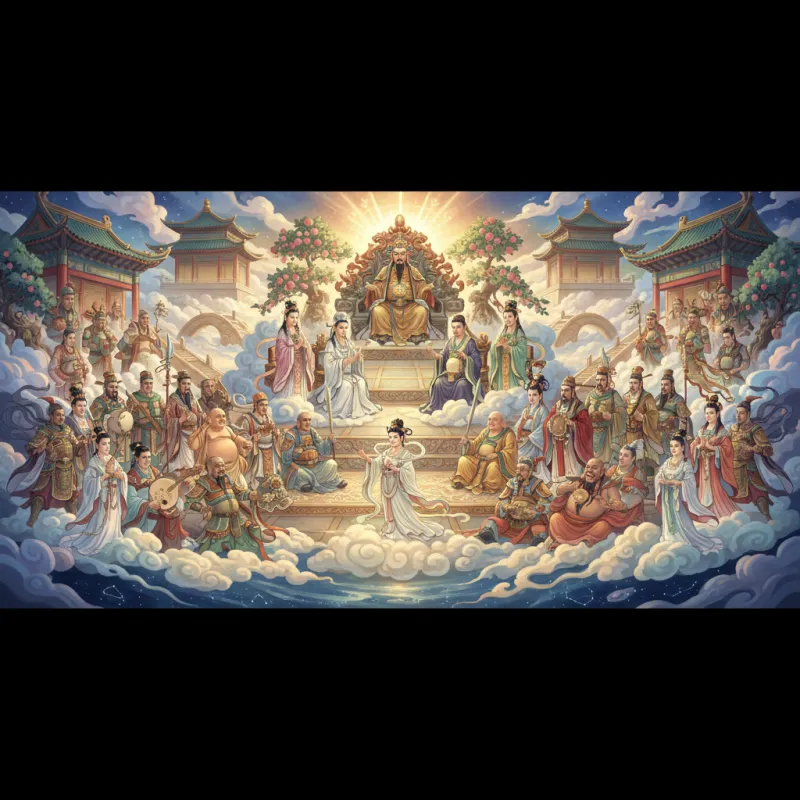
The Jade Emperor sits on his throne of clouds, flanked by celestial ministers who've spent millennia perfecting the art of divine bureaucracy. If you think earthly governments love paperwork, wait until you see the Heavenly Court—where every mortal prayer requires proper filing, every karmic debt needs documentation, and even the gods must submit reports in triplicate. This isn't just mythology; it's a mirror of imperial China projected onto the cosmos, complete with all the political intrigue, power struggles, and administrative complexity that defined Chinese civilization for thousands of years.
The Divine Bureaucracy: Heaven Mirrors Earth
The Heavenly Court (天庭, Tiāntíng) operates on a principle that would have made Confucius proud: celestial hierarchy reflecting earthly order. During the Song Dynasty (960-1279 CE), when this cosmology crystallized into its most recognizable form, Chinese theologians essentially took the imperial bureaucracy and gave it wings. The Jade Emperor (玉皇大帝, Yùhuáng Dàdì) functions as the celestial Son of Heaven, presiding over departments that manage everything from weather patterns to human lifespans.
What makes this system fascinating is its sheer practicality. Unlike the capricious gods of Greek mythology or the distant deities of many other traditions, Chinese celestial beings punch a cosmic time clock. The God of Wealth (財神, Cáishén) has specific office hours for blessing businesses. The Kitchen God (灶君, Zàojūn) files annual reports on household behavior every Lunar New Year. Even the fearsome Erlang Shen (二郎神, Èrláng Shén), the three-eyed warrior deity, serves as essentially a celestial law enforcement officer with a divine dog as his partner.
This bureaucratic structure reveals something profound about Chinese religious thought: the universe operates on principles of order, merit, and proper procedure. You can't just storm heaven's gates demanding favors—you need to go through channels, much like navigating the complex hierarchies of Daoist immortals who earned their positions through cultivation and virtue.
From Shamans to Immortals: The Evolution of Xian
The concept of immortals (仙, xiān) predates the organized Heavenly Court by centuries, emerging from ancient shamanic traditions during the Warring States period (475-221 BCE). Early Daoist texts like the Zhuangzi describe these beings as transcendent individuals who achieved freedom from death through breathing exercises, alchemical practices, and spiritual cultivation. They weren't born divine—they earned it.
This meritocratic approach to divinity sets Chinese mythology apart. The Eight Immortals (八仙, Bāxiān), perhaps the most beloved group in the pantheon, include a crippled beggar (Li Tieguai), a gender-fluid deity (Lan Caihe), and a former general (Cao Guojiu). Their stories emphasize that immortality isn't reserved for the naturally gifted or nobly born. Zhang Guolao rode his donkey backward, Lü Dongbin failed the imperial examinations multiple times before achieving enlightenment, and Han Xiangzi was just a flute-playing nephew of a famous Tang Dynasty official.
The Ming Dynasty novel Journey to the West (西遊記, Xīyóu Jì), completed around 1592, showcases this system brilliantly. Sun Wukong, the Monkey King, literally fights his way into the celestial bureaucracy, demanding recognition and a proper title. When the Jade Emperor tries to placate him with the meaningless position of "Keeper of the Heavenly Horses," Sun Wukong rebels—not because he opposes heaven, but because he demands respect within its hierarchy. Eventually, he earns the title "Great Sage Equal to Heaven" through a combination of power, persistence, and eventually, Buddhist enlightenment.
The Buddhist-Daoist Synthesis: When Pantheons Collide
By the Tang Dynasty (618-907 CE), something remarkable happened: Buddhist and Daoist deities began sharing celestial real estate. Guanyin (觀音, Guānyīn), the Bodhisattva of Compassion, became one of the most popular figures in Chinese religion despite her Buddhist origins. She appears in Daoist temples, folk shrines, and even in the Heavenly Court's organizational charts, often depicted as a mediator between the strict celestial bureaucracy and suffering mortals.
This wasn't a hostile takeover but a gradual synthesis. The Daoist Queen Mother of the West (西王母, Xīwángmǔ), who predates organized Daoism itself with roots in Shang Dynasty (1600-1046 BCE) shamanic traditions, maintained her position as keeper of the Peaches of Immortality. Meanwhile, Buddhist figures like Dizang Wang (地藏王, Dìzàng Wáng), who vowed to empty hell before achieving Buddhahood, took on roles managing the underworld bureaucracy alongside traditional Chinese death deities.
The result is a pantheon that defies simple categorization. Is Nezha (哪吒, Nézhā), the child deity who fought dragons and rebuilt his body from lotus flowers, a Daoist immortal or a Buddhist guardian? The answer is both, and neither—he's a Chinese deity whose story incorporates elements from both traditions, filtered through centuries of popular storytelling and religious practice.
The Celestial Civil Service Exam: Earning Divine Status
Here's where Chinese mythology gets deliciously specific: many deities achieved their positions through something resembling a cosmic civil service examination. Guan Yu (關羽, Guān Yǔ), the red-faced warrior from the Three Kingdoms period (220-280 CE), was a historical general who died in 220 CE. By the Song Dynasty, he'd been promoted to god of war. By the Ming Dynasty, he'd climbed to "Emperor Guan" with authority over military affairs, business contracts, and even literature.
This posthumous promotion system reflects the Chinese belief that virtue and achievement matter more than birth. The City God (城隍, Chénghuáng) positions—deities responsible for protecting specific cities—were often filled by exemplary historical figures who demonstrated exceptional moral character during their mortal lives. It's essentially a divine meritocracy, where even humans can aspire to join the ranks of celestial administrators through righteous living.
The examination theme appears explicitly in stories like that of Zhong Kui (鍾馗, Zhōng Kuí), who committed suicide after being denied the top position in the imperial examinations due to his ugly appearance. The Jade Emperor, recognizing this injustice, appointed him as the chief demon hunter of heaven—a position where his fierce appearance became an asset rather than a liability.
The Heavenly Court in Popular Culture: From Temples to Television
Walk into any traditional Chinese temple, and you'll see the Heavenly Court's organizational chart made manifest. Statues are arranged by rank, with the Jade Emperor typically in the central, highest position, flanked by his celestial ministers. The Three Pure Ones (三清, Sānqīng)—the highest Daoist deities representing different aspects of the Dao—occupy positions of supreme honor, while lesser deities and immortals fill supporting roles based on their specific domains and responsibilities.
Modern Chinese television and film have embraced this mythology with enthusiasm. The 1986 television adaptation of Journey to the West introduced these characters to hundreds of millions of viewers, cementing their place in contemporary Chinese consciousness. More recent productions like The Legend of Nezha (2019) have reimagined these ancient stories for new audiences, sometimes taking creative liberties but always maintaining the core concept of a structured, hierarchical heaven.
What's remarkable is how these ancient deities remain relevant. During Chinese New Year, families still honor the Kitchen God before he makes his annual report to the Jade Emperor. Business owners display images of the God of Wealth, hoping for celestial favor in their commercial ventures. Pregnant women pray to the goddess Bixia Yuanjun (碧霞元君, Bìxiá Yuánjūn) for safe childbirth, just as their ancestors did centuries ago.
The Underworld Connection: Heaven's Dark Mirror
The Heavenly Court doesn't exist in isolation—it's part of a three-tiered cosmos including earth and the underworld. Yanluo Wang (閻羅王, Yánluó Wáng), the king of hell, operates his own bureaucracy that mirrors heaven's structure. The Ten Courts of Hell each have a presiding judge who evaluates souls based on their earthly deeds, consulting detailed records maintained by celestial scribes.
This underworld isn't simply a place of punishment; it's another administrative division of the cosmic government. Souls are processed, judged, and assigned to appropriate realms of rebirth based on their karmic balance sheets. The system is so detailed that specific hells exist for specific sins—there's a hell for people who wasted food, another for those who mistreated books, and yet another for corrupt officials (which, given Chinese history, must be quite crowded).
The connection between heaven and hell emphasizes the Chinese religious worldview's fundamental fairness. The universe operates on principles of cause and effect, merit and demerit, action and consequence. Even the gods themselves aren't above cosmic law—they can be demoted for incompetence or promoted for exceptional service.
Living Mythology: Why the Heavenly Court Still Matters
The Heavenly Court isn't just ancient history or quaint folklore—it's a living mythology that continues to shape how millions of people understand the cosmos and their place within it. The system offers something psychologically powerful: a universe that operates on comprehensible principles, where virtue is rewarded, vice is punished, and even the divine realm follows rules.
This mythology also provides a framework for understanding social hierarchy and moral behavior. If heaven itself operates as a meritocratic bureaucracy, then earthly institutions should aspire to the same standards. The celestial civil service becomes a model for human governance, with the implicit message that leaders should earn their positions through virtue and capability, not merely birth or force.
For modern practitioners of Chinese folk religion, Daoism, and syncretic traditions, these deities remain active presences in daily life. They're not distant, abstract concepts but accessible intermediaries who can be petitioned, honored, and even negotiated with through proper ritual and sincere devotion. The Heavenly Court, in this sense, democratizes the divine—making the cosmic bureaucracy as accessible as any earthly government office, provided you know the right forms to fill out and the proper offerings to make.
Related Reading
- The Celestial Bureaucracy: How Chinese Heaven Is Organized
- Sun Wukong: The Great Sage Who Challenged Heaven — Shenxian Perspective
- The Heavenly Court: How Chinese Heaven Is Organized
- Celestial Warriors: The Mightiest Fighters in Chinese Heaven
- The Jade Emperor: Supreme Ruler of the Chinese Heavens
- A Practical Guide to Visiting Chinese Temples: What to Do and What Not to Do
- Journey to the West: From Novel to Netflix — Every Major Adaptation
- Exploring the Rich Pantheon of Chinese Deities and Immortals in Daoism and Buddhism