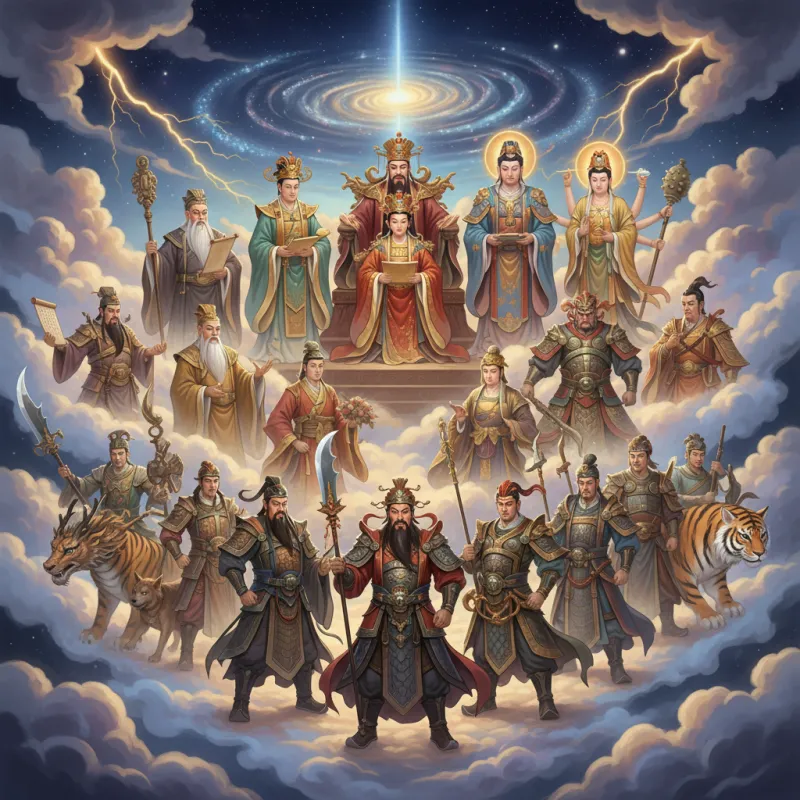
When the Monkey King shattered the gates of Heaven and sent 100,000 celestial soldiers fleeing in terror, the Jade Emperor had to make a humiliating phone call. Not to another god, but to his own nephew—a warrior so formidable he'd chosen to live as a mortal administrator rather than accept heavenly rank. That's the kind of fighter we're talking about when we discuss the celestial warriors of Chinese mythology: beings so powerful that even the supreme ruler of the cosmos keeps their numbers on speed dial.
The Heavenly Hierarchy of Violence
Chinese Heaven isn't some peaceful cloud kingdom where everyone plays harps. It's a militarized bureaucracy with a standing army that would make any earthly empire jealous. The celestial military structure mirrors the imperial Chinese system, with generals, commanders, and specialized units—but these soldiers wield thunder instead of swords and can transform into anything from tigers to mountains. At the top of this divine food chain sit the warrior gods, figures who've earned their positions through actual combat prowess rather than political maneuvering.
The difference between a regular celestial soldier and a true warrior god is like comparing a mall security guard to a special forces operative. Your average heavenly trooper might have a few centuries of training and some basic immortality, but the elite fighters possess unique abilities that make them irreplaceable. They're the ones who get called when demons breach the cosmic order, when rebellious immortals need subduing, or when someone needs to escort a Buddhist monk across demon-infested territory for fourteen years.
Erlang Shen: The God Who Doesn't Need Heaven
Erlang Shen (二郎神, Èrláng Shén)—also known as Yang Jian (杨戬, Yáng Jiǎn)—represents everything a celestial warrior should be, which is precisely why he refuses to fully join their ranks. Born to a mortal father and the Jade Emperor's sister, he earned his divinity the hard way: by splitting open a mountain to rescue his mother, who'd been imprisoned for the crime of loving a human. That origin story tells you everything about his character—he's loyal to family over bureaucracy, powerful enough to defy cosmic law, and stubborn enough to hold a grudge against his uncle for millennia.
His Third Eye (天眼, tiān yǎn) isn't just for show. Located in the center of his forehead, it pierces through every illusion, transformation, and deception in existence. When Sun Wukong transformed into a temple during their legendary battle in Journey to the West, Erlang Shen's third eye immediately spotted the tail the Monkey King forgot to hide. This ability makes him the ultimate counter to shapeshifters and tricksters—you can't con someone who sees reality itself.
The Xiaotian Quan (哮天犬, Xiàotiān Quǎn), his celestial hound, deserves its own paragraph. This isn't some cute divine pet; it's a battle-hardened creature that once bit Sun Wukong hard enough to make the "indestructible" Monkey King yelp. In some versions of the mythology, Xiaotian Quan is actually a transformed celestial general who chose to serve Erlang Shen in canine form. The dog fights alongside its master, tracks demons across dimensions, and has been known to hold its own against opponents that would terrify lesser gods.
What makes Erlang Shen truly fascinating is his relationship with Heaven itself. Despite being the Jade Emperor's nephew and possessing power that rivals the highest deities in the celestial bureaucracy, he governs a small region on Earth—Guankou—and only answers Heaven's summons when he feels like it. He's essentially the divine equivalent of a retired special ops soldier who occasionally takes consulting gigs. This independence makes him more popular in folk religion than many higher-ranking gods; people love a powerful figure who doesn't bow to authority.
Ne Zha: The Child God Who Killed a Dragon Prince
If Erlang Shen is the seasoned special forces operative, Ne Zha (哪吒, Nézhā) is the teenage prodigy who graduated from the academy at age seven and immediately started breaking records. Born as a ball of flesh after a three-year pregnancy, he emerged fully formed and ready to fight. Within days of his birth, he killed the Dragon King's son, skinned him, and used his tendons as a belt. Most babies learn to crawl; Ne Zha learned to commit regicide.
His signature weapons define his fighting style: the Universe Ring (乾坤圈, Qiánkūn Quān), the Fire-tipped Spear (火尖枪, Huǒjiān Qiāng), and the Huntian Ling (混天绫, Hùntiān Líng)—a magical silk ribbon that can extend infinitely and bind opponents. But his most iconic equipment is his transportation: the Wind Fire Wheels (风火轮, Fēnghuǒ Lún), flaming wheels he stands on that let him fly at supersonic speeds. Imagine a divine skateboard made of fire that never runs out of fuel.
Ne Zha's most famous story involves his suicide and resurrection. After killing the Dragon Prince, the Dragon King demanded Ne Zha's life as compensation. To save his parents from the dragons' wrath, Ne Zha committed suicide by slicing his own flesh and breaking his bones, returning everything to his parents. His teacher, the immortal Taiyi Zhenren, later reconstructed his body from lotus roots and leaves, making him even more powerful than before. This death-and-rebirth narrative gives Ne Zha a unique status: he's a god who chose mortality to protect his family, then transcended mortality entirely.
The Four Heavenly Kings: Directional Defenders
The Four Heavenly Kings (四大天王, Sì Dà Tiānwáng) guard the four cardinal directions of Heaven, and each brings specialized skills to the celestial military. These aren't just symbolic positions—they're active combat roles that require constant vigilance against demonic incursions.
Li Jing (李靖, Lǐ Jìng), the Pagoda-Bearing Heavenly King and father of Ne Zha, commands the celestial armies. His pagoda isn't decorative; it contains his rebellious son's soul tablet, preventing Ne Zha from attacking him (their relationship is complicated, to put it mildly). Li Jing represents the military bureaucrat—competent, organized, and politically savvy enough to maintain his position despite his son's chaos.
The other three kings each wield symbolic weapons: one holds a pipa (lute) that controls wind and fire, another carries an umbrella that creates darkness and chaos, and the third wields a sword and commands a dragon. Together, they form Heaven's first line of defense, and in Journey to the West, they're the ones who initially try (and fail) to capture Sun Wukong before Erlang Shen gets involved.
Marshal Tianpeng: From Heaven's Navy to Pig Demon
Before he became Zhu Bajie (猪八戒, Zhū Bājiè), the gluttonous pig companion in Journey to the West, Marshal Tianpeng (天蓬元帅, Tiānpéng Yuánshuài) commanded Heaven's naval forces—80,000 celestial sailors who patrolled the cosmic waterways. His fall from grace (getting drunk and harassing the Moon Goddess, then being reincarnated as a pig-demon) is one of mythology's great cautionary tales about workplace harassment.
But before his disgrace, Tianpeng was legitimately formidable. He wielded a nine-toothed rake that could level mountains and commanded water-based magic that made him nearly unbeatable in aquatic environments. His story reminds us that even Heaven's mightiest warriors can fall—and that sometimes the fallen ones become the most interesting characters in the story.
The Celestial Military in Action
These warriors don't just exist in isolation; they form a functioning military hierarchy that responds to cosmic threats. When Sun Wukong rebelled, Heaven deployed its forces in escalating waves: first the regular troops (who got demolished), then the Four Heavenly Kings (who fared slightly better), then specialized demon-hunters, and finally Erlang Shen as the ultimate solution. This graduated response shows that Heaven's military operates like any sophisticated defense system—you don't send your best asset to handle every minor problem.
The celestial warriors also interact with Buddhist and Daoist deities in complex ways. Some, like Ne Zha, have teachers from the Daoist immortal tradition. Others, like the Four Heavenly Kings, have Buddhist origins but were absorbed into the Chinese pantheon. This religious syncretism creates a military force that draws on multiple spiritual traditions, making Heaven's army a true melting pot of divine power.
Why These Warriors Matter Today
The celestial warriors remain culturally relevant because they embody ideals that transcend their mythological origins. Erlang Shen represents competence without arrogance, power without corruption. Ne Zha symbolizes filial piety taken to its extreme—literally dying for your parents—while also representing youthful rebellion and transformation. Even the disgraced Tianpeng teaches valuable lessons about consequences and redemption.
Modern Chinese media constantly reimagines these figures. Video games, movies, and novels reinterpret their stories for contemporary audiences, but the core appeal remains: these are warriors who earned their positions through merit, who fight for principles rather than just following orders, and who remain compellingly human despite their divine status. In a culture that values both hierarchy and individual excellence, the celestial warriors represent the perfect balance—powerful enough to matter, independent enough to be interesting, and flawed enough to be relatable.
Related Reading
- The Jade Emperor: Supreme Ruler of the Chinese Heavens
- The Heavenly Court: How Chinese Mythology Organized the Universe Like a Government Office
- Exploring the Rich Tapestry of Chinese Deities and Immortals in the Heavenly Court
- The Heavenly Court: How Chinese Heaven Is Organized
- The Celestial Bureaucracy: How Chinese Heaven Is Organized
- Guanyin: The Goddess of Mercy
- Ox-Head and Horse-Face: The Underworld's Enforcers
- Exploring Chinese Deities and Immortals: Insights into Daoist and Buddhist Folk Gods