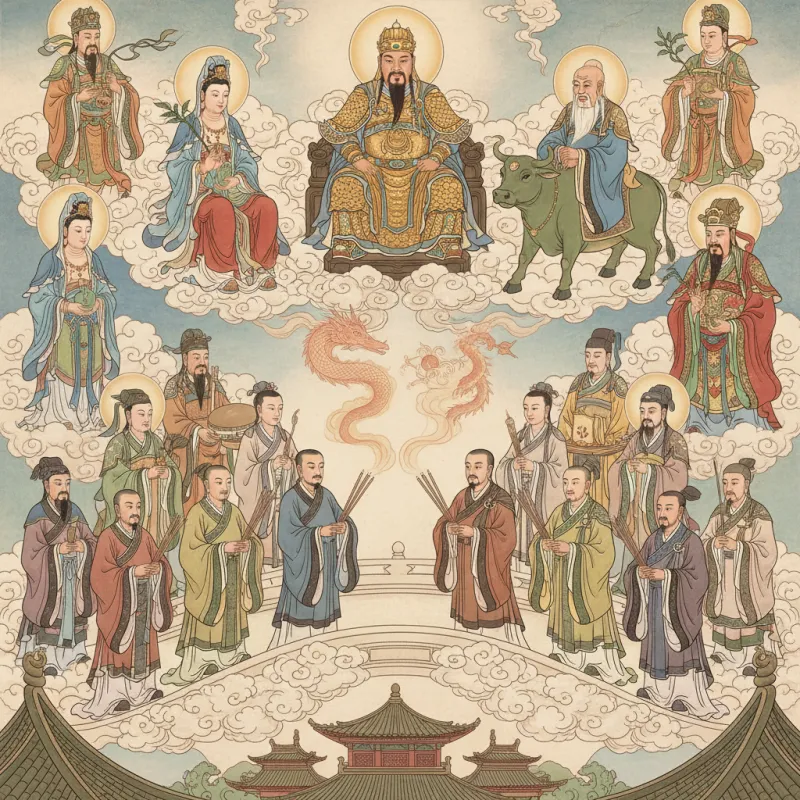
The elderly woman ahead of you bows three times, holds three smoking sticks level with her forehead, and whispers something urgent before planting them in the ash-filled urn. You clutch your own incense sticks awkwardly, suddenly aware you have no idea what you're doing. The smoke stings your eyes. A child bumps past. The temple feels both sacred and chaotic, and you're frozen, wondering: do you bow first or light first? How many sticks? What do you even say?
This is the moment most foreigners panic in a Chinese temple. But here's the thing — offering incense isn't mysterious or complicated. It's a practical skill with clear steps, and once you understand the logic behind it, you'll move through temples with the same ease as locals who've done this since childhood.
Why Incense Matters More Than You Think
Incense (香 xiāng) isn't decoration or atmosphere. In Chinese religious practice, it's the actual mechanism of communication. The smoke carries your words, your intentions, your requests upward to the divine realm. Without incense, you're essentially trying to make a phone call without dialing — the gods won't hear you.
This belief is ancient and consistent across Daoist temples, Buddhist monasteries, and folk shrines. The Baopuzi (抱朴子), a 4th-century Daoist text, explicitly describes incense smoke as creating a "fragrant pathway" between realms. Buddhist sutras compare it to the sweet scent that announces a bodhisattva's presence. Even Confucian ancestral rites require incense to "invite the spirits to descend."
The practical implication: if you're going to visit a Chinese temple, you need to understand incense. Not as a tourist observing a quaint custom, but as a participant in a communication technology that's been refined over two millennia.
The Right Incense for the Right Occasion
Walk into any temple and you'll see incense for sale near the entrance. Most visitors grab whatever's available, but locals know the differences matter:
Joss sticks (线香 xiànxiāng) are your standard option — thin bamboo sticks coated with incense paste, usually sold in bundles. These work for 90% of temple visits. They're cheap, burn for about 30 minutes, and are appropriate for any deity. If you're unsure, choose these.
Coil incense (盘香 pánxiāng) hangs from temple ceilings like springs, burning for days or even weeks. You'll see these in older temples, often with red paper tags attached listing the donor's name and prayer. These are for serious, long-term petitions — passing an exam, recovering from illness, finding a spouse. You don't light these yourself; you purchase them from the temple and monks hang them for you.
Sandalwood incense (檀香 tánxiāng) is the premium option, more expensive and reserved for major deities or important requests. The scent is distinctly woody and sweet. Some temples require sandalwood for certain rituals, particularly those involving Daoist immortals or high-ranking Buddhist figures.
Stick count matters too. Three sticks is standard — representing heaven, earth, and humanity in Daoist thought, or the Buddha, Dharma, and Sangha in Buddhism. Some people offer one stick (for focused, personal prayers) or nine sticks (for major life events). Never offer four sticks — the number sounds like "death" (死 sǐ) in Chinese.
The Actual Steps (Finally)
Here's what you do, in order:
1. Purchase and prepare. Buy incense at the temple entrance or bring your own. If the temple provides free incense, take only what you need — three sticks is standard. Hold all three sticks together in both hands.
2. Light properly. Use the large communal candle or oil lamp provided, never your own lighter if you can avoid it (using the temple's sacred flame is considered more respectful). Light all three sticks at once. If they don't catch immediately, don't wave them around frantically — hold them steady in the flame until they ignite.
3. Extinguish the flame. Here's where most foreigners mess up: don't blow out the flame. Blowing is considered disrespectful, like spitting on the offering. Instead, wave the sticks gently side-to-side until the flame goes out and only glowing embers and smoke remain. Some people fan them with their other hand.
4. Hold at forehead level. Raise the smoking sticks to your forehead, holding them vertically with both hands. The sticks should point upward, with your hands positioned as if in prayer. This is the position for addressing the divine.
5. Bow three times. Keep the incense at forehead level and bow from the waist three times. These bows should be deliberate, not rushed. Each bow is a separate gesture of respect.
6. State your business. This is the actual prayer moment. Still holding the incense at forehead level, speak your request or gratitude. You can speak aloud or silently — both work. Be specific: give your name, your birthdate (lunar calendar if you know it), your address, and your request. Chinese deities appreciate clarity. "Please help me" is too vague. "Please help me pass my medical licensing exam on March 15th" is better.
7. Plant the incense. Walk to the large incense urn (usually directly in front of the main altar) and insert your three sticks into the ash. Plant them firmly so they stand upright. Some people arrange them in a small triangle, others in a straight line. Both are fine.
8. Step back and bow again. Take three steps backward (never turn your back immediately on the altar), then bow once more before turning away.
The entire process takes maybe two minutes. Watch locals do it once and you'll recognize the pattern immediately.
Common Mistakes Foreigners Make
Treating it like a photo opportunity. Temples are active worship spaces, not museums. Taking selfies while holding lit incense, or posing in front of people trying to pray, marks you as disrespectfully clueless. If you want photos, take them before or after your incense offering, and be aware of your surroundings.
Offering to the wrong deity first. In temples with multiple halls and altars, there's usually a hierarchy. The main deity gets incense first, then secondary figures. If you're unsure, follow the crowd — locals know the proper order. In many temples, you'll also offer to Guanyin (觀音) if she has a dedicated hall, as she's particularly responsive to sincere prayers.
Overthinking the prayer. You don't need to memorize sutras or know special formulas. Speak naturally. Chinese deities are pragmatic — they want to know what you need and whether you're sincere. A simple, honest request beats elaborate religious language you don't understand.
Forgetting the follow-up. If your prayer is answered, you're expected to return and offer thanks. This might mean more incense, or fruit, or a donation to the temple. Chinese religious practice operates on reciprocity — the gods help you, you acknowledge their help. Failing to return after a granted wish is considered extremely rude and may affect future requests.
The Unspoken Rules
Some things nobody tells you but everyone knows:
Pregnant women traditionally avoid offering incense in the first trimester, though this varies by region and family custom. The concern is that smoke inhalation might harm the fetus, though it's also tied to beliefs about spiritual vulnerability during early pregnancy.
Menstruating women face no restrictions in most temples, despite what some outdated guidebooks claim. This taboo exists in certain folk traditions but isn't enforced in mainstream Buddhist or Daoist temples.
Left hand vs. right hand doesn't matter as much as Western sources suggest. Hold the incense with both hands and you're fine. The elaborate rules about "pure hand" and "impure hand" are more relevant in specific ritual contexts, not everyday temple visits.
Timing your visit can matter. Early morning (6-9 AM) is considered most auspicious, as the boundary between night and day is spiritually potent. The 1st and 15th of each lunar month are particularly busy, as these are traditional worship days. If you want a quieter, more contemplative experience, visit mid-afternoon on regular days.
What Happens to All That Incense?
Stand in a major temple like Longshan Temple in Taipei or Wong Tai Sin Temple in Hong Kong and you'll see hundreds of incense sticks burning simultaneously, creating a thick haze. The smoke is intense, the ash accumulates constantly, and you might wonder: isn't this a fire hazard? Isn't this terrible for air quality?
Yes, actually. Many temples now limit incense burning or provide shorter sticks to reduce smoke. Some have moved to electronic incense or single-stick policies. This has caused controversy among traditionalists who argue that reducing incense diminishes the spiritual efficacy of prayers.
The ash itself is considered sacred. Temples collect it and either bury it respectfully, scatter it in rivers, or (in some cases) mix it into protective amulets. You'll sometimes see packets of "temple ash" (香灰 xiānghuī) sold as protective charms — this is literally the accumulated ash from thousands of incense offerings, believed to carry concentrated spiritual power.
Beyond the Basics
Once you're comfortable with standard incense offering, you might notice locals doing additional practices:
Circling the incense urn three times clockwise before planting the sticks, symbolizing the sun's movement and cosmic order.
Touching the incense smoke and bringing it toward their body, "bathing" in the blessed smoke for purification and protection.
Offering to specific directions — some people face different cardinal directions while holding incense, addressing different divine bureaucracies or spiritual forces.
These aren't required, but they're not wrong either. Chinese religious practice is remarkably flexible. The core elements (light, bow, pray, plant) remain constant, but individuals add personal touches based on family tradition, regional custom, or temple-specific practices.
The Real Point of All This
Learning to offer incense properly isn't about following rules for rules' sake. It's about participating in a living tradition that connects you to centuries of Chinese spiritual practice. When you light those three sticks and bow before an altar, you're doing exactly what a Tang Dynasty merchant did, what a Ming Dynasty scholar did, what a Qing Dynasty grandmother did.
The specific deity might change — maybe you're addressing Mazu for safe travels, or Wenchang for academic success, or Tudi Gong for local protection. The temple architecture might be ancient or modern. But the gesture remains the same: smoke rising, prayers ascending, humans reaching toward the divine with hope and respect.
That's why it's worth learning to do it right. Not to avoid embarrassment (though that's nice), but to genuinely participate in something meaningful. The elderly woman who bowed three times ahead of you in line? She wasn't performing a quaint cultural ritual. She was communicating with forces she believes are real and responsive. Whether you share that belief or not, understanding the practice lets you engage with Chinese religious culture on its own terms.
Next time you visit a temple, buy three sticks of incense. Light them carefully. Bow with intention. Plant them firmly in the ash. And watch the smoke rise, carrying whatever you need to say into the space between earth and heaven.
Related Reading
- Burning Ghost Money: The Complete Guide to Afterlife Offerings
- Chinese Funeral Traditions: A Guide to Death Customs
- Chinese Rituals for the Dead: A Practical Guide to Ancestor Worship
- Chinese Rituals and Ceremonies: The Sacred Practices That Connect Heaven and Earth
- Exploring Chinese Deities and Immortals: Rituals in Daoist and Buddhist Traditions
- Sacred Mountain Pilgrimage: The Chinese Tradition of Climbing to Heaven
- The Earth God: Your Neighborhood Deity
- Exploring the Rich Pantheon of Chinese Deities and Immortals in Daoism and Buddhism